Michael Brown: Israel’s Divine Healer

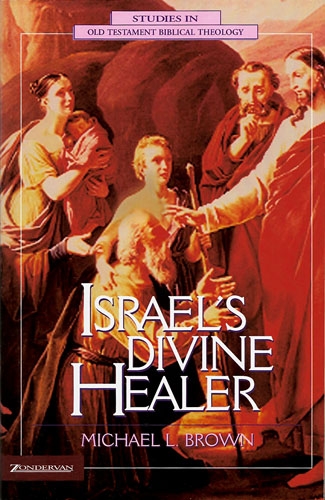
 Israel’s Divine Healer. Michael Brown. Grand Rapids: Zondervan, 1995. Pp. 462.
For those who believe that God miraculously heals today, this book is a decisive argument in their favor. I am not aware of any other book that so thoroughly offers a theological and exegetical foundation for divine healing, especially from the Hebrew Scriptures and the perspective of Messianic fulfillment in the New Testament.
Part of the Studies in Old Testament Biblical Theology series edited by William VanGemeren and Tremper Longman III, the author of this work has come to be well known to many classical Pentecostals in recent years. Dr. Michael Brown finished this book before his tenure as the Messianic Jewish scholar of the “Brownsville Revival†in Pensacola, Florida.
Brown begins with a detailed word study of various roots associated with “healing†in the Hebrew Scriptures. Even those unfamiliar with Hebrew will see quickly the holistic understanding of “healing†in the Jewish mind. Just as salvation is not mere fire insurance, healing—as understood in Hebrew—includes all aspects of restoration to “full†life.
Next, Brown looks at human physicians and ancient healing deities to establish the similarities and distinction between Israel and its ancient neighbors. He notes that minor injuries (cuts, fractures) were taken care of by natural means while internal and serious conditions (fevers, severe pain) were always seen as an attack from something outside of man. Brown uses numerous examples to demonstrate that it was “normal†to have physicians in ancient times that set bones and treated wounds, and (at least in Israel) without necessarily invoking magic or the supernatural. One point of interest in this chapter is the debunking of 2 Chron. 16:12 as a general critique of physicians and modern medical practice. Brown argues that the context of Asa’s reign and early major victory demands that Asa languished in his disease of the feet not because he made inquiry (Brown says that the word for the “inquiry†Asa made always has a spiritual connotation—this was more a visit to a witchdoctor than a family practitioner) of physicians but because he relied on the arm of flesh and not God. Godless trust in man was Asa’s sin, not trust in doctors. Brown says “To the ancient and Near Eastern—and biblical!—mind, it was impossible to countenance a major god/God who did not heal†(p. 53, emphasis his). Even the Greeks combined doctor and savior as complimentary (p. 59). There are also numerous explanations of rabbinic thought, as diverse as it was, on the subjects of healing and physicians.
It is difficult to summarize the research assembled by Brown in his exegetical study. His thematic study starts with the Torah and historical books, quickly tying together the idea that God’s covenant promise to be Israel’s Healer was a dynamic one. God “promised not to place sickness on his obedient children†(p. 77, emphasis his). “Health in and of itself is virtually never promised in the OT. Rather, the promise is presented either in general terms of ‘healing’ with no specific reference to sickness (e.g.. Pr 3:7-8; 4:20-22), in terms of sickness and disease never touching the faithful children of God (e.g., Ps 91, esp. vv 5-10), or in terms of the reversal of a specific sickness (e.g., Ps 41:1-3). … God’s pledge to be Israel’s Healer is primarily expressed in terms of keeping them free from disease, as opposed to keeping them healthy†(p. 80, emphasis his).
Making “psychosomatic observations†from Proverbs, Brown quotes Malbim “Flesh and bones are only as healthy as the spirit they encase†(p. 165), and observes, “Circumstances, words, and relationships impact the mind, will, and emotions, which in turn impact the body—to its very bones†(p. 165). Brown also finds that the book of Job has much to say regarding sickness, judgment, restoration, and even “quack doctors†(something Job calls his friends).
The mistake of Job and his friends was that Job radically altered his view of God because of his sufferings, while the friends drastically altered their view of Job because of his sufferings and subsequent behavior. Instead, it is best to patiently wait and trust, always believing in the goodness of God and his desire to bless, walking humbly before him, and expecting that in the end, he will cause everything to work for the good.
Where sickness or disaster is preceded by known sin, it should immediately be confessed and forsaken (Pr 28:18; 1Jn 1:9), and mercy should be sought. Where the disciplinary hand of the Lord is sensed, there should be complete cooperation to see that this trial accomplishes its goal. In both cases, however, it should be expected that healing or restoration will generally follow repentance, submission, and/or change, although in some cases, there may still be lasting negative consequences. Also, in both of these cases the suffering is not inexplicable or mysterious, although, as emphasized previously, it can still be redemptive. However, when no such convenient explanation is at hand, then unshakable, persevering faith is the only answer. And when satanic involvement in revealed or discerned—this is now moving us to a NT perspective—the evil one is to be resisted (p. 180-181, emphasis his).
Brown makes an important statement on p. 185 regarding equating “healing†only with spiritual healing.
It is incorrect to state that in the prophetic books, sickness and pain are merely figurative expressions representing sin and alienation, as if “healing†is equated there only with forgiveness and reconciliation.
Brown elaborates that healing/restoration was understood to encompass all areas of life. This gives ground for challenging the commonly published idea in biblical studies that healing is only for one’s soul/spirit and not the body also.
Few who teach divine healing are aware that Matthew 8:17 departs from the LXX (the Septuagint: translation of the Hebrew Scriptures into Greek) in its translation of Isaiah 53:4. While the LXX spiritualizes the diseases and sicknesses “borne†by the Servant, Matthew translates literally, “He Himself took our infirmities and bore our sicknesses†(NKJV). Along this line, Brown says, “Some Christian expositors and proponents of divine healing have noted that from Matthew’s viewpoint, Isaiah 53:5 is speaking of physical healing and thus healing of the body is considered to be part of ‘the atonement.’ Others, pointing to†1 Peter 2:24 “… have sought to establish that what is in view in Isaiah 53 is actually spiritual healing in ‘the atonement.’ The citation in Matthew 8:17 is then explained as follows: ‘The Lord took away the diseases of men by healing them. He died for our sins, not for our diseases.’ However, these divisions are completely unscriptural, and they do not do justice to the context of either Matthew 8:16-17 or Isaiah 53:4-5. A. Edersheim’s rebuke should have been enough for the general readers, for whom his work was intended: ‘I can scarcely find words strong enough to express my dissent from those who limit Is. liii. 4, whether on the one hand to spiritual, or the other to physical “sicknesses.†The promise is one of future deliverance from both, of a Restorer from all the woe which sin had brought.’ Yet it is with these very readers that his words have gone unheeded†(p. 197). Brown further writes,
… the servant came to relieve the burden of sin and sickness; his wounds make his people whole. What makes Matthew’s citation especially significant is that, from the viewpoint of Christological exegesis, the servant’s bearing of our sickness and pain (Isa 53:4a) took place on the cross. Yet the evangelist refers it to the Lord’s itinerant preaching and healing ministry! This is correctly interpreted by D. A. Carson, who does not fail to draw out the implications of Matthew’s theology: “Jesus’ healing ministry is itself a function of his substitutionary death, by which he lays the foundation for destroying sickness.â€
Thus, for Matthew (and from a Christian perspective, for Isaiah as well), healing cannot be conveniently divorced from “the atonementâ€
…
By bearing sin and iniquity the servant bore sickness and pain; by taking his people’s guilt he thereby incurred their punishment; and it is at the cost of his wounds that total healing has come. There is no dichotomy here! The whole man has been wholly healed. The straying and sickly nation has been completely restored and made well (p. 197-198, emphasis his).
As the book moves to the study of divine healing in the New Testament, Brown declares, “It is impossible to think of the ministry of Jesus and the early believers without thinking of miraculous healing†(p. 209, emphasis his). Brown also does an important word study of sozo and other words related to healing. Brown also makes the important connection between healing and the eschatological jubilee (see pp. 217-218).
Contrary to much of today’s teaching on the subject, Brown says that “sickness, however, is not part of the cross we are to bear†(p. 233). He further clarifies the difference between suffering for the faith (persecution, opposition) and sickness and states that Christians who are sick, diseased, or handicapped are not therefore under the wrath of God. God can and will work all things for their good, however they are not “suffering for the gospel.†Brown also briefly states that Paul’s “thorn in the flesh†is not sickness, in his opinion.
Brown closes his study of the progression of God as Healer from the Old to the New Testament saying that God now does for His people what He has always wanted to, allowing a foretaste of the world to come. His conclusion chapter alone is worth the price of the book, all the more so because of the exegetical foundation he lays to draw his conclusions.
This book is more technical than most Pentecostal/charismatic pastors are accustomed to. While all Hebrew, Greek and Semitic words have been transliterated, the “select†bibliography spans 18 pages and the endnotes are a lengthy 172 pages. However, anyone interested in divine healing, its implications for ministry today, and its basis in God’s Word cannot afford to miss this definitive work.
Reviewed by Raul Mock