
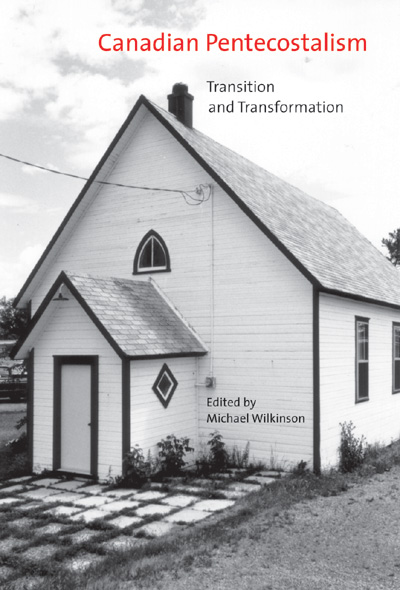
Michael Wilkinson: Canadian Pentecostalism

 Michael Wilkinson, ed., Canadian Pentecostalism: Transition and Transformation (Montreal and Kingston: McGill-Queen’s University Press, 2009), 308 pages, ISBN 978077355.
Canada is probably not the first place that comes to mind when we speak of Pentecostalism. One of the most significant transformations in twentieth-century Christianity, the emergence and development of Pentecostalism is typically more closely related to the history of the United States. Even in its global proportions, Africa, Asia, and Latin America may come to mind before one thinks of Pentecostalism in Canada. Michael Wilkinson’s book shows us that we have been misinformed. Canadian Pentecostalism provides the first comprehensive overview of Pentecostalism in Canada.
The book is a collection of essays from thirteen scholars, most of them Canadian, and all of them intimately familiar with the subject matter. The collection begins with the editor’s introduction, properly entitled “Pentecostalism in Canada.†The reader learns about the official history of Pentecostals in Canada since 1911 and the variety of denominations that characterize the Pentecostal landscape in the northern part of the North American continent. Wilkinson introduces the reader to the fundamental questions to which the book attends: How did Pentecostals emerge and develop in Canada? What are the particularities of Pentecostalism in Canada? And how did the Pentecostal movement become institutionalized and globalized? The book is organized around these questions into three areas: the origins and development of Pentecostalism in Canada, aspects of the Canadian experience of Pentecostalism, and the institutionalization and globalization of Pentecostalism.
In the first part, Michael Di Giacomo, Thomas A. Robinson, Peter Althouse, and Randall Holm seek to uncover the origins of Pentecostalism in Canada as well as to overcome the historiographical bias that has shifted too much attention to the United States. Giacomo addresses the early British influences on Pentecostals in Canada, Robinson examines Oneness Pentecostalism, Althouse explores the social dimension of Pentecostal eschatology, and Holm looks at the peculiarities of Canadian Pentecostal spirituality.
The second part deals with the development of Pentecostalism in education, theology, mission, and gender relations. Bruce Guenther explores the distinctive beliefs of Pentecostals and its pedagogical influences in Canada. Martin Mittelstadt looks at the distinctive Pentecostal reading of the Bible from the perspective of Luke-Acts. Robert Burkinshaw describes the early developments of mission work by Pentecostals in British Columbia, and Pamela Holmes considers the interactions of gender, institutions, and Pentecostal spirituality.

This broad collection from various perspectives offers a fine introduction to Pentecostalism in Canada and further contributes to an understanding of Pentecostalism in North America. The hefty price tag will unfortunately deter many individuals from purchasing the book. The essays are well-written, and the collection is superbly edited. A bibliography and index conclude a well-rounded collection that is sure to make a fine contribution to any library on Pentecostalism. What the book does not achieve is to do justice to its title. The essays in the collection illustrate once again that Pentecostalism is a global phenomenon that exists in various shades and voices in different localities. Canada shows itself as one place where Pentecostalism has found a home. Yet, Canada shares this experience with others who likewise display the emergence and transformation of Pentecostalism. There is nothing particular about Pentecostalism in this book that could be branded “Canadian,†just as there is no American Pentecostalism, Asian Pentecostalism, Indian Pentecostalism, English, German, or French Pentecostalism. However, the collection does show that there is a difference between being a Pentecostal in Canada as opposed to any other country. The particular social, cultural, religious, and ecclesiastical landscape of Canada forged its own character on Pentecostalism. At the same time, the final section also reveals that even this particularly “Canadian†character is in constant transition due to the global forces acting on the Pentecostal movement in all its global localities. As Peter Beyer points out in the final essay, “exactly the same conclusion applies to the study of Pentecostalism in all the other regions and localities of the world …†(270). Pentecostal scholarship faces the task of understanding the peculiar history, trends, and developments of Pentecostalism in the many parts of the world. At the same time, the forces of institutionalization and globalization seem to point to the emergence of Pentecostalism as a single phenomenon and Canada as one of its global representations. For this task, Wilkinson’s book offers a fine contribution.
Reviewed by Wolfgang Vondey
Preview Canadian Pentecostalism: books.google.com/books?id=ym8yoBPZFBQC
Publisher’s page: www.mqup.ca/canadian-pentecostalism-products-9780773537330.php