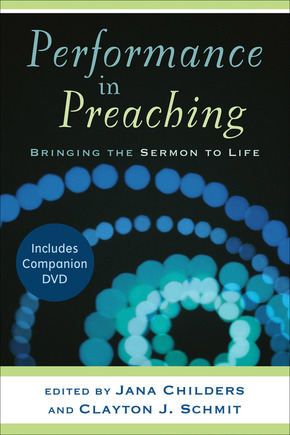
Performance in Preaching

 Jana Childers and Clayton J. Schmit, eds., Performance in Preaching: Bringing the Sermon to Life (Baker Academic, 2008), 256 pages, ISBN 9780801036132.
While whole libraries of books have been written on the preparation of sermons, the art of successfully delivering them is much less studied. In this collection of articles, leading scholars on the performance aspect of preaching give us a welcome insight into not only the things preachers can learn from other performers but also what it means to examine preaching in this light.
From the first lines of the introduction, it is clear that we are not in the well-trodden territory of traditional preaching manuals. By comparing the variety found in preaching to that found in a circus, Childers and Schmidt make it clear that the emphasis in this volume will not be in making all preachers alike but in alerting them to ways of building greater self-awareness and improving their skills.
All this talk of circuses and performance might make us wary that preaching will be relegated to the status of entertainment and lose its power (cf. 1 Corinthians 2: 1-5). It is with this in mind that we should read Margaret Shuster’s essay entitled “The Truth and Truthfulness.” While outlining the importance of the spoken and listening aspects of preaching, Shuster is keen to stress that the primary role of a preacher is not that of a performer but that of a proclaimer of Truth. Performance is therefore the servant of the text and the preacher is above all a servant of God.
John M. Rottman’s discussion of the application of Speech Act theory to preaching reminds us of the limitations of using the tools of performance studies. God does, after all, work mightily through sermons that fail to fulfil the criteria we might set up for good preaching. Nevertheless, Dr Rottman is still keen for us to learn what we can from performance studies while still remembering that God is the senior partner in our preaching.
This partnership does, of course, include our responsibility to ensure that our delivery does not hamper the work of God in the congregation. This concern is reflected in several of the articles in this book, such as Todd Farley’s insightful chapter on movement and Richard F. Ward’s essay on the use of the voice. Both of these pieces contain useful ideas on improving the connection between what we say in the pulpit and how we say it.
In a similar vein, Alyson M. Mackenzie’s examination of the New Homiletics, which insists on the importance of the delivery of sermons, can be read as a useful bridge between the theological discussions of performing a sermon and their practical application. Given her perspective, it is no accident that this article contains a range of thoughts and questions that will guide preachers towards more effective delivery.
This article also shares much in common with Clayton J. Schmit’s contribution on the relationship between the patterns and inevitabilities that make up excellent music and the patterns and flow of great preaching. These connections allow him to develop the argument that developing our preaching gifts is analogous to the way musicians develop their talents. This article, much like Jana Childers’ article on how to move forward when creativity seems to dry up, offers preachers a real treasure trove of ideas and inspiration. This article also deserves praise for its useful insights on how to find space and time for creativity, even in our busy modern lives. While not all preachers will feel attracted to all the ideas presented here, there are enough suggestions here to move even the most stubborn preacher’s block.
The article by Ronald J. Allen entitled “Performance and the New Testament in Preaching” could also come under criticism. While he is quite right to assert that the original oral nature of much of the Bible must impact our reading of it, Evangelical readers may feel that he takes this too far when he gives readers and preachers license to critique the Word of God when “a passage runs against the grain of a preacher’s beliefs” (p. 112). The problem here is that there are absolutely no limits put on this process, allowing the most heretical teaching to be accepted as a legitimate interpretation. It also weakens the power of the Word of God to transform as it is precisely in having our beliefs challenged by the Word that we are changed (cf. Acts 2: 36-47, Romans 12: 1-2, Ephesians 5: 26, 2 Timothy 4: 1-4, Hebrews 4: 12 etc).
The book closes with a contribution by Charles L. Bartow whose earlier work is much-quoted throughout this volume. He reminds us once again that, while performance studies has its uses in theology, there are limits. By exploring these limits within the context what the Bible says about truth and our duties as preachers, Bartow ensures that the focus of preaching remains the fact that God chooses to reveal Himself through our words and not on the skills we might possess. Given the tendency of one or two scholars in this volume to go too far in their analysis, this article is an entirely necessary contribution.
Overall, despite one or two disappointing articles, this book fills an important gap by clarifying the place of sermon delivery and the performance aspect of preaching. With the addition of the included performance exercises and techniques DVD, which includes further material from the authors and editors, this book will be a useful addition to any preaching library.
Reviewed by Jonathan Downie
Preview Performance in Preaching online: christianbook.com/reader/?item_no=036132 Publisher’s page: www.bakerpublishinggroup.com/books/performance-in-preaching/287670