J. Ross Wagner: Reading the Sealed Book

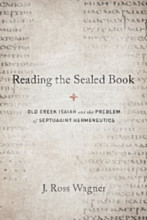
 J. Ross Wagner, Reading the Sealed Book: Old Greek Isaiah and the Problem of Septuagint Hermeneutics (Baylor University Press/Mohr-Siebeck, 2014), 308 pages, ISBN 9781602589803.
Reading the Sealed Book aims to bring together the academic fields of Translation Studies and Biblical Studies to help us better understand the choices made by the translator(s) of Isaiah from Hebrew to Greek in the Septuagint Bible. The Septuagint is important for two reasons. Not only is it the earliest written translation of the Old Testament into any other language but, if New Testament quotations of the Old Testament are anything to go by, it was also the Bible of common use in the early days of the church. Understanding the translation choices made by the Septuagint translators therefore offers great potential to bring us closer to the approach to Scripture used by the early Church.
J. Ross Wagner’s argument is that we can apply approaches from Translation Studies to help us interpret these choices, including the translator’s reasons for making them. This would seem a promising approach, especially since most current discussion of Bible translation seems to be still entrenched in debates around types of “equivalence†and the well-worn “free†vs. “literal†debate, which have long been abandoned in Translation Studies. The precise approach adopted by Prof Wagner is Descriptive Translation Studies (DTS), which treats the translation as a text in its own right, only turning to the “assumed source text†(Toury 2012, p.99ff) when and if the particular research questions requires it. This means that it is possible within DTS to study translation choices without any reference to the source texts at all, since this could be done by comparing texts which present themselves as different translations of the same source text.
This is relevant for Wagner’s book not just because he claims to be using DTS in his study but because it suggests a shift in focus from the traditional arguments about accuracy towards understanding how the text was shaped by its community. This is where terms like “acceptability†(Wagner 2013, pp.227–234)[1] come into play, underlining that every translation is created for a person or group of people whose expectations will necessarily be taken into account by the translator. The Septuagint is no exception to this principle.
Wagner’s book follows a very simple structure, introducing the problem and historical background in the first chapter, before providing a clear exposition of the theories involved in the second. The third and fourth chapters are by far the longest and contain a close examination of the Septuagint version of Isaiah 1. Here, readers will find an exhaustive analysis of the translation choices made in this chapter and their possible rationales and effects. Unfortunately, this analysis bears much more resemblance to traditional source/target text comparisons than to what most researchers in Translation Studies would understand as DTS. It is perhaps no accident that it is in those places where the author does lean more towards what would traditionally be thought of as DTS (eg. pp. 216-217, 224-225) that the analysis provides some of the most thought-provoking details on how the translation would have been received by its first readers.
The fifth chapter offers a brief but fascinating summary of the results of the study and its implications for interpreting Isaiah 1. This section, and especially the discussion of the textual and literary acceptability of the translation (pp. 229-234), is an excellent example of what DTS can add to Biblical exegesis and hermeneutics.
This book is clearly aimed at those who already have good knowledge of Greek and Hebrew, with long quotes in either language often appearing in the main body of the text and in the copious footnotes without translation. Knowledge of German is also assumed, for much the same reasons. Yet, even without such knowledge, the book still provides a useful and deeply analysed account of the Septuagint translation of Isaiah 1, with hints of the possibilities offered by working with analytical methods such as DTS.
There are places, however, where translation and interpreting scholars would wish to see the author engage with more modern work in Translation Studies. His discussion of the translator’s attention to the sound of the target text (p. 215) and to its possible use in synagogue worship (pp. 234-235) would have benefitted greatly from the perspectives offered by Francine Kaufmann (2005) on the use of “metourguemanim†[interpreters] in bilingual Jewish worship from the time of Ezra. This may also provide a clue to the numerous small-scale differences the author found between the assumed source text and its translation since metourguemanim were instructed to work one verse at a time for the books of the law and up to three verses at a time for readings from the prophets (Kaufmann 2005, p.980). It is entirely possible that this practice lies behind some of the Septuagint, explaining why the translator seems able to reconfigure entire arguments in places (pp. 167-173) in some places. It also explains the recurring theme of the translator introducing alliteration and words with related consonant clusters into the text, as these would have added to the performance of the text in the synagogue (see Maxey & Wendland 2012 for discussions of similar effects in Biblical texts in modern and ancient languages).
In conclusion, Reading the Sealed Book is undeniably aimed at academics and especially those with prior knowledge of Biblical languages. It represents an important step in the necessary and ongoing work of bringing Translation Studies, Theology and Biblical Studies closer together. It is disappointing that this step could not cover more ground. In fact, it seems as if the author has taken on board the themes and terminology of DTS without consistently applying its method. Nevertheless, the book still offers an impressive depth of analysis, which are shown to the full in the author’s skill in explaining the results and significance of his work in the concluding chapter.
Reviewed by Jonathan Downie
Notes
[1] Any following references are to this book unless otherwise stated.
References
Kaufmann, F., 2005. Contribution à l’histoire de l’interprétation consécutive : le metourguemane dans les synagogues de l’Antiquité. Meta, 50(3), pp.972–986.
Maxey, J.A. & Wendland, E.R., 2012. Translating Scripture for Sound and Performance, Wipf & Stock Publishers.
Toury, G., 2012. Descriptive Translation Studies – and Beyond, John Benjamins Publishing.
Wagner, J.R., 2013. Reading the Sealed Book, Mohr Siebeck.
Publisher’s page: http://www.baylorpress.com/Book/390/Reading_the_Sealed_Book.html