The Tenzin Lahkpa Story

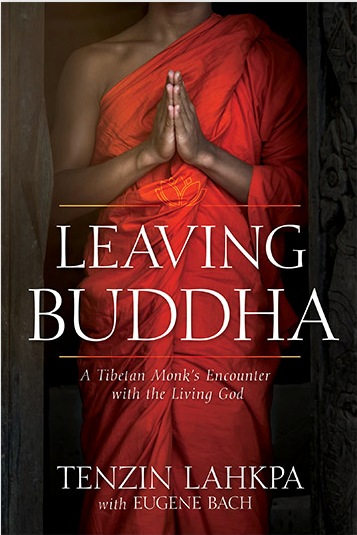
In this excerpt from Leaving Buddha, Eugene Bach introduces us to the amazing story of Tenzin Lahkpa, a Buddhist monk who had a powerful encounter with Jesus the Messiah.

Read the review by John Lathrop.
When I began to write this book, my relationship with Tenzin Lahkpa (a pseudonym) was completely new. I met him at a lunch meeting in August 2017 in western China, where our Back to Jerusalem missionary team was discussing a project to reach out to the Tibetan people. One of the pastors brought along Tenzin, a former Buddhist monk, who shared his personal testimony at the table.
When I heard Tenzin’s story, I was speechless. I was so moved and inspired by his experiences that I knew right away this was a story that needed to be shared with others.
Tenzin is not the first Buddhist monk I have met who has come to Christ (although I believe the number is relatively few), but he is the first to allow me to share his amazing story. Every time I sat down at my computer to write his personal account, I trembled with fear, knowing that it was a special project—one I did not feel qualified for due to the challenges and intricacies involved.
The first challenge was to obtain a full version of his story. I had asked Tenzin to write down his experiences so that I could translate them and make his life story available to others—but what I received was a very humble, two-page biography! Additional information came during subsequent interviews where Tenzin felt embarrassed and extremely reluctant to talk about himself. As a Buddhist monk, he had been instructed for years to remove any sign of self-identity in an effort to obtain enlightenment. Talking about his own story and focusing on himself was the exact opposite of what he had been taught to do. Furthermore, like many Christians living in Tibet today, Tenzin does not see himself as anything special. He is simple and unassuming. If you were to meet him on the street, you would most likely not think twice about him.
The second challenge was that I was convinced my level of facility in the Chinese and Tibetan languages was not high enough to adequately translate Tenzin’s experiences. Thus, this book was written from a series of interviews conducted in 2017 and 2018 by five of my close colleagues and translated from Amdo Tibetan to Mandarin Chinese and eventually to English.
Third, in October 2017, a political development greatly hindered the interview process and the challenge of verifying an accurate translation of Tenzin’s story. The Chinese Communist Party came together in Beijing and passed new oppressive religious laws that came into effect on February 1, 2018. Thus, the interviews with Tenzin were carried out illegally and in secret during some of the most intense crackdowns on Christianity in China in more than a decade.
Fourth, even after scouring the material and running it by Tenzin and the translators, I still felt certain there were things I had missed or did not understand that were important. I also thought there are things I might have misunderstood or translated incorrectly. However, I have checked and double-checked the facts and events in this story to the best of my ability.
Even with these limitations and difficulties, I still believed sharing the story of Tenzin’s life and his search for enlightenment was worth the tremendous hurdles needed to communicate it. His experiences give us a greater understanding of those who live in a closed and persecuted part of the world, of the branches and beliefs of Buddhism, of the universal search for truth, and of the God who is always ready to reach out to those who seek Him.
And so, in addition to the process described above, I used the following methodology to bring Tenzin’s story to Western readers. I drew on my personal experiences and resources from working and traveling in Tibet for almost twenty years, which helped me to express some parts of the story in a deeper way than I could if I had only included the specific words Tenzin spoke during our interviews. I also added descriptions as a way to familiarize my audience with the unfamiliar. Even though Tenzin has journeyed to Nepal and India, he has never traveled to a non-Buddhist area of the world. He is only familiar with Tibetan Buddhist culture, aside for brief periods of contact with Western visitors like myself. Consequently, he is unable to identify with a reader who might not know what a typical Tibetan setting, practice, or ceremony might look like and therefore would be unable to offer a comparison or explanation to help them understand it. Additionally, I have described people, places, smells, practices, and ceremonies using auxiliary information.
For security reasons, many names, places, and events have been changed to protect Tenzin’s identity. In order to bring clarity to certain aspects of the story, several conversations, people, places, and experiences were added that did not actually happen or did not exist. Some details, names, places, and people have also been added to the story to replace real events that might be a security risk to people if they were to be shared. Also, certain foreign missionaries and charity organizations have been involved in Tenzin’s life and have played a significant part in his testimony, but they have been purposefully omitted from his story in order to protect the secrecy of their ongoing work and their presence in China and Tibet.
I acknowledge that the methodology used to convey Tenzin’s story is both a strength and a weakness of this book—it takes its readers into the sights, sounds, color, and outlook of Tenzin’s world to help them understand it, but ultimately these features can only be representative of many of his experiences. They allow for a story that is strongly based on Tenzin’s life but, for the above reasons, necessarily includes aspects he did not personally express or experience.
Therefore, with full disclosure, by adding these descriptions and explanations, I have attempted to explain Tenzin’s story in the clearest and fullest way possible. Even as I have done all this, I have humbly tried to write Tenzin’s story as close to his direct words as possible and to present his story as a first-person account.
—Eugene Bach
Excerpted from Leaving Buddha: A Tibetan Monk’s Encounter with the Living God by Tenzin Lahpka with Eugene Bach, © 2019 by Back to Jerusalem, Inc. Published by Whitaker House. Used by permission.
Further Reading from Leaving Buddha:
Tenzin Lahkpa and Eugene Bach: Leaving Buddha: A Tibetan Monk’s Encounter with the Living GodPastor John Lathrop reviews Leaving Buddha.
Enlightened by Love and Sacrifice: An excerpt from Leaving BuddhaIn this excerpt from Leaving Buddha, Tenzin Lahkpa, formerly a Buddhist monk, recalls his first introduction to Jesus the Messiah.