Can Evangelicals unite amid its constituencies’ diverse denominational affiliation? Nine North American religious scholars from the Anglican, Baptist, Lutheran, Methodist, Pentecostal and Presbyterian denominations explain how their own confessional membership supports their corollary belonging as Evangelicals. Of the contributions, seven of all nine professors were presidents and deans of schools in theological educational at the time the volume was published, and so this volume carries implicit weight coming from the personal reflection of senior administrators and leaders in their respective ecclesiastical theological education institutions.
Learn about navigating denominational identity, evangelical affiliation, and how their dual traditioning relates with the historic Christian faith.
The volume opens with three introductory essays. Baptist Anthony Chute reminds that denominational identity is more than just strong-will people promoting religious partisanship. Evangelical identity can nurture unity even as members can maintain their own denominational affiliation. “If Christian unity is predicated on the gospel first†then, Christians do not have to compromise on their core convictions. Genuine unity seeks more than an “outward appearance of being unified†and members recognize that “God’s family is much larger than their own traditions†(pp.15-16). Chute’s other essay in the book recovers stories about how “one Lord and one faith†find “many expressions†in the founding of the six denominations (pp. 37-64). Despite the history of contextual factors that led to the fragmentation of the churches (into denominations), Chute observes that denominationalism provides opportunities for common and/or collaborative witness in today’s “denominational ageâ€; he reasons that Protestant Christians today rarely denounce divisions using older nomenclature of “orthodoxy versus heresy†(p. 43). Placed between Chute’s two essays, Christopher Morgan proposes that when Christians stand together, what he calls, the true unity among true believers, they display God’s unity, glory and power (pp. 19-36).
Does an evangelical-ecumenicity truly reflect the ecumenicity of the many tapestries of the Christian faith?
Readers cannot miss the contributors’ personal testimony and historical-theological plea for evangelical unity. After the introductory essays, six essayists demonstrate how they maintain their dual ecclesial belongings as evangelicals in their varied Protestant denomination. These essays highlight milestones, persons, and succinct thoughts in the historical development of their denominational identity, and the relationship between ecclesiastical families. Gerald Bray focuses on how his Anglican traditioning relates with other Protestant, national, and historic pre-English Reformational churches including Roman Catholics, Eastern Orthodoxy and non-Chalcedonian churches (pp. 65-92). Bray reminds that Anglicans’ enduring legacy seeks an openness to “other ideas and influences†and they may willingly “compromise on nonessentials,†and keeps an interest in “the life beyond the narrow confines of theological controversy†(p. 87). Timothy George proposes that for him, a “hierarchy of ecclesial identity†as a Protestant, Evangelical and Baptist adds to his more primary identity as a “Trinitarian Christian†who stood in continuity with historic believers who adhere to the theological consensus of the first five centuries of Christianity (pp. 93-110). Douglas Sweeney maintains that after experiencing various Protestant churches, he finds comfort, with Luther, in “the real, objective presence of God in the world and the saving grace in Scripture and sacrament†(p. 119; cf. pp. 111-132). Still, Sweeney urges no one to maintain a self-sufficiency of Lutheranism or preserving only evangelicalism alone. Sweeney recommends that evangelicals and Lutherans join “the true Christians everywhere (fides quae creditur) and hold unto the kind of faith that clings in a personal way to what is held by “Christians everywhere (fides qua creditur)†(p. 132). Timothy Tennent explains why he remained a Methodist because of, what he calls, the time-transcending elements in his Methodist Wesleyan tradition (pp. 133-150). Byron Klaus defends a Pentecostalism that is neither a “shallow emotionalism†nor an “insane experimentalism†(pp. 151-176). Bryan Chapell shows how his Reformed theology, worship and polity inform his practice as a Christian and as an ordained minister (pp. 177-208).
Byron D. Klaus on the cover of his book, And That’s the Way I See It!: Reflective commentary on contemporary issues (2013).
Readers will learn about navigating denominational identity, evangelical affiliation, and how their dual traditioning relates with the historic Christian faith. The last essay in the volume reviews the historical developments, the contemporary challenges, and the global opportunities for the renewing denominations. Baptist David Dockery explains how those who seek to renew their denominations do so by their emphasis not so much on theological distinctives but by their anchor and practice on denominational polity, liturgical practice. Indirectly, Dockery’s essay also encourages the traditions to become more trans-generational and transcontinental while maintaining fidelity to the historic Christian faith in doctrine and in its gospel-centered mission (pp. 209-232).
While many mainline Presbyterians, Lutherans, and Methodists have moved into multicultural, multi-ethnic, and multi-dimensional ministries, the shift away from male, white, North American dominance is perhaps only slowly catching on in more conservative evangelical Presbyterian, Lutheran, and Methodist congregations.
The volume contains several surprisingly and glaringly missing elements. First, I wonder how convincing the volume is, as a call to genuine global Christian unity when all the contributors in Why We Belong are all male, are racially and ethnically white evangelicals, and nearly all the contributors serve in various North American contexts. Among the essayist in the volume, only Timothy Tennent and David Dockery’s essays commented something noteworthy about non-western Christian movements, albeit that these global ecclesial realities are mentioned only in passing rather than engaged substantively (e.g., pp. 62, 133, 149, 227-228). To be sure, the final product of an edited volume may have been different from how the original project was envisioned, and often, prospective contributors had to back-out of projects for various personal and institutional reasons. While readers need not overtly criticize the resemblance of a caricature of North American evangelicalism as a tradition that de-privileges women or a racially-diverse populace, or sidelines the global context, the composition of essayists in the final form does say something about the vision and ethos of the project. And while many mainline Presbyterians, Lutherans, and Methodists have moved into multicultural, multi-ethnic, and multi-dimensional ministries, the shift away from male, white, North American dominance is perhaps only slowly catching on in more conservative evangelical Presbyterian, Lutheran, and Methodist congregations. The inclusivity is also not uniformly shared among the various Baptist denominations in North America.
Second, a number of the essayists presents a caricature of the modern ecumenical movement even though the introductory and concluding essays attempt to show the larger traditioning of Christianity and in so doing, seek to locate various denominational and evangelical identities as continuing with older and newer ecclesial traditions. For instance, how can Orthodox-Catholic relations be said to give an appearance of unity when many official bilateral and multilateral Catholics and the Eastern Churches’ dialogues report candidly many intractable differences that still prevent the churches from granting mutual recognition of each other’s ecclesiality, confessions, sacramentality, ministries, and the witness of the gospel? Caricaturizing about the ecumenical movement today in light of its nascent and maturing theorization of what unity means in the 1950s to 1960s will risk misrepresenting how ecumenicity is conceived and nurtured in today’s global Christian uniting (not reunion) efforts. Though by no means perfecting and perfected, at the least, the World Council of Churches as well as its various efforts such as the Faith and Order Commission, can be applauded for efforts to bring historic churches and newer church developments to understand each other at the ecumenical table. At the time of the publication ofWhy We Belong, constituencies of the Lausanne movement, the Pentecostal traditions, and the World Council of Churches have produced many dialogue reports, joint statements, and commitments, such as Together Towards Life and Christian Witness in a Religiously Plural World. Might these evangelical-ecumenical interchurch developments find their way into a revised and updated version of Why We Belong?
The final essay by Dockery reminds that the Christian movement is much larger than North America.
Third, I am encouraged that the final essay by Dockery reminds that the Christian movement is much larger than North America. It remains to be seen how various evangelical organizations, no less limited to those found in North America, could see the ascendency of representation larger than itself – no less limited to including colored representation and global representation at various levels, and possibly even to include non-evangelical Christian communities. I am less interested in superficial representation than I am interested in seeing a truly global, multi-colored, and trans-gendered collaborative efforts and decision-making at all levels of evangelical and interchurch institutions. In offering the reminder, which I have no doubt my North American, male and white evangelical leaders would agree with me on the value and benefit of widening their constituencies’ representation, I am also aware that participation at voluntary levels depends on those who are willing to come forward to volunteer their time and service. Thus, this critique may also be read as an invitation for my fellow colored and marginalized evangelicals to expand the mission and witness of their faith in evangelicalism. Much remains to be seen how the global evangelical movement could mature when the non-American counterparts share the burden of mission and service. And lastly, though some evangelicals may prefer to keep to a unitive exploration only within evangelicalism, perhaps, the question is, does an evangelical-ecumenicity truly reflect the ecumenicity of the many tapestries of the Christian faith? And as North American Evangelicalism in the Trump Administration has shown itself to be widely and politically diverse, perhaps, a revised edition of Why We Belong (if such a project is ever convened) might wish to expand on the socio-political witness of the churches despite risks that the project may become Why Belonging Calls for Re-envisioning (no pun intended). Let us submit to the leadership of the Trinitarian Spirit who binds and illuminates those in Christ to the worship of Abba and service to the God’s creation and world, and soon, the churches and the world will witness a renewal of the ecclesial, and a growing recognition of us all in Christ.
Timothy Teck Ngern Lim, M.Div. (BGST, Singapore), Ph.D. (Regent University), is a Visiting Lecturer for London School of Theology and Interim Co-Minister for St Columba Presbyterian Church at Botany, Auckland (New Zealand). He is on the advisory board of One in Christ (Turvey) as well as various committees of the Northern Presbytery of the Presbyterian Church of Aotearoa New Zealand (PCANZ). He is an evangelical-ecumenical theologian, ordained as a Teaching Elder with the Presbyterian Church (U.S.A.), and received as a Minister of Word and Sacrament with the Presbyterian Church of Aotearoa New Zealand. He has published in ecclesiology, ecumenical theology, and interdisciplinarity including Ecclesial Recognition with Hegelian Philosophy, Social Psychology, and Continental Political Theory: An Interdisciplinary Proposal (Brill, 2017) and Multilateral Theology: A 21st Century Theological Methodology (Routledge, 2021).
Veli-Matti Kärkkäinen, The Doctrine of God: A Global Introduction. A Biblical, Historical, and Contemporary Survey (Grand Rapids: Baker Academic, 2004), 315 pages. The Doctrine of God is one in a series of books published in recent years by Veli-Matti Kärkkäinen, a Finnish-born theologian who currently teaches at Fuller Theological Seminary. As the subtitle suggests,…
Kevin Giles, The Eternal Generation of the Son: Maintaining Orthodoxy in Trinitarian Theology (Downers Grove, IL: IVP Academic, 2012), 270 pages including indices, ISBN 9780830839650. What this reviewer sees in Kevin Giles’ The Eternal Generation of the Son is a carefully reasoned presentation of what is inherent, or implied within John 1:1 and also…
Edward Irving’s Incarnational Christology: A Theological Examination of Irving’s Notion of Christ’s Sinful Flesh as it relates to the Fullness of the Incarnation In this three-part series, Trevor Martindale gives us an in-depth look at how Edward Irving, one of the 19th Century’s most important church leaders, understood the meaning of God coming in the…
Samuel L. Adams, Social and Economic Life in Second Temple Judea (Louisville: Westminster John Knox, 2014). Adams has written a fine study of the familial, social, occupational, and financial aspects of life in Judea in the period from the sixth century BCE to the first century CE. Each aspect is expertly introduced and discussed in…
Gastón Espinosa, Latino Pentecostals in America: Faith and Politics in Action (Cambridge, MA, and London: Harvard University Press, 2014), xi + 505 pages. Daniel RamÃrez, Migrating Faith: Pentecostalism in the United States and Mexico in the Twentieth Century (Chapel Hill, NC: The University of North Carolina Press, 2015), xix + 283 pages. Why should readers…
Brad Harper and Paul Louis Metzger, Exploring Ecclesiology: An Evangelical and Ecumenical Introduction (Grand Rapids: Brazos, 2009), 336 pages, ISBN 9781587431739. Exploring Ecclesiology promises “an evangelical and ecumenical introduction†to the doctrine of the church. This subtitle to the otherwise aptly entitled book is multi-faceted and, judging from the nature of the book, intentionally so….



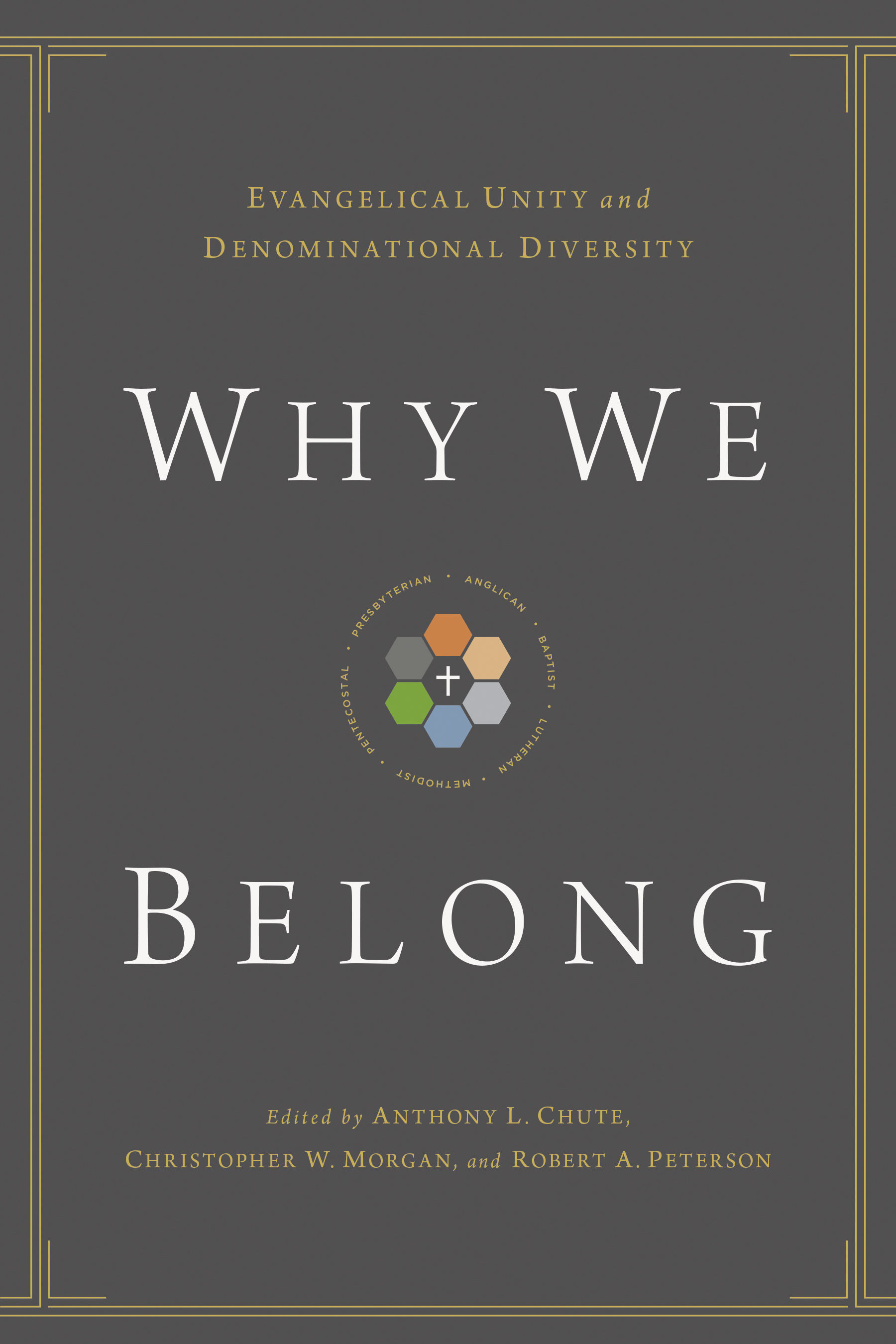 Anthony L. Chute, Christopher W. Morgan, and Robert A. Peterson, eds., Why We Belong: Evangelical Unity and Denominational Diversity (Wheaton, Illinois: Crossway Books, 2013), 251 pages, ISBN 9781433514838.