Ivan Satyavrata: The Holy Spirit

Editor’s Note: This is the full review of Ivan Satyavrata, The Holy Spirit: Lord and Giver of Life. For the Review in Brief, see the full Summer 2010 issue of Pneuma Review.
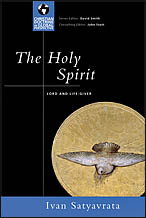
 Ivan Satyavrata, The Holy Spirit: Lord and Giver of Life, Christian Doctrine in Global Perspective Series (Downers Grove, Illinois: IVP Academic, 2009), 182 pages, ISBN 9780830833078.
The Holy Spirit is part of a joint project between Langham Trust and IVP. The author, Ivan Satyavrata, is President of Buntain Theological College, Chairman of Asia Theological Association in India, and an ordained minister of the Assemblies of God. In nine chapters, Satyavrata articulates a pneumatology that is rooted in the authority of Scripture, and that is historically sensitive about the diversity of doctrinal understandings of the Holy Spirit. It is also intended as a contribution that illuminates a non-western pneumatology in so far as the series, edited by John R.W. Stott and David W. Smith, seeks to present a biblically faithful and contextually relevant set of Christian doctrines from non-western perspectives, for both western and non-western Christian readers. Hereafter, I will summarize Satyavrata’s main ideas, and then offer a critical assessment.
Satyavrata’s quest is to discern the Spirit against the backdrop of an increasingly post-Enlightenment world, and to show sensitivity of pneumatology in the western and eastern hemisphere. In chapter one, he explains the reasons for a surging pursuit of religious experience and captivation with eastern spirituality among the youth in post-enlightenment western societies. He attributes this quest for authentic religious experience as a reaction to and a disillusionment of the cold, logical, deductive reasoning and objective academic analysis inherited from the Enlightenment. If this trend is not curtailed, subjective experience will eventually become the final authority on truth. This leads to the danger of religious pluralism and the subverting of the authority from which truth is to be discovered.
The larger backdrop for Satyavrata’s pneumatology is his historical account of “the Spirit in the life of the Church.” In twenty-eight pages, chapter two provides a broad and sweeping snapshot of renewal in Christian history. The aim is to show the Spirit’s pervasive activity in the Church over the last twenty centuries – from the earliest Christian community’s experience of the Spirit, to the Church Fathers (such as Justin Martyr, Clement of Alexandria, Tertullian, Cyril of Jerusalem, Basil of Caesarea), to the “Sectarian Spirit Movements” represented by Gnosticism, Montanism, Joachimism, Friends of God, Irvingites of Roman Catholicism, to Christian Mysticism (such as Bernard of Clairvaux, Martin of Tours, Benedictine Hildegard of Bingen, Francis of Assisi, Anthony of Padua, Catherin of Siena, Vincent Ferrer, Teresa of Avila, Meister Eckhart, John of the Cross), to the Reformation Christianity of Martin Luther, John Calvin, Ulrich Zwingli, Thomas Muentzer, and to modern ‘Spiritual Renewal’ movements (such as Puritanism, Pietism, Quakerism, Quietism, Revivalism [of John Wesley, George Whitefield, Jonathan Edwards, Dwight L. Moody], Evangelicalism, the Holiness movement, and Pentecostalism). The crux of this chapter is that “Spirit-renewal,” such as the Pentecostal renewal since the twentieth century, occurs all through the centuries. The Church struggles historically with the limits and validity of organization versus renewal, form versus freedom, and ritual versus charismata, and the tensions will probably continue until the End of the Age. The tensions are evidence that the Church has been trying to correct the excesses of renewal movements.
In chapter three, Satyavrata discusses four aspects pertaining to the nature and character of God the Spirit in the Old Testament. He is the creative Spirit who “is continually creating and ceaselessly active in directing the processes of the natural world” (p. 55). As such, “the Spirit’s role in creation ensures he is everywhere and must not be excluded from any aspect of human experience” (p. 55). He is the enabling Spirit who equips his chosen ones for leadership and for roles he predisposes, both in the religious and in the ‘secular’ arenas. As the prophetic Spirit who inspires, God the Spirit is the channel of communication between God and people – both in ethically neutral issues and in moral grounds. Finally, he is the universal and messianic Spirit who promises God’s redemption for humanity – foreshadowing the eschatological Spirit of the New Testament who is poured out at Pentecost and who indwells believers.
Both the Old and the New Testaments reveals a myriad of concepts of the Holy Spirit – this is the focus of chapter four. The Spirit is a person and not an impersonal force. The Spirit is God. The Spirit and Christ are distinct and yet inseparably linked, so much so that Christ is the criteria for discerning the true Spirit. The Spirit in the Christian life is the agent who effects Christ’s finished work. This is contrasted with the portrayal of the ‘Shamanistic’ and “Han” Spirits in the opening prayers of 1991 Seventh Assembly of the World Council of Churches led by Chung Hyun-Kyung, a South Korean female theologian.
Chapter five takes off from Irenaeus’ analogy of the “two hands of God” to articulate the Spirit’s relations to the Trinity: The Spirit is the divine person. The Spirit is the Spirit of the Father and of Christ, and the Spirit has a personal relationship with the other members of the Trinity. This demonstrates the nature of mutual and divine love in this “community of being” (p. 91). As Satyavrata conceives it, communion best captures the Spirit’s work in mediating the presence of God, his love, and unity to the believers.
In chapter six, Satyavrata explains that when the Word and the Spirit converges in divine revelation, that clarifies the Spirit as the Spirit of Truth. The Spirit always directs us to the Word of God – to authenticate the authorship of Scripture, and to validate God’s Word in the process of the canonization of Scripture, and in making Scripture applicable for believers. The Spirit is conceived as the interpreter and illuminator of the Word and of the truth about Christ.
Having discussed the Spirit’s essential nature and character, Satyavrata then proceeds to examine the Spirit in Christian life, devoting chapter seven to the individual dimension of “the Spirit and Salvation,” chapter eight to the communal aspect of the Spirit in the Church, and chapter nine to “Keeping in Step with the Spirit.” In the personal dimension, Satyavrata postulates that even though the Spirit is invisible, the Christian is consciously aware of the presence and power of the Spirit – the Spirit draws attention not to himself but to Christ, with soteriological intent. The Spirit convicts, converts, gives life, washes/regenerates, adopts, baptizes into Christ, endues with spiritual gifts, and grants subsequent/second baptism in the Spirit (contra the cessationist view). Communally, the Spirit gives identity, mission, and character to the Christian community. The Spirit makes the Church God’s dwelling place, the Body of Christ with all the diversity among its members, God’s family. The Spirit orientates the being and inner life of the Church making it “the community of the Spirit” (p.145), characterizes by its worship, holiness, equipping for ministry, and by marks/signs of the Church as the Kingdom of God. To keep pace, the Spirit empowers the believer to overcome evil, make them disciples, assists them in spiritual warfare, and brings the world to Christ, by means of genuine experiences of the Spirit of God.
In my assessment, Satyavrata’s pneumatology is introductory, and it stands in continuity with western theological development. It is introductory because the pneumatology he lays out is at an elementary level. There is no engagement with deeper theological truth reflection such as that seen in David Coffey’s Deus Trinitas, Michael Welker’s God the Spirit, and/or Yves Congar’s I Believe in the Holy Spirit. What we have in Satyavrata is a pneumatology in plain language and in its most basic form. Perhaps it is intended for a lay-readership who just wants a ‘feel’ for the subject. But for that, readers may not find it easy to follow Satyavrata. This is because there are quite a lot of overlaps in the way Satyavrata organize his materials/ideas. While repetitions may indeed be helpful for lay readership, the ideas are jumbled all over the places instead of following sequentially with each other, thereby making it difficult to follow – chapter 2 on the Spirit in the life of the Church, and chapter 8 on the Spirit and the Church in the context of the church as “the community of the Spirit,” chapter 4 the Spirit as God’s personal presence (Trinity), which is discussed again albeit in different ways in chapter 5 the Spirit and the Trinity, and so forth.
Satyavrata’s introductory pneumatology shows a fair familiarity with western theological tradition. He wrestles with an objective articulation of pneumatology (from an Enlightenment heritage) with the subjective experience of the Spirit in the history of ‘renewal’ (which is really a postmodern re-reading of church history along a pneumatic trajectory). When he defends the proposition that the Spirit is not a force field (even though he does not explicitly state who or what trajectory he is dealing with in rejecting the force field theory), readers familiar with western theological tradition would probably see that apologetic as a response to Wolfhart Pannenberg’s scientific force-field pneumatological theory, and even possibly Jurgen Moltmann’s pneumatology. When Satyavrata alludes to Scripture as the common theological commitment or concurrences foundational for his work, he is not only affirming the common Spirit in the Church, but he is showing sensitivity to the different trajectories concerning pneumatology that have developed in the history of Christianity. Of course, in all of these examples, Satyavrata neither expands nor develops his pneumatology in dialogue with the western traditions.
In The Holy Spirit, Satyavrata offers some glimpse of an Asian voice. He intentionally weaves into his writings Asian stories, and particularly from his Indian heritage. In these anecdotal accounts, he attempts to make theological connections and shows how his Asian understanding of the pneumatic, or of the spirits, should be understood according to the norms of Christian pneumatology. While I appreciate and agree with his theological assessments as he relates to typical Asian Indian conceptions, I also wonder about the ‘Asian-ness’ of his proposal. Essentially, if theology is to be teased out in context, I wondered if Satyavrata’s is no more than a pneumatology from a limited Indian perspective. Of course, a crucial question is – how Asian must it get for it to be considered ‘Asian’ pneumatology? Does giving anecdotal narratives necessarily make a theology Asian? Does critical engagement render it Asian? Satyavrata has presented concisely a pneumatology in the light of some aspects of his Indian Asian experience, but his proposal however remains too constricted within a ‘western’ mould. Perhaps, as a contrast, American Korean theologian Moonjang Lee has in a number of his essays provided an alternative Asian theology, one that is a deeply critical engagement with aspects of Asian cultural conceptions. The fundamental question when it comes to theology in context is of course, is as Richard Niebuhr had set out in Christ and Culture, or as conservative evangelical scholar D.A. Carson had proposed in Christ and Culture Revisited and The Gagging of God, how much engagement makes a theology authentically contextual – for culture, against culture, transforming culture? Satyavrata’s proposal bears too much in its conceptual form and substance with ‘western’ articulations of pneumatology. It is surprising that Satyavrata’s pneumatology in Asian perspective has not registered the dynamic work of the Spirit in the House Church Movement in China, in the world’s largest church in South Korea, in the persecuted churches in the Middle East, in Indonesia, and North Korea, just to name a few. These are not just some minor ‘awakening’ episodes, but significant interfaces of the Spirit in their respective cultures. The lessons on pneumatology herein can hardly be ignored when one considers pneumatology on the Asian ground.
Still on the whole, Satyavrata’s The Holy Spirit would make an interesting read for a few reasons: he concisely scans history of the Spirit in the Church; he produces a condensed and simplified version of an evangelical ‘western pneumatology’ in propositional terms; he attempts some dialogue and engagement with Asian and in particular Indian culture. But for those looking for a serious global or even Asian evangelical pneumatology, I regretfully say this is not the book.
Reviewed by Timothy Lim Teck Ngern
Publisher’s page: www.ivpress.com/cgi-ivpress/book.pl/code=3307
Preview The Holy Spirit online at: books.google.com/books?id=WoWIiuQhjKEC