
Allegiance, Truth and Power: Three crucial dimensions for Christian living

Â
How do experiential truth and the bondage-breaking power of the Spirit support every believer to have a right relationship with God?
Â
Given the fact that the Bible’s primary concern is our relationship to God, a relationship that starts with commitment or allegiance to Him, where are the contextualization studies dealing with relationship? What are the culturally appropriate varieties of commitment and relationship to God through Jesus Christ? And, since spiritual power is high on the list of concerns for both biblical peoples as well as for most of the peoples of the present world, where are the contextualization studies dealing with spiritual power? Doesn’t the Bible have a lot to say about this subject? And might there not be culturally appropriate differences in the ways God’s authority and power are to be exercised from society to society?

In 1991 and 19921 I published articles dealing with three encounters that are crucial to the experience and communication of the Gospel of Jesus Christ. I labeled these encounters: Allegiance (or Commitment), Truth and Power. As I have pondered these encounters, I have come to the conclusion that these areas are even more important than I had realized.
In my articles, I pointed out that each of these encounters leads to a specific very important dimension of Christian experience: allegiance leads to relationship, truth leads to understanding and spiritual power leads to freedom. Each of these areas is a crucial dimension of the God-connected life. I now believe the areas of encounter are pointing to the three crucial dimensions of Christian experience and witness. If so, we need to theorize concerning contextualization in each of these areas, rather than simply dealing with the truth (knowledge) area.
What I Mean By Dimensions
A dimension is an aspect of Christianity that, though closely interrelated with the other dimensions, is quite distinct in its content and, therefore, needs to be defined and treated as a distinct entity. We can focus on this distinctness in several ways. One way is to look at the distinctness of the human problems in view under each category.
There are those in the evangelical community who are cult watchers. Though they know a lot about cults and biblical truth, they seem to poorly understand spiritual power. They, therefore, are very good at exposing the errors of the cults, but can do nothing with their power. In fact, some of them in their lack of understanding of power, actively condemn legitimate Christian power ministries along with the cult groups.
Another way of distinguishing these dimensions is to look at the differences in the content of each dimension. Though I will go into greater detail below, I here present an overview of these differences. In the relationship dimension we find things like love, the fruits of the Spirit, faith, repentance, prayer, fellowship, intimacy with Christ and all of the other things in Christian experience that factor into our relationships with God and other humans.
These aspects of life, then, are quite different in experience from the things we deal with in our thinking behavior. Though we can think about, talk about, and teach about relationships, none of these knowledge aspects of the subject is the same as participating in a relationship. Indeed, many who demonstrate a considerable expertise in thinking about relationships don’t seem to do well in relating to others. Similarly, working in spiritual power is quite distinct from thinking about it. It is also quite distinct from relating.
In the truth-understanding dimension are all of the cognitive aspects of Christianity. Doctrinal and theological tenets such as our understandings of God, Jesus, the Holy Spirit, humanity, sin, redemption, faith, Satan and demons, the Church, the Kingdom of God and all the rest of the things we believe fall into this category. So do the things we understand concerning the allegiance-relationship and power-freedom dimensions. This dimension is the easiest of the three to deal with since it largely involves the mere transmitting of information. And transmitting truth, though it is better done when people are free from satanic power and linked together in solid relationships, is not as complicated as either relating or dealing with spiritual power.
The spiritual power dimension, then, involves working in the power of the Holy Spirit to bless, heal (both physically and emotionally), cast out demons and challenge territorial spirits. As with relationships, it involves doing something, not just thinking and talking about it. Jesus taught and demonstrated that we are at war with a powerful enemy but that we have authority and power to defeat him (Lk 9:1). The exercise of that power under the direction of the Holy Spirit constitutes a dimension distinct from the other two but working in conjunction with them, since the power we use must come from the true Source of power and the authority to work in that power from our relationship with Him.
The Problem
In the aforementioned articles, I focused on the fact that most EuroAmerican Evangelicals have known virtually nothing of the spiritual power dimension of Christianity. Unfortunately, in certain circles, at least, there is also a tendency to degrade or ignore the experiential, relationship dimension as well (see Kraft, 2002).
Church historians tell us that whenever there is renewal the experiential component comes into focus in a major way. This experiential component tends to be maintained in pietistic and Pentecostal groups, though often allowed to dim in “more respectable†evangelical circles except perhaps at conversion and revival times. In mainline liberal groups, then, experiential emphases tend to be discouraged or even castigated. The conversions involved in renewal movements, pietism or the like, of course, bring new people into the Church on the basis of new relationships to God and the Christian community. And these new people need training if they are to move toward maturity.
When the emphasis is on the truth/knowledge dimension, the focus becomes knowledge about Christian things, including the relational and the freedom dimensions, rather than experience of these things. The result is that many people who are well trained in Christian institutions can discourse very learnedly even about subjects such as relationship and spiritual power—subjects with which they have had little or no experience.
Evangelicals who come from this knowledge-oriented stance tend to make statements against emphasizing experience, as if it were something to be afraid of, not to be trusted and, therefore, avoided. This has led to the experiential/relational dimension functioning largely underground. For example, even though all knowledge is grounded in experience and all interpretation pervasively affected by experience, many evangelical knowledge brokers perpetuate the fantasy that what they are teaching is objective Truth unadulterated by their subjective interpretations. Whether they admit it or not, however, all of what they teach as objective truth is strongly conditioned by their or someone else’s experientially-influenced interpretations. And both their experience and their interpretations are conditioned, perhaps quite unconsciously, by the kind of relationship they have with God and their fellow human beings.
The fact is, then, that all we know is totally conditioned by both our conscious and our unconscious interpretation of our experience and our relationships. When someone teaches theology, for example, the real quality of what they teach is dependent on the nature of their relational experience with the God whose Truth they claim to proclaim. A distant relationship with God, the Source of theology, or with the subject being dealt with (e.g., pastoring, deliverance) yields a mere theoretical knowledge of those subjects that at least reduces, if not destroys the relevance of what is being taught.
Needed: Balance
I am not contending that relationship and experience should be emphasized more than understanding, though, given the fact that there is no salvation without a relationship with Jesus, we must give it proper priority. That relationship saves, whether or not we have a lot of knowledge to go with it. My plea is for balance, a balance that goes three ways. The academic nature of what we call theology and the classroom context in which we teach have, however, led us to largely ignore two of these dimensions.
Jesus called the twelve to be with him and only then to communicate and engage in power ministry (Mk 3:14). His teaching of Truth was, I believe, intended to serve these relational and ministry ends, not to be an end in itself. I have recently read and responded to two articles critical of some of what I am doing because, the authors contend, my theology may have some flaws in it. The impression I am left with is that these authors feel that what God really wants in this world is correct theology, whether or not people get helped. I think, though, Jack Deere was on the right track when he titled his chapter in the book Power Encounters Among Christians of the Western World (Harper Row, 1988), “Being Right Isn’t Enough.†By this he meant to indicate his repentance for seeking right theology over participating with God to bring freedom to those whom God loves.
My encounter articles point to an imbalance among evangelicals in our neglect of the power-freedom dimension of biblical Christianity. The additional neglect of the allegiance-relationship dimension may, however, make the situation even worse than I suggested, at least among the academically inclined. We may even have done injustice to the relational dimension out of fear of anything that is not easily explainable in rational categories.
We have recommended allegiance-relationship experience as the way to salvation. But, at least in academic circles, we have often downplayed the validity of interpretations of Scripture and life based on experience. Instead, we go full tilt for the knowledge-understanding dimension as if that were the most important. But even in this knowledge/truth dimension we go off the track because our understanding of knowledge and truth has been western Enlightenment rather than Scriptural. When we think of knowledge, for example, our interpretational reflex is to think of intellectual, theoretical knowledge. This kind of knowledge and truth is not, however, what the scriptural authors had in mind. The knowledge/truth spoken of in Scripture is experiential truth, not intellectual, theoretical truth/knowledge. If we are to be true to the original Greek (and the Hebrew worldview behind it), then, John 8:32 should be translated: “You will experience [not know in a theoretical sense] the truth and the truth will set you free.â€
People die spiritually in seminaries and Bible colleges (not to mention churches) because the relational dimension that is so foundational to Christian experience is submerged, ignored, even spoken against in our quest for knowledge about whatever subject we are investigating. Sometimes those subjects are relational things like conversion, spiritual growth, prayer, love, the fruit of the Spirit, faith and any of the other aspects of Christianity that belong to this dimension. But knowledge about is quite a different thing from actually experiencing these aspects of allegiance-relationship. And the focus on knowledge about, plus the time and energy required in our schools and churches to learn information mitigates against the practice of the very things we are learning about.
In order to further define what I see in these dimensions, I offer the following discussion.
Allegiance Commitment Leading to Relationship
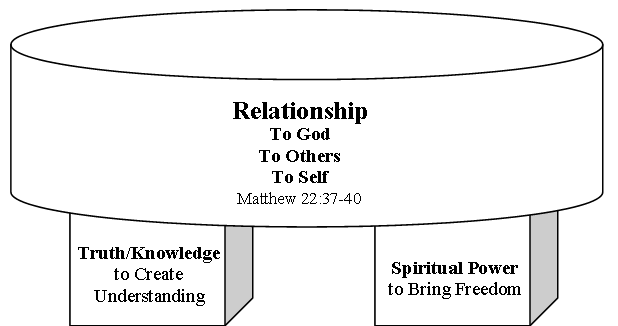
The first and most important of the three dimensions is what I call the relationship dimension. This is the dimension the other two dimensions are intended to support. We may picture this fact as follows:
This dimension begins with an initial allegiance/commitment to Christ that we often refer to as conversion and is expected to issue in a continual growth in commitment and intimacy with Christ. The dynamic of this dimension is growth, a process that involves change in the direction of Christlikeness on the part of the convert and movement into closer and closer relationships with Christ, His people and one’s self. As we grow, we are to become more and more conformed to the image of Christ, becoming more and more like Him to whom we have committed ourselves.
The allegiance-relationship dimension is quite distinct from the other two dimensions. For example, no one becomes a Christian simply through knowledge or power. As James says, even demons have enough understanding to cause them to tremble in fear (Jas 2:19). They have all the knowledge they need but none of the relationship required for salvation. Yet we are often taught to witness primarily by increasing the person’s knowledge, as if that knowledge is going to bring him/her into the Kingdom. This is a radically different dimension from the knowledge dimension, though related to it. And, we can’t simply click into a relationship on the basis of what we know.
 The problem we face, though, is how to cultivate and pass on this relationship. As Christians, we need to be constantly attentive to growing “in the grace and [experiential] knowledge of our Lord and Savior Jesus Christ†(2 Pet 3:18). For me, since I have learned well to read the Bible mainly for information, this has involved changing certain habits in order to learn to read the Scriptures relationally. I have been teaching myself to experience the events of Scripture as I read them.
The thing that propelled me in that direction, however, is something we will discuss below under the power-freedom dimension. I began to experience the presence of Jesus in ministry. I began doing some of the works Jesus promised in John 14:12 that we would do, His works of power and of love. Participating with Jesus in doing the kinds of things He did while on earth, then, has driven me ever closer to Him in the abiding in Him relationship He spoke about in John 15.
Leading others into a relationship with Christ, then, is a major challenge. It is much easier to contribute information to them than to bring them into Jesus’ family. But, though many are able to establish a relationship on their own once they have heard the message, as a general principle it takes a relationship to bring about a relationship. This is why certain groups advocate friendship evangelism, a way of bringing people to Christ that involves the witness first in establishing a friendship relationship with potential converts.
I remember helping a young woman who had been seeing a Christian psychologist for some time. I had learned that this psychologist had gone way out of her way to help this young woman, going to be with her at all hours of the night, even driving some distance to rescue her when she had run away. I asked the client what her relationship was with Jesus Christ. She replied that she probably didn’t have one and went on to describe her deep disappointment at the way she had been treated in various churches.
Wondering what to do, I ventured the question, “Would you accept [your therapist’s] Jesus?†Her face brightened as she said, “Yes, I’ll accept that Jesus.†And she did. Her relationship with the Christian therapist enabled this very damaged woman to experience genuine love. This experience, then, made it easy to lead her into a relationship with the Source of that love.
The following chart summarizes my understanding of the allegiance-relationship dimension:
The Allegiance Dimension
Primary concern: Relationship
This is the most important of the three dimensions
Starts with conversion—a commitment to Christ—to establish a saving relationship with God through Jesus Christ
Aim is to replace any other allegiance/relationship as primary—all other allegiances are to be secondary to this one
It continues as growth in one’s relationship with Christ and with others expressed as loving God with one’s whole heart and one’s neighbor as oneself
It includes all that the Bible teaches on subjects like love, faith(fulness), fellowship, the fruits of the Spirit, intimacy with Christ (e.g. Jn 15), forgiveness, repentance, reconciliation, obedience
True intimacy and relationship should not be confused with knowledge about intimacy and relationship
All other allegiances are to be countered with commitment to Christ
Under this dimension, the church is to be experienced as family
Witness to one’s personal experience is key to communicating this dimension
Theology is experienced in worship and submission to God (Rom 12:2)
Truth/Knowledge Leading to Understanding
This is the dimension most familiar to us. Jesus spent a high proportion of His time and energy in the teaching of truth. He wanted people to understand as much as possible about His Father, Himself and all that the relationships between God and humans and between humans and other humans should involve. He punctuated His teaching with regular power encounters and appeals for allegiance. He regularly demonstrated, not just talked about, both the allegiance-relational and the power-freedom dimensions as a part of His teaching of truth.
One of the crucial aspects of Jesus’ method was to enfold His teaching of truth in a relational context—discipleship. He chose twelve people to teach by example in the context of the day-in, day-out activities of living together and ministering to people in love and power. He used His freedom-giving power to minister relational love to others within a discipling relationship with His closest followers (including more disciples than the twelve plus several women). But He wrapped all of this in a truth teaching context. His was a balanced approach to doing and thinking about the doing. He never allowed His ministry to become a merely thinking about ministry.
Nevertheless, we continue to fill people’s minds with information, knowledge and truth to the point of intellectual indigestion because our training techniques seldom include actually doing what we are talking about. With one notable exception. In Christian training institutions focused on producing pastors, there are usually courses designed to train people to preach in which the students actually have to produce and deliver sermons. Well and good. They actually learn how to do something by doing it. Yet what they learn is seldom more than how to present information about Christian topics. If they are to learn anything about how to interact with people relationally to bring about healthy relationships with God and humans, they have to learn these things elsewhere. And if they are to learn how to operate in God’s power to bring the freedom their people crave, they have to learn this outside of the curricula of the schools supposedly established to train them to do pastoral work.
Ideally, then, we should be teaching truth as Jesus did to combat ignorance and error. We should know, however, that whenever the Scripture speaks of knowledge and truth, it is referring to experiential knowledge and truth, not merely the intellectual byproducts of these factors. And we should be led in teaching truth by the Holy Spirit who, incidentally is also the Producer of the relational fruits of the Spirit and the Giver of the power-oriented gifts of the Spirit. That is, He is in charge of all three of these crucial dimensions.
The Truth Dimension
Primary concern: Understanding
This dimension involves teaching led by the Holy Spirit (Jn 16:13)
Scripturally both truth and knowledge are experiential, not simply cognitive
Truth provides antidotes for ignorance and error
Though spiritual truth is pervasively relational and experiential (Jn 8:32), there is also a cognitive and informational dimension
This dimension embodies truth and knowledge of all aspects of Christian experience
We are to learn in this dimension about the contents of the other two dimensions
We are expected to grow in this knowledge dimension as in all other dimensions of Christian experience
Satanic and human lies are to be countered with God’s truths
Under this dimension, the church is to be experienced as a teaching place (discipleship, mentoring, classroom)
Theology is both cognitive and experiential
Power Leading to Freedom
Jesus said He came to set captives free (Lk 4:18). In making such a statement, He implied both that there is one who has captured many people and that people need the freedom God offers. People need freedom so badly that He, Jesus, came to earth to offer this freedom. He then demonstrated throughout His ministry what He meant by this statement.
Jesus did all this to demonstrate God’s love (a relational thing), to teach us what God and the Christian life are all about (knowledge/truth things), to free people from Satan (a power thing). Thus He showed us how we should go about our lives as participants in the Kingdom of God that Jesus planted in the middle of Satan’s kingdom. He gave to us the same Holy Spirit under Whom He worked, saying that whoever has faith in Him will do the same things He did, and more (Jn 14.12). Since today, as in Jesus’ day, the enemy is doing power things, Jesus gave us His authority and power (Lk 9.1) to carry on the freedom-giving activities of Kingdom builders.
When Jesus left, He gave us power in His name. We, then, are to operate in His authority to bring about the same ends He came to bring. We are to focus on bringing people into a relationship with God as Jesus did. But we are to recognize, as He did, that many are in captivity and, therefore, in need of freedom from the hold of the enemy. Only when they are freed will they be able to understand the Gospel and, building on that understanding, to commit themselves to Christ.
This is the dimension that Westerners and the Westernized understand the least. Many in the West fail to see either the extent of the satanic blinding (mentioned in 2 Corinthians 4:4) or the possibility of breaking through that blinding by using the power Jesus gave us. If we are to imitate Jesus, though, our ministries should be filled with instances of healing and deliverance as well as authoritative praying and teaching. The evangelists of Argentina have been demonstrating to us the effectiveness of an approach to evangelism that starts with breaking the enemy’s power over people before witness takes place.
After witness and conversion, then, many are still captive to emotional hurts and demons. How different our churches would be if classes leading to church membership employed the power of God as the Early Church did to heal and “clean up†the new converts before they joined the church. God’s power is available both at the start and throughout a Christian’s life to bring healing and deliverance.
Power Dimension
Primary concern: Freedom
The power in focus here is spiritual power (not political, personal, or something else).
This dimension recognizes that humans are held captive by Satan
Jesus worked in the power of the Holy Spirit to set captives free (Lk 4:18, 19)—He did nothing under the power of His own divinity (Phil 2:5-8)
Jesus passed this power on to His followers (Lk 9:1; Jn 14:12; Ac 1:4-8)
Satanic power must be defeated with God’s power (it cannot be defeated simply with truth or a correct allegiance, though these help)
Under this dimension, the church is experienced as both a hospital where wounds are healed, thus freeing people, and an army that attacks the enemy, defeating him both at ground level and at cosmic level
Awareness of the power dimensions of Christianity needs to be taught both cognitively and, especially, experientially (as Jesus did)
Theology is experienced as victory in warfare resulting in freedom to relate and think
Ways in Which The Dimensions Function Together
All three dimensions are present in every activity of God in the human sphere. If a given relational interaction with humans is from God, it will involve the power and love of the true God in operation. Any teaching of God’s truth, furthermore, will involve the power of God with the aim of bringing about growth in relationship with God. In contrast, whenever the enemy’s power is active, it is a counterfeit power rather than a godly power, and is designed to lead people into a wrong allegiance.
I have spoken above of the frequent need for God’s power to be in operation before people can understand enough to pledge allegiance to Jesus Christ. It is the power of God engaged through prayer, then, that enables us to grow stronger in our commitment to Christ and in our knowledge of His truth. Likewise, it is prayer-power that enables us to minister to others the truth that leads to Christian commitment.
As indicated above, I suggest a threefold approach to bringing people into church membership. What is usually done is simply to increase the potential member’s knowledge and to make sure that they have experienced a conversion to Christ. These ought to happen, but much more needs to be done for most people if they are to experience freedom through the healing and delivering power of Christ and to grow in their relationship with Christ.
I have no statistics to prove it, but if my experience in ministering to hundreds of hurting Christians is any indication, I suspect that a high percentage of church members (and church leaders) are in great need of healing from deep emotional hurts and from demons. Such a condition is crippling our churches. An approach to these problems that focuses as much on spiritual freedom and relationship as it usually does on truth and knowledge could revolutionize Christian experience and expression.
PRÂ
Notes
1 Cf. “What Kind of Encounters Do We Need In Our Christian Witness?†EMQ 27: 258-265, and “Allegiance, Truth and Power Encounters in Christian Witness†in Pentecost, Mission and Ecumenism: Essays on Intercultural Theology, Jan A. B. Jongeneel, ed., Frankfurt: Peter Lang, 215-230.
References
Kraft, Charles H. ed, Appropriate Christianity, Pasadena, CA: Wm Carey Library, 2002.
Tippett. A.R., People Movements in Southern Polynesia. Chicago: Moody Press, 1971.
This excerpt is an adaptation of “Contextualization in Three Crucial Dimensions†of which a previous version was published in Appropriate Christianity (2002).
Further Reading
To read the full chapter, “Contextualization in Three Crucial Dimensions†in Appropriate Christianity (2002), go to: books.google.com/books?id=RysiXCZ7JJgC&pg=PA99










Reader T.S. wrote this comment that appeared in the Winter 2011 issue: “Dr. Kraft’s explanation of the three dimensions of Christian living as relationship/allegiance/love, power and experiential truth has given me a succinct way of expressing something I have seen but could not articulate. Thank you for publishing “Allegiance, Truth and Power†in the Fall 2010 edition.
Also, I would like to recommend an article to your readers that I found helpful and somewhat relevant to your discussion on church leadership.
Ed Stetzer, “Life in Those Old Bones: If you’re interested in doing mission, there could hardly be a better tool than denominations†Christianity Today (June 2010).
This was the cover story of the June 2010 issue, but anyone can access it online here:” http://christianitytoday.com/ct/2010/june/11.24.html