Andrew Clarke: Serve the Community of the Church

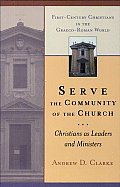
 Andrew D. Clarke, Serve the Community of the Church: Christians as Leaders and Ministers (Grand Rapids: William B. Eerdmans Publishing Company, 2000), 305 pages, ISBN 9780802841827.
This book is a recent release of Eerdmans (2000), as the second volume of the series called “First-Century Christians in the Graeco-Roman World†for the Institute of Early Christianity in the Graeco-Roman World, Cambridge. As a historical search, the book gives a fascinating socio-historical background of the New Testament which will be helpful to students of Biblical studies. However, the content will also benefit students of practical studies as its major concern is about leadership practice in the early Christian community.
The focus of the book is to discuss “the nature of leadership in the early Christian community … taught by Paul and practiced in the congregations of the first century†(preface, ix). The book is divided into two major sections. The first of these sections mainly deals with different leadership practices of first century Graeco-Roman world, in which Christians had to locate themselves as a distinct social community. The second section is about how early Christians practiced their leadership within the church (and in front of the surrounding culture) as an application of their faith, while living in such diverse social contexts.
After first warning readers about “the hermeneutical gap†between distant Graeco-Roman world and modern society—in language, culture and philosophy—Clarke opens with a confession of the historical ambiguity related to his current topic. He promises that better answers will eventually come from the “significant wealth of archaeological finds†of recent decades (p. 5).
In part one, to overlay his background studies, Clarke categorizes five socio-political parties of Graeco-Roman world and gives detail discussion on each while indicating that how each party could undoubtedly influence the emerging Christian community. These are: wider Graeco-Roman cities and their political leadership tradition, growing Roman colonies (and cities) and their leadership system, less influential Graeco-Roman voluntary associations and their leadership practice, wide use of Roman household structure and patria potestas (absolute authority with the head) concept, and Jewish synagogue structure as the nearest leadership model for emerging Judeo-Christianity.
According to Clarke, the wider Graeco-Roman political structure and its leadership system represent the model for the other social units, with the exception of some of the diverse Jewish synagogue practices. Clarke argues that political leadership practices within Graeco-Roman cities “had become the exclusive domain of the affluent†by the time of Roman supremacy and this meant that the traditional practice of democracy was “in name only†despite the residual claim to the long tradition of classical Greek city-state (pp. 32-33).
Again, in growing Roman colonies and cities, Clarke sees no difference of leadership systems from the Roman administrative structure, as “their civic leaders were in similar respects drawn from elites, and likewise functioned in both a political and religious capacity†(p. 58). Moreover, Clarke states that all other lower level associations of the time including Roman households also adopted or operated the same hierarchical system of authority similar to the civic level. Concerning Jewish synagogue practice, Clarke assumes the possibility of cultural adaptation of Jewish communities to their prevalent culture but that these might be different from one place to another throughout the empire. In fact, he believes that even synagogue leadership practice of diaspora Jews might be somewhat similar to their wider civic culture, (cf., p. 141).
Having all of this as a cultural background, Clarke, in the second part of the book, advocates that early Christians might have to some extent adapted to their surrounding culture. However, to Clarke’s understanding, Paul while allowing reasonable length of cultural adaptation (i.e., household system, taxation to civic government, etc.), has laid totally different life-principles and value-systems which solely centered on Jesus Christ and the gospel.
To detail, Clarke insightfully provides the benefits and threats that cultural adaptation brought to the community of the church in two major chapters (cf. chapters 7 & 8). However, to Paul, in Clarke’s summary, the fundamental principle of Christian leadership is “service†rather than position or even authority. Even in his favorite use of self-addresses (“apostle†in many occasions and as “father†especially to Corinthians), Clarke reads that Paul never had any intention of power-suppression nor any evidence of authoritative arrogance as some might think, but he used those titles and authority only in accordance with the gospel with an intention to “build up†the church (p. 232, 232).
Therefore, in his conclusion, basing on the whole discussion Clarke confidently claims (and more challenges modern Christian leaders) that Christian leadership is not a position nor a social status but service, in which leaders are serving as “ministers.â€
Indeed, Clarke’s comprehensive study on early Christian leadership practice is really worth to read by all faculties in theological studies. It is historical study in nature, but the content is directly related to the New Testament and the focus is a very practical one. Further, it is of course a scholarly research that can lead one even unto publishing of such theological discussion as biblical theology of Christian leadership and such (readers’ own opinion).
Concerning the content, among many insights Clarke gives to his readers, his historical investigation on the important role of religious belief or cultic practice in Graeco-Roman society, by and large, and a very clear overlapping of religion and politics is good to commend first as being well noted and skillfully brought out to the understanding of modern mind that succinctly draw a thin line between this two different worlds. Then, the choice use of the word “honour†also is good to mention. As many other scholars would also use the same connotation (cf., M.A. Chancey & others), this keyword best describes the nature of first-century secular organizations and their value-system (as also reflected in John 7:4, 18; 2 Cor. 10:12). And then, by pointing out the claimed title of pater patriae (father of the fatherland) by Roman Emperors, Clarke gives a very reasonable assumption of the important role of Roman household concept in a wider Roman politics
Further, Clarke’s new reading of Paul also is a very convincing statement against current biblical scholarship that claims the probable authoritative manner of Paul over his communities. In contrast, as Clarke advocates, the ever defining word of Paul in concern with his leadership or his apostleship is “servant,†that should be understood in the context of first century Graeco-Roman employment of the word, “doulos and (diakonos).â€
Indeed, despite the omission of Ephesians and Pastoral Epistles in the discussion for some unknown reasons, this book is highly worthwhile, especially for students majoring in biblical studies, historical studies, and practical studies. It gives complete background-history of the New Testament, comprehensive information on New Testament perspective of Christian leadership, and descriptive reflection on Paul and his ministry.
Reviewed by Thang San Mung
Preview Serve the Community of the Church: http://books.google.com/books/about/Serve_the_Community_of_the_Church.html?id=UnrKVo10LPMC
<p style=”padding-left: 30px;”>Originally published on the Pneuma Foundation (parent organization of PneumaReview.com) website. Later included in the <a href=”/category/spring 2013/”>Spring 2013 issue</a>.</p>