
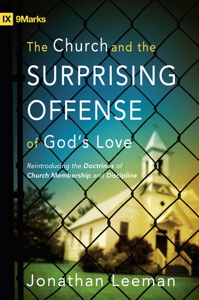
Jonathan Leeman’s The Church and the Surprising Offense of God’s Love, reviewed by Timothy Lim Teck Ngern

Editor’s Note: This is the full review of Jonathan Leeman, The Church and the Surprising Offense of God’s Love. For the Review in Brief, see the full Fall 2012 issue of Pneuma Review.
 Jonathan Leeman, The Church and the Surprising Offense of God’s Love: Reintroducing the Doctrines of Church Membership and Discipline, 9-Marks Building Healthy Churches Series (Wheaton, Illinois: Crossway, 2010), 375 pages, ISBN 9781433509056.
When was the last time you read a significant discussion on church membership, discipline and excommunication? Jonathan Leeman’s contribution stands out for three reasons: first, he rethinks the case for church membership grounded in the nature, rule, charter, and covenant of God’s love and not the concept of love as conceived by contemporary Western culture. A critique of the churches’ subtle acceptance of popular conceptions of love is in order, and in that sense, Leeman’s work surpasses significant contributions such as by Clark, Dulles, Lawless, and White-Duesing-Yarnell.[1] Second, Leeman bridges theoria and praxis, speaking as an elder in a Baptist Church (Washington, D.C.) and a PhD candidate (University of Wales). In this volume, his greatest contribution lies in the practical ramifications to his proposal in Part 3: “Loved Lived.” Excommunication—which is a form of church discipline made public—is necessary to preserve God’s glory and for the church to reconsider whether it is able to affirm the individual’s faith, only in areas of formal sins of unrepentance that are serious in nature (though he excludes those who renounce the faith from this list). Church officials enforcing discipline should not exercise coercion (a sign of the workings of the flesh) but they should rather appeal to the gospel and depend on the Spirit (since all humans are utterly helpless and unable to repent and submit apart from the Spirit of grace). Third, he correctly views his own project as an attempt to support British theologian John Webster’s claim in a footnote that ecclesiology (the doctrine of the church) is only as strong as its membership, whose identity and shape must be built on the doctrine of God.
In a nutshell, Leeman argues that local church membership and discipline (implied, excommunications when necessary) understood biblically is the best structure for the corporate life of the church in her witness to the gospel. Believers who fail to submit to biblical injunction for church membership raise questions about their authenticity in the faith. He further postulates that those who are offended by church membership merely reflects their own offense at God’s love; this is because, the prevailing culture’s idolatrous understanding of love will pull in the direction opposite of the church’s understanding of the exclusionary nature of God’s love. Leeman draws the analogies from sources such as Hawthorne’s Scarlet Letter to demonstrate the difference between the pursuit of unsanctioned and adulterous love and the love instilled by the church’s holy discipline. Contemporary understandings of love as freedom from strictures (i.e., boundaries, institutional/moral judgments, and authorities) contravene Christian civilization, doctrines, and ecclesiological structures.
The contemporary church has succumbed to the “realities of enculturation in the churches” (p.41) when it follows contemporary culture to keep boundary-markers out of the churches, charges Leeman. When love becomes self-expression and self-fulfillment, “the gospel … becomes refashioned for therapeutic purposes” (p.49). Consequently, churches become objects for satisfying humanity’s unquenchable desires (p.50); the commitment expected of love is replaced by the notion that “ask little of others and gives little in return” (p.56). When moral absolutes that accompany true love are rejected, skepticism’s motivation of “love as anything goes or whatever works for you/us” becomes the new mantle for how churches relate with church members and newcomers. Ultimately, this hatred for authority of the church and the premium placed on communal individuality rests on a diminished concept of God (p.63).
Perhaps some readers will ask; how has the church succumbed to this idolatrous love? Leeman argues that the belief of the prevailing churches, that God loves unconditionally and indiscriminately, does not represent the biblical concept of God’s love; rather it demonstrates a thoroughly, man-centered theology—theology becomes refashioned for therapeutic purposes. The biblical view of God’s love demonstrates grace/inclusivity on the one hand, and discrimination/exclusivity on the other hand. God’s love is aimed at humanity’s good, but the good that is fixed and certain in, by, and for God and God alone; we are to love whoever and whatever God loves, and to oppose everyone and everything God opposes—To love God, and to follow God’s love is to simultaneously embrace a love-hate relationship (p.86). Biblical love, which is holy and centers on God alone shows that God’s love is conditional (p.94-105); this is an affront to the natural human’s desire to place themselves at the center, and as such, humanity will always be offended at God’s offer of love, at the gospel, and at the church—this is because God’s love and judgment which exists in concert will render judgment against humanity’s self-centeredness and desire for God’s unconditional love without judgment (p.106, 115).
Ignoring God’s rule of love comes with this mis-definition of God’s love. Leeman suggests that when love is mis-defined, churches would ground their misplaced theology of church membership on a “relational ontology” (i.e., it is all about relationships) without recourse to “substance ontology” (i.e., substance prefigures relationships) and “pre-modern authority” (p.138-139). He acknowledges that in the fallen world, abuses of authority may occur frequently; but to reject human authority in view of human tendencies to mistrust authority because of humanity’s experience of the abuses of power and authority is not a valid reason for supplanting God’s rule of love. When authority becomes relegated to a lower place in the life of the church, and when churches follow “love” understood as “whatever works for you/us” motif, churches will no longer become the avenue for cultivating discipleship; this is because true discipleship enacts submission to Christ (and the authorities he instituted in the fallen world) and practices love towards one another.
In chapters four and five—the Charter of Love, and the Covenant of Love—Leeman reviews the New Testament churches’ view of church membership, particularly Matthew 16, 18, and 28 as the metaphor for understanding the practice of church authority and divine love, and explores its relationship with the Old Testament’s concept of God’s exclusionary love. Here, he defines church membership as the covenantal union between a particular church and a Christian which consists of the church’s affirmation of the believer’s gospel profession, and the church’s promise to provide oversight to the nurture of the Christian, keep promise to gather with and submit to the church’s oversight (p.217). Church discipline is understood as corrective in nature, for operation within the church body, especially the covenant between members and their churches; and when members becomes unsubmissive in their discipleship, the local church must withdraw its affirmation of the individual’s profession of faith, announce its termination to provide pastoral oversight, and release the individual into the world (p.220). On a lesser degree, Leeman recommends that other Christians from other churches do share in the covenantal responsibility in view of the gospel connection, those Christians from other churches must always operate out of respect and deference for each Christian’s local church. In Part III, Leeman continued to explicate practical examples of how membership and discipline are to be exercised, which I will not comment on that but to say that it bears careful consideration.
I am in agreement with the overall thrust of Leeman’s desire to rehabilitate a theology of church membership for the purpose of facilitating Christian discipleship for the glory of God. However, notwithstanding Leeman’s ideals, I have to admit that the book contains several drawbacks, which impinges on the effectiveness of his proposal. While pastors may not be too keen to read further at this point, scholars of various persuasions may note that Leeman makes a number of sweeping generalizations, that appear like straw-man arguments and logical fallacies which would not hold up to expert reviews, e.g., his critique of Catholic ecclesiology, the contemporary ecclesiological mess (as he puts it), the negative review of the philosophical developments from Enlightenment to Postmodernity, the pneumatological winds in contemporary church orientations which he claims to be nothing substantial, the communitarian anthropological theology of Moltmann, Pannenberg, and Zizioulas, the hatred of God in contemporary anti-authoritarian expressions, and the questioning second-order systematic theological enterprises. What is the significance of these drawbacks in Leeman’s work, or does it matter at all in the end? Well, some of these areas are pertinent to the elder’s argument and undermine his overall project. For instance, to fault Moltmann, Pannenberg, and Zizioulas among others as example of a communitarian anthropological approach (of relational ontology) that undercuts a substance ontology, represents a particular and selective reading of these theologians; though true to some extent, Leeman has yet to demonstrate how these theologians fall within the camp he is taking a stand against; and in fact, scholars of Zizioulas and Pannenberg for instance would counter that they have held the immanence and transcendence of God in a harmonious tension that do not trade-off one for the other. In another instance, I find it ironical that while Leeman seems to have an axe to grind against second-order theological systems, he is not able to see that his own theological work is also a second-order reflection; unless Leeman has recourse unavailable to all of other finite beings, he, like the rest of us, is not able to stand outside of time and space to view systematic reflection from God’s eternal perspective.
What perhaps remains unsaid in Leeman’s work, which I think would be important for someone wishing to explicate the relevance of an old doctrine for the contemporary context, is how he intends to reconcile the manner in which the ideology and practice of church membership and discipline differ in the contexts of the early church, the medieval church, and in the contemporary settings? Church discipline in the early church and early medieval church setting were able to toe the line of affirming, supporting, and providing oversight to members’ discipleship. This is because the local church became the family for believers who were persecuted and unable to find community and acceptance outside of the church. In the middle ages and late monastic ages, at least until modernity have successfully saw the overturning of the institutional church, church membership was important for believers to maintain social acceptance with its ‘spiritual’ privileges since it was a generally accepted worldview then that “outside the church, there is no salvation.” I would argue that Church membership could be exercised more successfully under those circumstances. However, with the contemporary pluralistic notion of church, religions, and society, I wondered at the plausibility and implementation of Leeman’s proposal to return to the Surprising Offense of God’s Love. Indeed, we have to seriously concur with Leeman’s assessment that contemporary church membership views seem to be a caricature of contemporary views of love and in that sense contravenes a proper ecclesial understanding of divine love. However, Leeman’s proposal offers no real solution to the reality that in today’s ecclesiastical and denominational multiplicity, Christians who were excommunicated by a church may easily find membership with other churches that commensurate more closely with their own doctrinal positions and preferences. Yes, Leeman wisely proposes that Christians and churches should exercise respect and deference for one another and consult earlier churches especially in cases of transfer memberships. If we take a closer look at his proposal, he limits his conversations within certain Protestant groups, and more specifically within those closer to congregational models of ecclesiology; does that tell us anything about his proposal for a doctrine of church membership and discipline?
Outside of Leeman’s analysis, church membership and discipline have been singled out as important subjects by many churches across ecclesiastical lines—Protestants, Pentecostals, Baptists, Catholics, and Orthodoxy and the list continues. I earnestly hope that Leeman will fill in those gaps in his forthcoming Church Membership: How the world knows who represents Jesus (2012) and Church Discipline: How the Church protects the name of Jesus (2012), or at the least, we may get some answers from recent resurgence in this topic, e.g., J. Ed Eubanks Jr.’s Grafted Into the Vine; Rethinking Biblical Church Membership (Doulos Resources, 2011), and John Hammett and Nejamin Merkle’s edited Those Who Must Give an Account: A Study of Church Membership and Discipline (B&H Academic, 2012).
In conclusion, Pneuma Review readers (many of whom maybe senior denominational statesmen/women, pastors, and church leaders) should take up Leeman’s implicit challenge to straighten up our theology of God, the gospel, and the church. Leeman claims that the churches have sold-out the true God, the true gospel and the true intent of the church for a now man-centered theology of God, of the gospel, and of the church that offers all but a therapeutic purpose towards human’s self-expressions and self-fulfillment. Leeman’s critique is rhetorically too strong here. Still, I suggest, it would not hurt the churches that we examine afresh what we have cherished in our faith and faith’s articulation, and to ask, if indeed our churches have succumbed to an unhealthy cultural accommodation of Christianity. I have used the adjective unhealthy accommodation because in many ways, it would be naïve to assume a purist theology and ecclesiology since our articulations are mediated through a complexity of criteria—many of which are filtered through the lens of experience and expressions of culture in interpreting Scripture (it would be naïve to think that an interpreter can stand outside of culture to read the Bible plainly since that are many horizons we have to account for when we seek to make sense of revelation, some of which include the tensions of transcendence and immanence together in light of biblical, theological, historical, and contemporary understandings of revelation and faith).
Will we come closer to God and truer to God’s intention for the church? It is in the one true God, Father, Son and Spirit, that we trust, intercede, labor, believe, and hope. May our lamps be burning brightly when the Lamb of God comes for his bride! Till then, we dare not ignore this call for examination by church-loving critic, Jonathan Leeman. May the Spirit finds us faithful.
Reviewed by Timothy Lim Teck Ngern
Preview this book: books.google.com/books?id=pU9Ly2XPsDYC
Notes
1 Wayne Clark’s The Meaning of Church Membership (Judson, 1950), Avery R. Dulles’s Church Membership as a Catholic and Ecumenical Problem (Marquette University Press, 1974), Charles Lawless’ Membership Matters (Zondervan, 2005), and Thomas White, Jason Duesing and Malcom Yarnell III’s edited Restoring Integrity in Baptist Churches (Kregel Academic & Professional, 2007).