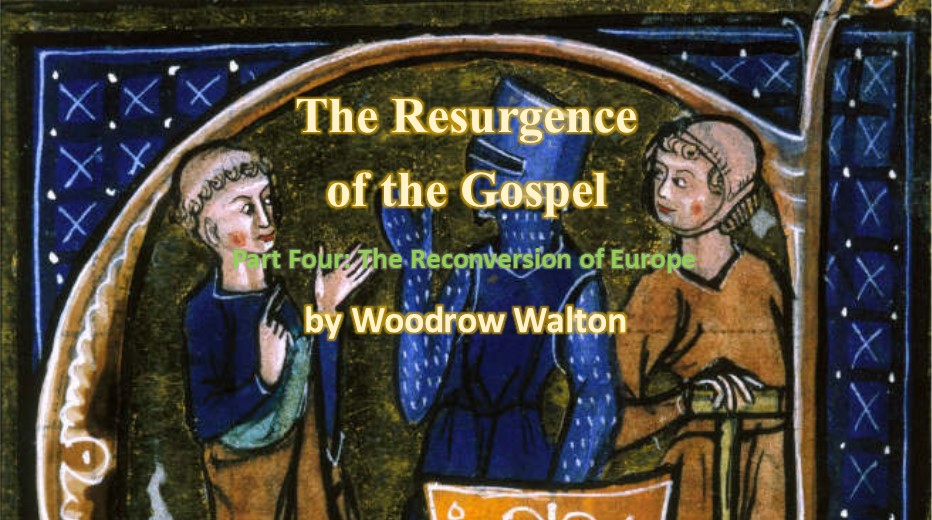
The Resurgence of the Gospel, Part Four: The Reconversion of Europe


The Resurgence of the Gospel and the Flowering of the Global Christian Message
Part Four: The Reconversion of Europe
How did monasteries, hospitality, and persecution lead to the spread of the Gospel of Jesus Christ? Part of The Gospel in History series.
The Re-conversion of Europe
At this juncture, I turn my attention back to Egypt and the heritage of the Coptic Church. Coptic Christianity began in Egypt and spread South into the Sudan and into Ethiopia. Through the influence of its institutions, it affected the Christian missions to Ireland and Scotland, of all places, and ultimately, the reconversion of Europe under Irish, Scottish, and British monastics, transforming European Christian life.
John Cassian has already been spoken of [Editor’s note: see also “The Resurgence of the Gospel, Part Two: Recharting the Christian World Mission” and “Spreading from the Frontiers: Another Look at the Gospel in the Medieval Church”] as having visited the monasteries which Pachomius had initiated in the desert lands of Egypt. These monasteries transformed new Christians into missionaries, missionaries who were not only knowledgeable in the Christian Scriptures but were also able artisans and craftsmen who knew how to relate to the common man. Cassian took what he saw and introduced the same concept into Western Europe and even Wales and Ireland. One man who was strongly influenced by Egyptian monasticism was the person we know today as St. Patrick.

Image: Wikimedia Commons
Born in Wales, Patrick was captured by Irish pirates at the age of 16 and enslaved to look after the sheep of his captors. According to his Confessions, he remained in Eire (Ireland) for six years before making his escape and returning to the southern coast of Britain. Soon after returning home, he continued his education at a monastery and entered the monastic life. At some point in his life, as recorded in his Confessions, he traveled to Rome where he gained commission as a missionary to Ireland. He elected to make northern Ireland his field of work. For more than thirty years, he traveled throughout northern Ireland. He also established a Pachomian style of monasticism which encouraged literary education, the arts, the crafts, and intense biblical study. As he had walked the breadth of Ireland with the gospel, he encouraged his students to go by foot as they ministered the Word of God.
Christian historians have referred to this band of foot soldiers for Christ, the perigrini [“pilgrims”], and for the next decades these Irish perigrini traveled the footpaths of Ireland and northern and central and Europe and as far south as southern Italy and into Scotland. The central monastic center was Armagh in northern Ireland.
The first mission outside of Ireland was Britain, northern England and Scotland. When Patrick and his students set foot in England, the Catholic missionaries and clergy already present criticized Patrick as invading their legitimate claim to the land. Patrick vigorously responded by writing and producing his now-famous Confessions, which validated the right to mission work within England. In addition, he wrote a scorching letter to Coroticus, the English King, for enslaving Irish Christians in a raid, threatening to initiate excommunication of the king for violating Church canons against enslavement. The two documents, written in Ireland, have been preserved through the centuries and reveal a very courageous personage.
In recent years, Thomas Cahill wrote a book entitled How the Irish Saved Civilization (Doubleday, 1995), reminding many non-historians of the key role monasteries played in preserving Western culture and Christian history. When the Ostrogoths made an effective end to the Western Roman Empire in the West by taking possession of the city of Rome in the middle of the 400’s, the Church and Lactantius funneled records out of the city toward Britain and Ireland. In the Irish monasteries, those records were preserved. The literary education that Patrick encouraged at Armagh paid off for the history of the Church in the West.
The Irish monasteries reproduced themselves in the monasteries founded first at Iona, on the west coast of Scotland, by Patrick’s successor Columba (ad 521-597), and then at Lindisfarne, on the east coast. The successors of Patrick and Columba, and then of Columbanus (died circa ad 615) were a band of disciplined, mission-minded men who traveled Scotland, upper England, and over the English channel into Gaul, Belgium, the German provinces, and through much of Europe spreading the gospel and establishing centers for Christian renewal. Those in Ireland and Britain also developed a unique set of illuminated Bibles and Gospels, the most famous of which is The Book of Kells.

Besides the distinctive innovations of the Irish perigrini was the retention of the Coptic and Eastern Orthodox celebration of the Resurrection. It was argued that the Resurrection occurred during the Pascha [“Passover”]. Jesus was the Paschal lamb who was slain on a Friday and rose from the dead and on the first day of the week. However, this celebration differed from the Roman Catholic calendar even though it aligned with the Jewish Passover.
In AD 664, at Whitby Abbey in the Northumbrian area of England, a synod was held with the chief spokesman St. Wilfrid of York. There a settlement was reached about the liturgy and administration of the churches within the whole of England. Those from the north represented the Irish and Scottish missions, while those from York and the south represented the missions and church affiliations occasioned by the work of Augustine of Canterbury and others with him in and around ad 550. The discussions on the matter of determining the day of the Paschal celebration of the Resurrection dragged on for a long time before a settlement in favor of the Roman Catholic celebration. Those who favored the Eastern Orthodox-Coptic practice and who were more representative of the Scottish churches withdrew back into Scotland.
The Venerable Bede in his Ecclesiastical History of the English Church and its People, which was finished about ad 734, described the proceedings of the Council while the Anglo-Saxon Chronicle composed closer to the event makes no mention of the Council. Bede died in AD 735. Without Bede, we would know very little of the early years of the Christian faith in Britain, especially the history of the Celtic mission in Ireland, Britain, and its early missions in Europe. His accuracy cannot be questioned as is his painstaking thoroughness is self-evident as he quotes 144 different sources and had other traveling individuals to check Vatican archives for him.
Bede is one of the most influential individuals, not only in the history of Christianity in Europe, but also in biblical interpretation. He wrote commentaries on the first five books of the Old Testament the four Gospel accounts, Acts, and The Revelation. As he lay dying, he completed the translation of the Gospel of John from the Latin into English and can be considered the father of the English Bible.
Bede is important in still another way. Alcuin, Christian adviser to Charlamagne (also known as Charles/Carroll the Great), studied under Bede. On one occasion, he criticized the French ruler on treatment of the Angles and Saxons and compelling the “tribal groups” to accept baptism and become Christians. Charlemagne backed off after being reprimanded. In time, the Angles and Saxons did come to accept the gospel and proved to be strong in their adherence to the gospel.
One other feature of the mission of the Church in Europe was that of establishing Christian communities and houses of worship to foster the sense of community as a people of God. This was done by developing parishes and creating another band of priests referred as “secular” priest as distinct from the “regular” (regula=rule) who were the monastics. The function of the secular was to walk the world with the parishioners and not be separated from them. The houses of worship were referred to “parishes.” Over the passage of years, these men came to be referred to as “pastors” who walked and cared for the sheep.
One other innovation was the stained glass window which frequently pictured Jesus as carrying his sheep. This art form carried a message “Jesus cares for His Own.” Christian nurture became a part of the Christian mission, and developed further over the passage of time.
As for outreach beyond the local and unreached peoples in Europe, the Scandinavians and the Baltic Sea peoples were among the last to respond to the gospel. The Irish and Scots were fearful of the “north men” but through time by contact and trade the Norwegians, Danes, Swedes, and Baltic tribes were exposed to the Christian message. Among the first of the converts was Harald “Bluetooth” Gormsson of Denmark. The “how” of his conversion is not clear. Writers as Widukind of Corvey and Adam of Bremen give conflicting accounts. There is an inscription on runic Jelling stones dated as belonging to the 960’s:
“King Harald bade these memorials to be made for Gorm, his father, and Thyra, his mother. The Harald who won the whole of Denmark and Norway and turned the Danes to Christianity.”

Image: Erik Christensen / Wikimedia Commons
The spread of the Gospel in the Scandinavian countries and the Baltic countries does not fit the picture of evangelistic efforts but does fit within the framework of acculturation as when two or more people groups interact with one another either through living close to each other or mutual contact through trade and business. This pattern was repeated throughout the Scandinavian countries and when the Danes invaded England and set up the settlement known as the Danelaw.
The same holds true when the Northmen of Norway invaded northern France and settled a region thereafter referred to as Normandy. It also occurred with the outcome of the Battle between the Danish King Harold in England and William of Normandy. The outcome of that battle was William of Normandy’s victory and the settling of Nor(th)men in England. The Normans’ co-existence with the French and then with the inhabitants of England had far-reaching effects not only culturally but also with respects to the spread of Christian influences.
Last of all, and the most intriguing of circumstances was the discovery of a parish church building in Greenland, which archaeologists have dated as built prior to 1452. It was well attested that Scandinavians were the settlers of Iceland. But interaction with Greenland in the Western Hemisphere and settlement there, however brief it may have been, was not known. It was a startling discovery.
The Eastern Church
This takes us to the last consideration: the mission of Byzantine Orthodox Christianity. This Christian tradition was distinct in that it encouraged not only the translation of the Bible in the various indigenous languages of the Slavic people groups but also the encouragement of indigenous autonomy. There is no conical hierarchy as exists within the Roman Catholic Church. The Ecumenical Patriarch in Constantinople/Istanbul is honored but is considered as one among equals. The Russian Orthodox Church, the Bulgarian Orthodox Church, the Serbian Orthodox Church, and The Greek Orthodox Church, each are part of a large family of autocephalous [“self headed” or autonomous] Orthodox Churches united only by faith, not by ecclesiastical structure. [Editor’s note: See Pentecostal historian Harold Hunter’s review of the biography of the Ecumenical Patriarch, “Journey with the Orthodox.”]
In ad 862 Prince Rastislav of Greater Moravia (today’s Slovakia and The Czech Republic) made a request that the Patriarch of Constantinople send missionaries into his country to evangelize his Slavic subjects. His motives may have been more political than concern for the people. The letters to Emperor Michael III and Patriarch Photius did state that the people had already rejected paganism and adhere to Christian law. Both Michael III and Patriarch Photius selected a pair of brothers, Cyril and Methodius. In ad 863, with the help of assistants, Cyril and Methodius translated the Bible into Old Church Slavonic and traveled to Great Moravia to begin the process of making it available and to create a Slavic liturgy for worship. German missionaries, representing the Roman Catholic Church in Greater Moravia, opposed the efforts but lost out. Since the Slavic peoples had no alphabet for their spoken language, Cyril and Methodius developed the Glagolithic alphabet to match the specific spoken features of the Slavic language. The alphabet, since known as the Cyrillic, is still used by many languages today including Russian.
The brothers’ accomplishments eventually caught the attention of Pope Adrian II, who formerly authorized the use of the Slavic liturgy. Cyril and Methodius later visited Rome and were warmly received by Pope Nicholas I in 867. Their work in Moravia and elsewhere found support also from the later Pope Adrian II.

Image: Wikimedia Commons
The alphabet they invented caught on elsewhere as in Bulgaria, Pannonia, Macedonia, Slovakia, among the Czechs, and the Russians. Soon after Prince Vladimir’s baptism in ad 987, the new Russian Christian worship adopted the Byzantine rite in the Old Church Slavonic language. This was done primarily to remain independent of the Germans and of Rome. The Patriarch in Constantinople appointed an archbishop for Kiev. This determined the course of Russian Christianity and checked the influence of the Roman Latin church in Slavic Eastern Europe even while there was an exchange of legates between Kiev and Rome.
The relationship of the Orthodox Church to the Russian royalty continued a situation which hindered Orthodoxy from the very first when Constantine issued in ad 317 an edict ending persecution of Christians, the meddling of the rulers in the affairs of the church. It was the opposite of what occurred in Western Europe, where the Papacy could exert influence over the political rulers. From the time of Patriarch John Chrysostom in the latter 300’s, there have been occasions when a Patriarch or other church leader had been sent into exile. It is ironic, however, that even when an archbishop or other church leader was exiled because of a falling out with a ruler, they retained their influence and had tremendous impact upon the life of the realm and the expansion of the church.
Peculiar to the worship of the Orthodox Church is its rendering of Philippians 2:5-11, where the apostle Paul writes of Jesus, “who being in the form of God, did not consider it robbery to be equal with God, but made Himself of no reputation, taking the form of a bondservant, and coming in the likeness of men, and being found in appearance as a man, he humbled Himself… .” This is referred to as the kenosis verse, the verse that speaks of complete humility with no resemblance of pride. This emphasis of Orthodox Christianity is its focus in caring for the sick, the prisoner, the slave, the dying, the homeless.
This practical outgrowth of Christian hospitality is worth mentioning because this aspect of the early church accounted for the spread of the gospel both East and West. It even merited the attention of Julian the Apostate, who was emperor between 366-363. Although he hated the Christians, he complained in an official letter about how the general public of his time cared not for the elderly, neglected the poor and dying, and exposed unwanted children yet these Christians cared for the ill, rescued children, provided medicine, buried the dead, and established homes for orphans and the lame. Julian died two years after his attempt to restore the ancient pantheon of gods. He died in a battle from a wound inflicted by an arrow. The historian Sozome, in his Ecclesiastical History of the Church from A.D. 324 said that, according, to a centurion close to Julian, heard Julian cry out: “O pale Galilean, thou hast conquered.”
Even earlier, close to AD 250, in a letter composed to a Diognetus by some unknown Christian, were some very interesting lines, to wit: “Any country can be their homeland, but for them their homeland, wherever it may be, is a foreign country. Like others, they marry and have children, but they do not expose them. They share their meals, but not their wives.”
It continued, “They live in the flesh, but they are not governed by the desires of the flesh. They pass their days upon earth, but they are citizens of heaven. Obedient to the laws, yet they live on a level which transcends the law.”
 The letter to Diognetus consists of five paragraphs of varying length describing the life of the Christians in the world. The unknown author gives an accurate picture of Christians in both Western and Eastern Europe, Northern Africa and Asia. The Christian Church, wherever it was found, and whether Catholic, Orthodox, Coptic, or Syriac, was mother of all our modern eleemosynary institutions be they hospitals, rehab centers, homes for children, the disabled, rescue missions. A person interested in this area of influence would well to read Amanda Porterfield’s Healing in the History of Christianity (Oxford University Press, 2009) [Editor’s note: see the review by Roscoe Barnes III].
The hostels for travelers along the difficult roads of the Roman empire and the dangerous silk roads of Asia were built by the monasteries. The monasteries have often been given bad press by popular writers. However, some of these monasteries expanded to become universities and produced some of the greatest minds, who by their influence and writings, fathered advances in science, mechanics, technology, education.
What the persecutions East and West accomplished was the scattering of Christians, turning them into global missionaries, many of whom preserved the cultures they were called to. Early North African Christian Tertullian, living in the third century made a statement that the blood of the martyrs were the seeds of the church. Re-read through the eyes of a dying Julian on the western plains of Parthian Persia, “O pale Galilean, you have conquered!,” it certainly seemed that way, but it was not all that way. No matter how small the numbers it was the perseverance and the entrenchment of the Christians that made the church into a global phenomenon. In the same century of the third crusade of the 12th century, Christian reform began taking place within Italy and elsewhere in Europe. It was to increase in the thirteen and fourteenth century and explode in the sixteenth. But what was happening in the 12th and 13th centuries had great impact on the gathering “winds” of the late 15th century oceanic enterprise.
Close to the end of the Third Crusade, in ad 1170, Peter Waldo (1140-1217), sold his possessions and devoted the rest of his life preaching the gospel to his fellow Provencal-speaking Italians. To help the non-clergy among them understand the New Testament, he translated it into Provencal. His ministry expanded throughout the western mountain country of Italy, northward toward France and far northeastern Spain. In 1184, Pope Lucius III declared them heretics solely because lay people, including women, were allowed to preach.
The result of the ban was the rapid expansion of the Waldensian movement from strength to strength into the 13th, 14th, 15th, 16th Centuries. The movement would later give impetus to Jan Hus in Prague, southern Germany, and Austria, and finally John Calvin in Switzerland. The Waldensians inspired Luther and the entire Reformation of the 16th century.

Image: Peter Trimming / Wikimedia Commons
By the 14th Century, the winds of reform grew stronger within the Roman Catholic Church. One of its number, John Wycliffe (born in the mid-1320’s, died 1384), teaching at Balliol College, Oxford, England, decided to translate the Bible into the English language. He also discouraged the Corbian interpretation of the Holy Eucharist (The Lord’s Supper), and wanted the church to allow wide participation of the laity (the people) with all authority derived from the Scriptures. This did not sit well with Rome. But already the winds of reform billowed in intensity. Three men, members of the King’s Court, Sir William Neville, Sir John Montague and Sir William Beachamp, along with the help of John of Gaunt, supported Wycliffe and with them the Lollard Movement came into being.
Some historians have not given Wycliffe, the Lollards, or Balliol College the credit due to them for all that followed. Wycliffe has been referred to as “the Morning Star of the Protestant” Reformation but considered to be of more importance for England and the events that would lead to William Tyndale’s translation of the Scriptures into English and the adoption of Tyndale’s midland England’s English within the English translation authorized by King James and assigned to Lancelot Andrewes and his committee of scholars to complete.

Image: Wikimedia Commons
What is not often mentioned is that Balliol College was not a school just for English students. It had a wide reputation across Europe and had students from as far east as Prague in Bohemia (Czechoslovakia). It was a Bohemian student who brought the news of Wycliffe’s work to the ears of Jan Hus, a Roman Catholic preacher in Prague who then picked up within Eastern Europe where Wycliffe left off. In his turn, Hus took issue with the existing Catholic order and gained the ire of the papacy in Rome.
The spark took fire and spread to Florence, Italy. Another prominent Catholic leader took issue with the existing Catholic order. Girolamo Savonarola was also a Dominican friar and a prominent preacher in the city who not only took issue with his Church but also with the Florentine civic leaders as well.
The storm clouds of change was in the air. Hus, in his turn, and John Tauler, the late Medieval Mystic of the via moderna persuasion, influenced an Augustinian educator named Martin Luther in Wittenberg, Saxony, to take issue.
Then a Dutchman, also a Catholic, wrote his famous, In Praise of Folly, and started afresh in translating the Greek New Testament for everyone to read. It has been said that Erasmus “laid the egg” that Luther hatched.

Image: Wikimedia Commons
What resulted with the Turkish takeover of Constantinople and renaming it Istanbul was to cut off all access to the Red Sea and the Silk Roads to the East. This cut off all commerce with the East by way of waterway and by road. In doing so, it created the circumstances for an experimental plan that was initiated by the Portuguese prior to 1452, and imitated later by Spain and the Netherlands.
Already the Portuguese developed a type of ship with a deeper and wider draft which enabled her fishermen to harvest the waters of the northern Atlantic for cod and other fish. Also in the works was the voyage of a Portuguese shipmaster named Vasco da Gama. Sailing with him down the west coast of Africa was a Portuguese Catholic monastic. Da Gama rounded the Cape of Good Hope and noted the sun shone on his right arm instead of his left. Sailing northeast-ward he tended toward the open area of the Arabian Sea and made landfall at Goa on the northwest coast of India. Here, he noticed with complete astonishment a remnant of Syriac speaking Christians claiming their existence to Mar Thomas who followed Jesus.
The ripple effect of da Gama’s voyage not only re-ordered Europe’s economic and political order but transformed the mission of the church along oceanic lines. Da Gama’s return voyage to Portugal created a stir throughout Europe from Genoa and Venice in the eastern Mediterranean to up and down English Channel. Borrowing Portugal shipwrights, England, the Netherlands, France, Spain, and other coastal nations fashioned a new type of ship that could handle deepwater sailing.
PR
Coming in the Summer 2019 issue:
Woodrow Walton ties together what the challenge of the Turkic-Moslem curtain meant and how it affected the people of Europe and the global mission of Christianity.