
A Pentecostal Season: The Methodists in England and America, Part 1
In this excerpt from his book, The Supernatural Thread in Methodism: Signs and Wonders Among Methodists Then and Now, Methodist historian and renewalist Frank Billman reveals how miracles and supernatural interventions were widespread in the ministries of John Wesley and the early Methodists.
Author’s Introduction to this Excerpt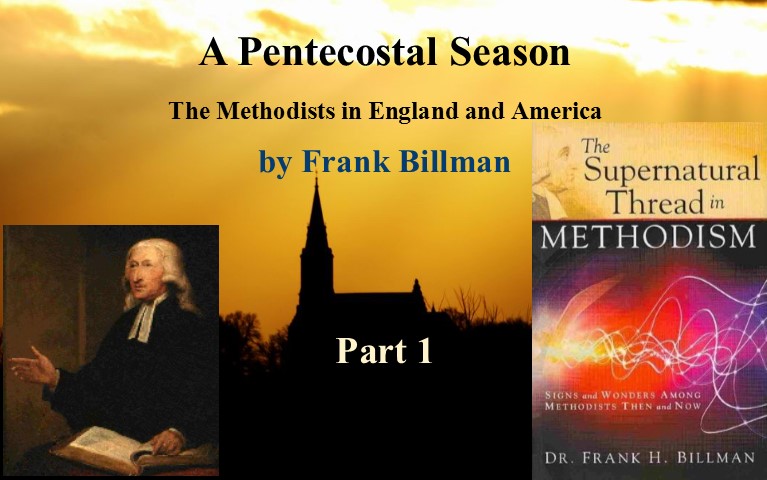
Miraculous healing, falling down under the power, tongues …
Is this Methodist?
For some, this is a more important question than “Is it Biblical?” or “Has it happened before in church history?”

Randy Clark reports that when several Southern Baptist seminary professors of evangelism were asked by phone, “What was the greatest revival in Baptist history?” The response was unanimously, “The Shantung Revival in China.” Healing, falling, electricity, laughing in the spirit, even the raising of the dead is recorded in The Shantung Revival, a book by Mary Crawford, one of the Southern Baptist missionaries who experienced this revival first-hand in the early 1930’s. In the book are accounts of almost everything that has been characteristic of the Toronto Revival and the Pensacola Outpouring. Unfortunately, most Southern Baptists are not aware of what happened during their greatest revival. Several years ago, the book was reprinted with almost all of the phenomena of the Holy Spirit edited out.[1]
Southern Baptists have “sanitized” their history at this point. They have removed historical accounts that are not consistent with their current theology and practices. Some Presbyterians did the same thing when it came to recording the history of the Cambuslang revival. And some Methodists have done the same “sanitizing” of our history in removing many accounts of the supernatural power and manifestations of the Holy Spirit moving among the Methodists.
So, what about the ministries of Wesley, Whitefield and Asbury? Is this stuff Methodist?
—George Whitfield at Aldersgate
Wesley wrote on April 17, 1739, “We called upon God to confirm his word. Immediately one that stood by (to our no small surprise) cried out aloud, with the utmost vehemence, even as in the agonies of death. But we continued in prayer, till a new song was put in her mouth. … Soon after two other persons, … were seized with strong pain, and constrained to roar for the disquietness of their heart.”[4]
—from John Wesley’s Journal
Four days later he wrote, “April 30, 1739—We understood that many were offended at the cries of those on whom the power of God came: Among whom was a physician, who was much afraid there might be fraud or imposture in the case. Today one whom he had known for many years was the first … who broke out ‘into strong cries and tears.’ He could hardly believe his own eyes and ears … But when both her soul and body were healed in a moment, he acknowledged the finger of God.”[6]
And a day later, “May 1, 1739—Many were offended again, and, indeed much more than before. For at Baldwin Street my voice could scarce be heard amidst the groaning of some, and the cries of others, calling aloud to Him that is ‘mighty to save’. … A Quaker, who stood by, was not a little displeased at the dissimulation of these creatures and was biting his lips and knitting his brows, when he dropped down as thunderstruck. The agony he was in was even terrible to behold. We besought God not to lay folly to his charge. And he soon lifted up his head and cried aloud, ‘Now I know thou art a prophet of the Lord!’”[7]
Manifestations of the presence and power of God continued in Wesley’s ministry. He wrote, “July 19, 1757—Toward the conclusion of my sermon, the person with whom I lodged was much offended at one who sunk down and cried aloud for mercy. Herself dropped down next and cried as loud as her, so did several others quickly after.”[8]
In a letter to Wesley from Limerick in 1762 reporting on the work of God there: “Many more were brought to the birth. All were in floods of tears, they cried, they prayed, they roared aloud, all of them lying on the ground.”[12]
—from John Wesley’s Journal

On May 9, 1740 Wesley reported an incident that happened 10 or 11 years before where John and Charles Wesley took a walk in a meadow intending to sing psalms in praise to God. Just as they started to sing Charles burst out into loud laughter. Before long, John too was laughing uncontrollably.[14] In his Second Letter to Bishop Lavington, Wesley noted the bishop commenting on this event from his Journal, saying “Though I am not convinced that these fits of laughing are to be ascribed to Satan, yet I entirely agree, that they are involuntary and unavoidable.” Wesley responded that he entirely agreed with that statement but added: “But I must still go farther: I cannot but ascribe them to a preternatural agent; having observed so many circumstances attending them which cannot be accounted for by any natural causes.”[15]
It is important to understand that these experiences are not isolated incidents in Wesley’s ministry. They are illustrative of experiences with the supernatural manifestation of the power of God that were frequent throughout his ministry. Readers of Wesley will note less reporting of these later in his ministry, but it is possible that by then they were not unusual enough to report.
Wesley was clearly not a Reformed cessationist. He wrote: “I do not recollect any Scripture wherein we are taught that miracles were to be confined within the limits either of the apostolic age … or any period of time, longer or shorter, even till the restitution of all things.”[16]
In his Journal he wrote, “The grand reason why the miraculous gifts were so soon withdrawn, was not only that faith and holiness were well nigh lost; but that dry, formal, orthodox men began even then to ridicule whatever gifts they had not themselves, and to decry them all as either madness or imposture.”[17]
In a sermon he wrote: “It does not appear that these extraordinary gifts of the Holy Ghost were common in the Church for more than two or three centuries … The real cause was, ‘the love of many’, almost of all Christians, so called, was ‘waxed cold.’ The Christians had no more of the Spirit of Christ than the other heathens … This was the real cause why the extraordinary gifts of the Holy Ghost were no longer to be found in the Christian Church; because the Christians were turned heathens again, and had only a dead form left.”[18]
the new strange language of Thy love.
—Charles Wesley in “A Hymn For Pentecost”
John’s brother, Charles Wesley, wrote A Hymn For Pentecost that is not in our United Methodist hymnal. In the 5th verse he wrote: Now let us speak with other tongues/ the new strange language of Thy love.
Thomas Walsh, a friend and colleague of Wesley wrote in his journal February 24, 1751, “The influence of His Spirit wrought so powerfully upon me, that my joy was beyond expression.” In his journal on March 8, 1751 he writes, “This morning the Lord gave me a language I knew not of, raising my soul to Him in a wonderful manner.”[21]
In his writings, Wesley testified to a belief in demons and spiritual warfare. He believed in and experienced miraculous healings. He believed in the gift of prophecy, visions and dreams. He testified to the ministry of angels.

In his sermon “On Divine Providence” (written in 1784), Wesley writes “Admitting then that, in the common course of nature, God does act by general laws, he has never precluded himself from making exceptions to them, whensoever he pleases; either by suspending that law in favour of those that love him. Or by employing his mighty angels: By either of which means he can deliver out of all danger them that trust in him. ‘What! You expect miracles then?’ Certainly I do, if I believe the Bible: For the Bible teaches me, that God hears and answers prayer: But every answer to prayer is, properly, a miracle.”[22]
As late as 1856, British Methodist preacher, William Arthur, published his book The Tongue of Fire, which remained in print for more than a century, and in that book he dismissed the traditional view of the cessation and withdrawal of spiritual gifts by saying: “Whatever is necessary to the holiness of the individual, to the spiritual life and minister gifts of the church, or to the conversion of the world, is as much the heritage of the people of God in the latest days as in the first…We feel satisfied that he who does expect the gift of healing and the gif of tongues or any other miraculous manifestations of the Holy Spirit…has ten times more scriptural ground on which to base his expectation than have they for their unbelief who do not expect supernatural sanctifying strength for the believer.”[23]
Discerning “Enthusiasm”
Resting in the Spirit, swooning, falling down as if dead, and other such physical manifestations were some of the reasons that the Methodists were given the derogatory term “enthusiasts.” When a Church of England clergyman in Maryland railed against the Methodists and “enthusiasm” a woman in the congregation cried out, Glory to God! If what I now feel be enthusiasm, let me always be an enthusiast![24]
John Cennick, one of Wesley’s early associates claimed that “frequently when none were agitated in the meetings, Wesley prayed, ‘Lord! Where are thy tokens and signs?’ And I don’t remember ever to have seen it otherwise that on his so praying several were seized and screamed out.”[25]
–a woman touched by revival in Maryland
Wesley was not willing to label all manifestations as being completely of God. He said that sometimes they were, sometimes it was a mixture of God and the person and sometimes it might be the devil. He said, “Perhaps the danger is, to regard [the manifestations] too little, to condemn them altogether; to imagine they had nothing of God in them, and were an hindrance to his work … this should not make us either deny or undervalue the real work of the Spirit. The shadow is no disparagement of the substance, nor the counterfeit of the real diamond”.[27]
More than once Wesley asked God to forgive him and his associates for “blaspheming his work among us, imputing it either to nature, to the force of imagination and animal spirits, or even to the delusion of the devil.”[28]
Within particular seasons throughout John Wesley’s entire life, he saw people weeping, violently shaking, crying out, losing consciousness, falling down, and occasionally becoming uncontrollably agitated during his meetings. In response to one who was concerned about the “strange work” that occurred in his meetings, Wesley testifies: “I have seen (as far as a thing of this kind can be seen) very many persons changed in a moment from the spirit of fear, horror, despair, to the spirit of love, joy, and peace; and from sinful desire, till then reigning over them, to a pure desire of doing the will of God. These are matters of fact, whereof I have been, and almost am, an eye or ear witness.”
Wesley continues: “I will show you him that was a lion till then, and is now a lamb; him that was a drunkard, and is now exemplarily sober; the whoremonger that was, who now abhors the very garment spotted by the flesh.” Wesley judged by the “whole tenor” of their lives and called these people his “living arguments.”
He then offers the following remarkable explanation for the outward signs: “Perhaps it might be because of the hardness of our hearts, unready to receive any thing unless we see it with our eyes and hear it with our ears, that God, in tender condescension to our weakness, suffered so many outward signs of the very time when he wrought this inward change to be continually seen and heard among us.”[29]
Later, Whitfield came to confront Wesley about this in person. The day after Whitefield spoke to Wesley about this, while Whitefield was preaching, here is what Wesley records happening in his Journal for July 7, 1739: “The next day he had an opportunity of informing himself better: For no sooner had he begun (in the application of his sermon) to invite all sinners to believe in Christ, than four persons sunk down close to him, almost in the same moment. One of them lay without either sense or motion. A second trembled exceedingly. The third had strong convulsions all over his body, but made no noise, unless by groans, The fourth, equally convulsed, called upon God, with strong cries and tears. From this time, I trust, we shall all suffer God to carry on His own work in the way that pleaseth him”[31] [That is good advice to all of us!]
Wesley was sensitive to the danger of criticizing someone else’s spiritual experience. We read in 2 Samuel 6 that David danced himself out of his clothes while bringing the Ark of the Covenant from the house of Obed Edom to Jerusalem and that his wife, Michal, criticized his behavior. We read that she became barren because of this criticism. One of the ways that we become spiritually barren is by criticizing the spiritual experience of another person.
John Crowder writes: “John tells us to “prove the spirits whether they be of God” (1 Jn. 4:1). He never tells us to test the outward manifestations, but the spirits themselves. … Discernment is not a paranoid hunt for devils in the middle of every manifestation….Instead, John’s admonition was positive and optimistic; he wanted us to constantly be looking for God in every situation, testing spirits to see if they are bringing something of value from Him. … The problem is that paranoia has long masqueraded as the gift of discernment of spirits. Here is another way of explaining it: Instead of trying the spirits “whether they be of God,” we have tried the spirits whether they be of the devil.”[32]
Crowder goes on to say: “We need an extreme tolerance for manifestations. Think of how patient the apostle Paul was with this stuff! When Paul visited Macedonia in Acts 16, a slave girl possessed by a spirit of divination followed him for “Many days” … Paul allowed this girl to rattle off for many days before getting “greatly annoyed” and casting out her devils. … Paul afforded great leniency with manifestations. Give God room to work, and don’t stress out about devils around every corner.”[33]
The need for “watchmen on the wall” is often raised in charismatic circles. There is certainly a need for watchmen and watchwomen! But Crowder clarifies their purpose: “The most important thing is to recognize when the Lord is truly moving, so we do not miss out on His fullness. The watchmen on the wall had a two-fold responsibility in Old Testament times. They sounded an alarm when they saw the enemy approaching. But this was not their primary task. The greater responsibility was to watch for the king coming, so the gates could be opened and the inner chambers prepared for him.”[34]
A king would come to one of his cities far more frequently than an enemy. The watchman would be watching more frequently for the coming of the king. Thus, when David writes in Psalm 24:7 “Lift up your heads, O you gates; be lifted up, you ancient doors, that the King of glory may come in,” it would have been the watchman who would have cried out this command to open the gates for the coming of the king. And even here, the watchman saw the arrival of the King of glory, not an enemy.
In another place, Crowder asks a poignant question: “Unlike those early disciples, much of the church is so afraid of the demonic, that we won’t open up to new ways of spiritual expression with which we are unfamiliar. … Is your fear of the demonic greater than your hunger for God?”[35]
[Author’s note: When I took my Methodist history course at one of our United Methodist seminaries, from a prominent Methodist historian, who wrote the textbook on Methodist history that we used in the course, why did I not learn anything about the supernatural manifestations of the power of God that took place in Wesley’s ministry and the ministry of many other early American Methodists? The answer is “bias by the historian.” If the historian does not believe in the supernatural, or believes that Wesley and the early Methodists were just ignorant products of their time, believing unscientific and superstitious ideas of their day, then these “facts” would not be included in their histories.]
Ann Taves goes on to write: “Methodist historian, Stephen Gunter indicates that “for two centuries students of the Methodist revival have tended to ‘play down’ Wesley’s emphasis on…miraculous intervention.” The fact is, Gunter writes, that “[Wesley] searched incessantly for testimonies of conversion experiences which would substantiate the validity of his claim that human experience was a form of proof for divine activity.” According to Gunter, “Even Charles, who was more resistant to this emphasis than John, requested the converts to provide written accounts of their conversion experiences. Scores of letters by converts were sent to Charles fulfilling this request, many of which have been preserved. A reading of these accounts will destroy the myth that this emphasis was short-lived.” The tendency to minimize the supernatural aspects of these accounts, as Gunter suggests, “can probably best be accounted for by recognizing a personal aversion to such phenomena on the part of scholars themselves.”[38]
John Wigger, in his book Taking Heaven By Storm: Methodism and the Rise of Popular Christianity in America wrote: “In fact, it may not be an exaggeration to say that this quest for the supernatural in everyday life … was the key theological characteristic of early American Methodism,” (p.110) and he goes on to say: “While early American Methodism cannot be reduced to enthusiasm, neither can it be understood without it. …visions, dreams, and supernatural impressions not only held deep religious meaning but also served to validate the Methodist system. This kind of militant supernaturalism formed an integral part of the Methodist message in every region of the post-revolutionary United States.”[39]
Part 2 continues in the Fall 2018 issue:
George Whitefield; Francis Asbury; Thomas Rankin; Manifestations among the Evangelicals and United Brethren; Methodist Local Pastors and Lay Preachers; and Methodists and Healing
This excerpt from The Supernatural Thread in Methodism: Signs and Wonders Among Methodists Then and Now (Creation House, 2013) is used with permission.
Notes
[Editor’s Note: Please see The Supernatural Thread in Methodism for complete footnotes. Dr. Billman has also graciously provided a Bibliography covering all citations in this excerpt.]
[1] Randy Clark, There Is More!: The Secret to Experiencing God’s Power to Change Your Life (Mechanicsburg, PA: Global Awakening, 2006), 85. Global Awakening has reprinted the original Mary Crawford book.
[5]Ibid., 188.
[6] Ibid., 189.
[7] Ibid., 189-90.
[9] Ibid., 499
[10] Ibid.
[11] Ibid., 506-507.
[16] Wesley, Works, VIII, Principles of a Methodist Farther Explained, 465.
[18] Wesley, Works, VII, Sermon 89: The More Excellent Way,. 26-27.
[19] Laurence Wood, The Meaning of Pentecost in Early Methodism, (Lanham, MD: Scarecrow Press, 2002), 195.
[20] Wesley, Works, X, Letter to the Rev. Dr. Middleton, 56.
[21] Quoted in, Eddie Hyatt, 2000 Years, 104.
[22] Wesley, Works, VI, p.322.
[23] Quoted in Vinson Synan, The Century of the Holy Spirit, (Nashville: Thomas Nelson. 2001), 25-26.
[24] John Wigger, Taking Heaven by Storm, (Urbana, IL: University of Illinois Press, 1998), 185.
[25] John Cennick, “An Account of the Most Remarkable Occurrences in the Awakenings at Bristol and Kingswood,” The Moravian Messenger, Vol. 16; cited in Arnold A. Dallimore, George Whitefield, Vol. 1, (London: The Banner of Truth Trust, 1970), 326.
[29] Ibid., 195-196.
[30] Quoted in Arnold Lunn, John Wesley, (New York: The Dial Press, 1929), 138.
[33] Ibid., 165.
[34] Ibid., 267.