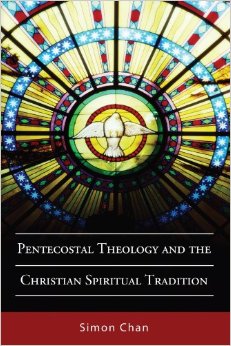
Simon Chan, Pentecostal Theology and the Christian Spiritual Tradition

 Simon Chan, Pentecostal Theology and the Christian Spiritual Tradition (Sheffield, UK: Sheffield Academic, 2000, reprint 2003), paperback, 129 pages.
Simon Chan dares to offer an answer to a question many contemporary Pentecostals are only recently even daring to ask. How do we pass on Pentecostalism’s distinctive beliefs and experiences to subsequent generations? For apocalyptic and eschatological restorationist movements, that is not always an obvious issue. But I’m a third generation Pentecostal. My children are, and, hopefully, my grandchildren will be, fourth and fifth generation Pentecostals, respectively. Today we need to know how to pass on the faith properly. Chan is professor of systematic theology at Trinity Theological College in Singapore. In an earlier work, Spiritual Theology: A Systematic Study of the Christian Life (InterVarsity, 1998), he established a reputation as a Pentecostal analyst and sympathizer of the classic Christian spiritual tradition. In Pentecostal Theology and the Christian Spiritual Tradition he recommends a Pentecostal appreciation, and appropriation, of the rich history and experience of that tradition as a means of defending and extending the Pentecostal tradition. Scholars and students interested in the present cause and future course of Pentecostalism will wish to give his suggestion serious attention through this small but significant book.
Chan seems to have a dual purpose in writing this book. Generally, as already stated, he wishes to establish a method for Pentecostal “traditioning”. Specifically, he uses glossolalia, Spirit baptism, and ecclesiology as a kind of case study for his methodology, thus making it a means for advanced discussion of these timely topics. Consequently, readers receive both introduction into a sophisticated approach to defending and extending Pentecostal faith and values and inducement into constructive consideration of some “hot topics” among today’s Pentecostal believers and practitioners.
In the Introduction, Chan says the book “seeks to interpret the Pentecostal reality in the light of the Christian spiritual tradition, and in so doing, address the problem of Pentecostal traditioning.” Chan thinks Pentecostalism can best explain and retain the integrity of its distinctive uniqueness by “forging links with other Christian bodies”, in particular, with the classic Christian spiritual tradition. He is concerned that classical Pentecostalism as a movement is experiencing “spiritual fatigue” and that “signs of panic” among its leadership are becoming apparent. One of the major causes of this predicament is a failure of properly passing on the energy and vitality of the tradition of the early Pentecostal movement to its heirs a hundred years hence. The solution: Pentecostal traditioning. The source: the classic Christian spiritual tradition, an established tradition with which Pentecostalism shares much in common. The subjects: speaking in tongues and Spirit baptism, identifying experiences for Pentecostalism, and the Church, its weak link within the broader Christian family of faith.
Chapter 1, “The Traditioning Process,” looks at the nature of traditioning, problems of Pentecostal traditioning, need for systematization, and finally, the place for the Christian spiritual tradition. Chan expresses both hope and concern regarding the future of Pentecostalism and its tradition. Chapter 2, “Glossolalia as ‘Initial Evidence,’” defends and develops the doctrine of initial evidence in creative fashion. It primarily addresses a biblical perspective of Spirit baptism, a theological perspective of Spirit baptism, and a cultural-linguistic perspective of Spirit baptism as its accents Spirit baptism as spirituality and theological perspective. Chapter 3, “Pentecostal Asceticism,” brings insights and experiences from the traditional Three Ways (purgation, illumination, union) as repeatable patterns of spiritual growth and progress helpful in explicating Spirit baptism. Here Chan talks about ascetical tongues and offers a profile of a Pentecostal ascetic. He also discusses the doctrine of subsequence in this context. Chapter 4, “Pentecostal Ecclesiology,” wrestles with the prior existence of the Church with implications for its identity as a dynamic catholic, healing, and truth-traditioning community. It also explores eschatology and ecclesiology, and suggests explicating Pentecostal reality and everyday life under a rubric of playful worship. The book has an extensive bibliography and scripture reference and author indexes but no subject reference.
Pentecostal Theology and the Christian Spiritual Tradition is a scholarly but straightforward read. Its logical flow and development are succinct but not simple. It can be challenging at times but is consistently stimulating. A great strength of the book is its defense of traditional Pentecostal emphases simultaneous with their development through conversation with the Christian spiritual tradition. Its treatment of speaking in tongues and Spirit baptism affirms the general direction of classical Pentecostal theology and spirituality but attempts greater depth. Thus, it embraces the value of the categories of the subsequence of Spirit baptism and evidential tongues but argues for a repeatable pattern of spiritual growth and charismatic giftedness more directly connected to contemplative prayer and transformative experience. Accordingly, “traditional” Pentecostal ideas and experiences are not diminished but rather deeply developed in dynamic directions. A most fascinating example is Chan’s comparison of the historical origin and development of the doctrine of the Trinity in the Early Church with the historical origin and development of the doctrine of initial evidence in the Pentecostal movement. The comparison suggests enormous potential for contemporary mining.
Here is a gifted theological writer working hard to be faithful to the fundamental constructs of his particular tradition, Pentecostalism, while rigorously interpreting it in the context of a larger Christian spiritual tradition. Usually the outcomes are interesting and illuminating to say the least, and, more often than not, immensely exciting. However, at times one is hard pressed to discern which controls which. This ambiguity is probably most evident in his discussion of ecclesiology. Protestants may be surprised at lavish praise heaped upon Roman Catholic and Eastern Orthodox understandings of the Church. Pentecostals will surely struggle with a “Mother Church” hierarchical ecclesiological model. Prismatic observation of Spirit baptism and spiritual gifts through the sacraments may certainly sound novel to many. Yet usually Chan is able to steer clearly through such waters. Nevertheless, important questions call for careful address. At what point does interpreting become re-interpreting? When does recovery become reconstruction? However, in a day when some conscientious and committed Pentecostals are feeling forced to “abandon ship,” so to speak, on controversial topics in the Pentecostal tradition, while other equally conscientious and committed Pentecostals are having “knee jerk” reactions to what they see as a compromising trend, this honest and intense effort simultaneously to defend and extend Pentecostalism is surely something of a welcome relief. The key is to sustain the simultaneity.
Reviewed by Tony Richie
Preview this book online at: books.google.com/books?id=3aLWJALlUAkC