
Edward Irving’s Incarnational Christology, Part 2

Edward Irving’s Incarnational Christology: A Theological Examination of Irving’s Notion of Christ’s Sinful Flesh as it relates to the Fullness of the Incarnation
Edward Irving’s Incarnational Christology, Part 1
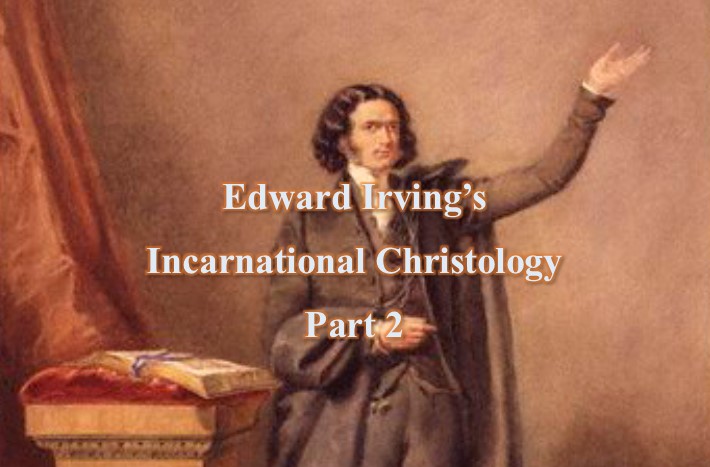 This is the second of a three-part series by Trevor Martindale. He gives us an in-depth look at how Edward Irving, one of the 19th Century’s most important church leaders, understood the meaning of God coming in the flesh. What does that controversy have to teach us today?
Part Two: The Crux of Irving’s Christology
This chapter will expose the fundamental concept underlying Irving’s Christology. Our treatment should not be understood to be exhaustive of his Christology on the whole. However, special consideration will later be given to the relationship between the Incarnation and the Atonement within our task.
2.1. Orthodox Doctrine at Stake – Irving’s Christ as Sinner?
Before one can examine Irving’s views in any depth, it is necessary to first make note of the key theological presuppositions that surrounded the historical controversy between the years of 1827 and 1833. Irving’s encounter with Henry Cole provides a well-summarised glimpse into the theological issues that influenced the parameters of the controversy. The importance of this encounter should not be overlooked, as most who have written on this topic have inserted the encounter in their examination of the controversy. Yet very few have analysed the details of the theological presuppositions present within the conversation. We find this as sufficient reason for examining the theological issues pertinent to their confrontation, as follows:
My address and questions, and your answers, were as follows: ‘I believe, Sir, a considerable part of the conclusion of your discourse this evening has been upon the Person and Work of Jesus Christ.’ You answered in the affirmative. – I added, ‘If I mistake not, you asserted that the human body of Christ was sinful substance.’ You replied, ‘Yes I did.’ – I continued, ‘But is that your real and considerate belief?’ You answered, ‘Yes it is, as far as I have considered the subject.’ And here you produced a book, which I believe was some national confession of faith, to confirm your faith and assertions: in which you pointed out to me these words, (if I mistake not,) ‘The flesh of Jesus Christ, which was by nature mortal and corruptible.’ – Upon which I continued with amazement, ‘But do you really maintain, Sir, that the human body of Jesus Christ was sinful, mortal and corruptible?’ You replied, ‘Yes, certainly. Christ (you continued) did no sin: but his human nature was sinful and corrupt; and his striving against these corruptions was the main part of his conflict.[2]
It is evident that issues contained within Irving’s assertion regarded the questions of whether his body was mortal and corruptible. Before Cole had heard about Irving, he had authored a tract positing a theory that the incarnate body of Christ was inherently immortal, incorruptible and without any taint of sin.[3] The foundation for his belief was the presupposition that sin was totally absent from Christ’s body because “where there is sin, there must inevitably and unalterably be mortality: and where there is mortality, there must inevitably and unalterably be sin.”[4] The notion of Christ’s mortality was inconceivable for Cole as this could only be due to the defilement and pollution of sin within his body, which would in turn make him a sinner.
While Irving unashamedly acknowledged his belief that Christ’s flesh was mortal and corruptible, closer inspection of Irving’s writings shows that he also defended the sinless perfection of Christ’s humanity: “There was united in Jesus Christ, the Godhead, in the person of the son, and in the manhood, in its fallen state; that they subsisted together in one person, in such a wise as that He was wholly without sin, holy and blameless in the sight of God.”[5] The assertion that Christ took our fallen flesh and “bore it pure, holy, and spotless, without one particle of uncleanness or defilement”[6] demonstrates a paradox within Irving’s thought with the association of sin to the person of Christ. This was a possibility that Cole also refused to entertain: “…the misguided holders and disseminators of the mortality doctrine, will persist in maintaining that the Body of Jesus Christ was a mortal body, yet, by an unaccountable perversion of the nature of things, they profess, at the same time, to hold that it was sinless and undefiled; which is a flat self-contradiction and a palpable absurdity…”[7]
In 1829, James Haldane concurred with Cole by criticising Irving for believing that Christ was naturally mortal: “…he [Irving] holds that Christ was naturally mortal, and consequently his death was not voluntary. It was not an ‘atonement’ for others, but a debt that he owed. Where there is sin there must be mortality, for the wages of sin is death. But such was not the death of Christ…”[8] Herein lies the bedrock of belief for Irving’s opponents that must be protected: If Christ be naturally mortal, his flesh would therefore be corrupt and fallen and he would himself require salvation. This mingling of the concepts of sinfulness and sinlessness, which fundamentally seem diametrically opposed to one another, led Irving’s critics to maintain that he had indeed abandoned belief in the sinlessness of Christ.
Irving’s assertion that Christ assumed sinful flesh, yet remained sinless, was not theologically erroneous in his view. Christ’s struggle against temptation was an important issue that occupied much of his writings.[9] Neither side of the debate would fail to acknowledge that Christ was tempted by the prospect of sin. However, the issue in contest is whether he strived against an inner conflict within himself due to this bodily state. Haldane argued that temptation arising from an internal source within Christ meant that he would have consequently been unholy.[10] He therefore rejected Irving’s suggestion that Christ was subject to temptations arising from an inner propensity to sin that was inherent within his own humanity. The presupposition again follows the same line of thought; “the being who possesses a corrupt nature is a sinful being.”[11] This inner propensity to sin could, therefore, in no way be ascribed to Jesus.
We continue as the argument intensifies:
…‘Or else (added you) what make you of all those passages in the Psalms, “Mine iniquities have taken hold upon me that I am not able to look up: They are more in number than the hairs of my head, etc., etc.”’ – I answered with astonishment, ‘ But surely, Sir, by all those passages are represented the agonies of the blessed Saviour under the number and weight of all his people’s sins imputed to and transferred upon him.’ – ‘No, No! (you replied) I admit imputation to its fullest extent, but that does not go far enough for me. Paul says, “He hath made him to be sin for us, who knew no sin.” Imputation was not the faith of the primitive saints, but introduced by councils which were held after the times of the Apostles.’ – I observed, ‘But, if, as you have already allowed, Christ did no sin, how can those passages in the Psalms refer to any sin, as being his own sins?’ You replied, ‘I will tell you what it is, and what I mean. Christ could always say with Paul, “Yet not I, but sin that dwelleth in me.”’ – ‘What! Do you mean, then, (I replied) that Jesus Christ has that “law of sin in his members” of which Paul speaks, when he says, “I find another law in my members warring against the law of my mind, and bringing me into captivity to the law of sin in my members?”’ ‘Not into captivity (you replied); but Christ experienced everything the same as Paul did, except the “captivity.”’ – ‘This, Sir, (I observed) is, to me, a most awful doctrine indeed.’[12]
The discussion turns toward the nature and extent of the doctrine of imputation. Irving found scriptural basis for believing that Christ was imputed with ‘sin in his members’, which was the cause of his having to struggle against temptation from within. Irving stresses that this struggle in no way resulted in Christ being captive to it. Yet Cole’s disagreement rested on the foundation that if the ‘law of sin’ resided within Christ’s body, he would have automatically been held captive by it, which would result in him being a sinner in need of salvation. Cole expresses how awful this proposition would be, as his understanding of imputation was limited to the ‘blessed Saviour’ being under the weight of the sins of others being transferred upon him at the cross. Yet for Irving, this fuller understanding of imputation was necessary for Christ to experience temptation in the same way as his fellow man, albeit without ever succumbing to it.
Finally, the confrontation ends with the question of whether Christ’s human body was ‘like that of all mankind.’ We again refer to Cole’s encounter with Irving:
And after making other remarks upon the awfulness of the doctrine, and asking you once or twice if such was your deliberate and considerate belief, which you answered in the affirmative, I put this final question to you, – ‘Do you then, Sir, really believe, that the body of the Son of God was a mortal, corrupt and corruptible body, like that of all mankind? The same body as yours and mine?’ You answered ‘Yes! Just so: certainly: that is what I believe.’[13]
Here it is plainly seen that the issues of sinfulness, mortality and corruptibility within the confrontation between Cole and Irving culminate over the question of whether Christ was fully consubstantial with fallen mankind. Irving’s assertion that Jesus was so closely associated with the fallen condition of mankind proved to be the root of the issue that caused concern among his contemporaries. It is regarding this concept that we will now refine the focus of enquiry to explore its significance in Irving’s views of the Incarnation and the Atonement.
2.2. ‘Consubstance’ as an Incarnational Necessity
This issue of the commonality of Christ’s flesh with the rest of humanity is the focal issue around which the debate over Irving’s notion of Christ’s ‘sinful flesh’ revolves – its relation to the understanding of the ‘fullness of the Incarnation’. It is this very issue that we will now examine, as we seek to get to the very heart of Irving’s teaching.
When the Church of Scotland had decided over Irving’s orthodoxy, the assumption that the debate had been settled once and for all can be seen Robert Meek’s claim that the views of the establishment had indeed been vindicated.[14] Yet with a degree of empathetic honesty, for which he is to be commended, Meek expresses his confusion over why, and indeed how Irving and his followers asserted that Christ’s flesh must be described as ‘sinful’ while simultaneously claiming him to be holy, sinless and without sin:
… why do they persist in retaining terms, in speaking of the humanity of the Saviour, … which give currency to heresy? Why do they hold up the Saviour as our great pattern, not as absolutely holy and clearly void of sin, both in flesh and the spirit, but as grappling with, and overcoming all sin and temptation in his flesh, and to which that flesh, they contend, was liable and inclined in common with our own? Why do they accuse their brethren with the denial of the true humanity of Christ, because they oppose Mr. Irving’s heresy at this point? How comes it to pass that there should be that singularity in their statements on this subject, which disturbs the faith of those who love the Saviour? …[15]
It seems there were still questions being asked by Irving’s opponents over why Christ’s assumption had to have been ‘sinful’ flesh. Why was it essential for Christ to have been incarnate in ‘sinful flesh’ in order for him to be fully consubstantial with humanity? For Irving, the importance of Patristic creedal language was clear: “…consubstantiability of flesh with us is as much an article of the right faith concerning Christ, as is the article of his being altogether without sin.”[16] For Irving held the very essence of the Incarnation to be that Christ took upon himself the burden of our fallen nature, bore it during his life, and carried it to his death. He saw no other option but to presuppose that the human nature assumed by Christ was in the fallen condition. “That Christ took our fallen nature is most manifest, because there is no other in existence to take.”[17]
Yet for Irving’s contemporaries, this was not the case. Haldane describes the theological foundation behind the culminating objection to Irving’s ideas: “Although Christ came in the flesh, he was untainted by Adam’s degeneracy, for his human nature was prepared by the immediate power of the Holy Ghost. He was therefore holy, harmless, undefiled, separate from sinners, as the east from the west, as light from darkness.”[18] Therefore, for Christ to be holy, his flesh needed to be wholly different from that of a normal human being. In Haldane’s reasoning, like that of all of Irving’s opponents, the necessity for Christ to remain sinless in his humanity required that his flesh, or human nature, be separate from sinners, as the east from the west, as light from darkness. There could, perhaps, be no stronger way to describe the difference between Christ’s flesh and the rest of humanity.
Irving clearly condemns this reasoning based purely on the need to have Christ as being intrinsically holy and ‘unblemished by sin’:
The erroneousness of all opinions which make a difference between Christ’s body born and ours born, or Christ’s body risen and his body interred, consisteth in this, that whatsoever was done in him and for his by the Godhead of Father, Son, and Holy Spirit, hath no necessary connection with us; proves no love, grace, or holiness of God towards us; holds forth no redemption, salvation, resurrection, nor glory for us, but only for one who had an essential difference from us…[19]
Elsewhere, Irving persuasively exerts the full intensity and importance of this issue:
They argue for an identity of origin merely; we argue for an identity of life also. They argue for an inherent holiness; we argue for a holiness maintained by the Person of the Son, through the operation of the Holy Ghost. They say, that though his body was changed in the generation [i.e. virgin birth], he was still our fellow in all temptations and sympathies: we deny that it could be so; for change is change; and if his body was changed in the conception, it not was in its life as ours is. In one word, we present believers with a real life; a suffering, mortal flesh; a real death and a real resurrection of this flesh of ours: they present the life, death, resurrection of a changed flesh: and so create a chasm between Him and us which no knowledge, nor even imagination, can overleap. And in doing so, they subvert all foundations: there is nothing left standing in our faith…[20]
Irving held that the flesh of Jesus was the concrete form of our human nature marked by Adam’s fall. This necessitates the very same human nature that needs to be reconciled to God. This assertion leads to the purpose of the Incarnation – the Atonement.
2.3. Incarnation as the ‘Cradle of Atonement’
We return to Robert Meek as we consider his claim that the purpose of Christ having an unfallen human nature was to act as a substitution on the cross for the sins of mankind:
[Irving’s] doctrine is not only contrary to all our ideas of the immaculate holiness of Christ, but is subversive of our faith in his atoning sacrifice…Had Christ possessed a fallen nature, an atonement for the sinfulness of his own nature would have been necessary. ‘For how,’ it has been justly asked, ‘could a being that was naturally corrupt, in whatever dept of his person the evil resided, ever make a satisfactory atonement for the moral corruption of other beings? An atonement was necessary to take away our sinfulness, and when, or where, or by whom, was that atonement made for Christ’s nature?…If then I could believe the doctrine of Christ’s assumption of a fallen and sinful nature, it would destroy my confidence in his atoning sacrifice.[21]
The soteriological concern of Irving’s argument was not merely a focus on the death of Christ on the cross but primarily upon the salvific intension of the Incarnation to save that which is assumed – that being fallen humanity. This argument invokes a principle of the classic Patristic teaching that ‘what Christ does not assume, he does not heal.’ Gregory of Nazianzus argued that our whole flesh needed to be assumed by Christ in order to be healed (i.e. Body, mind and soul), for whatever was not assumed by Christ in the Incarnation was unredeemed and unhealed.[22] Irving’s opponents’ alternative lay in the position that on the cross, all the sins of mankind were imputed to Christ. Colin Gunton comments regarding the weakness of this approach: “It is undoubtedly true that theologies centred on a legal or commercial metaphor can degenerate into what appears to be a kind of mathematical balancing of evils: Jesus bears so much evil as a counterweight, so to speak, to ours.”[23] Irving rejected this purely legal understanding of the atonement, stating that the problem that the Atonement solved “was is not the accumulation of the sins of all the elect; but the simple, single, common power of sin diffused throughout, and present in, the substance of the flesh of fallen human nature.”[24]
PR
Coming in Part 3 (Winter 2019):
Assessing Irving’s Orthodoxy
Notes
[1] Romans 8:3-4 (NRSV)
[2] Cole, A Letter to the Rev. Edward Irving, 7-8
[3] H. Cole, The True Signification of the English Adjective Mortal, and the Awfully Erroneous Consequences of the Application of that term of the Ever Mortal Body of Jesus Christ, Briefly Considered, London: J. Eedes, 1827
[4] H. Cole, True Signification, 10, cited in Dorries, Edward Irving’s Incarnational Christology, 298
[5] G. Carlyle, (ed) The Collected Writings of Edward Irving (5 volumes), Vol. V, London: Alexander Strahan & Co. 1864:157. [Hereafter listed by abbreviated title, volume (in Roman numerals) & page. E.g. C.W. V, 157]
[6] C.W. I, 359
[7] Cole, A Letter to the Rev. Edward Irving, 12
[8] J.A. Haldane, A Refutation of the Heretical Doctrine Promulgated by the Rev. Edward Irving, Respecting the Person and Atonement of the Lord Jesus Christ, Edinburgh: William Oliphant, 1829:36
[9] See CW II, (Lectures 1 – 5 on ‘The Temptation’)
[10] Haldane, A Refutation of the Heretical Doctrine, 15
[11] Ibid., 16
[12] Cole, A Letter to the Rev. Edward Irving, 8
[13] Ibid., 9
[14] R. Meek, The Sinless Humanity of Christ, vindicated against the Irving heresy: in a letter to a clerical friend, London: J. Hatchard & Son, 1833
[15] Ibid., 13-14
[16] Irving, Christ’s Holiness in Flesh, 1
[17] C.W. V, 115
[18] Haldane, A Refutation of the Heretical Doctrine, 45 [Italics mine]
[19] Cited in Dorries, Edward Irving’s Incarnational Christology, 352-3
[20] Irving, The Orthodox and Catholic Doctrine of Our Lord’s Human Nature, xi
[21] Meek, The Sinless Humanity of Christ, 12-13
[22] For more on Nazianzen’s argument and the patristic debate and its implications, see T.F. Torrance, The Trinitarian Faith, Edinburgh: T&T Clark, 1988:161-68; T.F. Torrance, Theology in Reconciliation, London: Goeffrey Chapman, 1975:146-7
[23] C.E. Gunton, The Actuality of Atonement: A Study of Metaphor, Rationality and the Christian Tradition, Edinburgh: T&T Clark, 1988:128
[24] Ibid., 131