
Good News of the Kingdom of God: An Interview with Paul Pomerville

Author of The Third Force in Missions, Missionary-scholar Paul Pomerville speaks with PneumaReview.com about theologies and attitudes he believes have hindered the effectiveness of the church, particularly the church in the West. He urges Pentecostals to throw off the poisonous ideas of colonialism and the Enlightenment and instead be filled with the Holy Spirit of justice and peace.
PneumaReview.com: Please tell us about your experience in missions.
 Paul Pomerville: After study in the national language of Indonesia, I started my service as an Assemblies of God missionary educating Indonesian ministers on the Island of Sumatra. I established a “theological education by extension” program that provided theological education for candidates for the ministry and active pastors in ten different areas of the island by way of independent study materials, a traveling faculty and weekly seminar-type training sessions. It was the first program of its kind in Southeast Asia; it was modeled after a similar program by missionary Dr. Ralph Winter in South America. When I was on furlough in the United States I started graduate education in missions. The next missionary service was in Brussels Belgium at the International Correspondence Institute, an arm of the Foreign Missions Division of the Assemblies of God. The Institute was preparing ministerial training materials and printing them on site for pastors and Christian educators via correspondence both in Western countries and also in the countries of the Southern Hemisphere. I wrote several courses and prepared an audience profile model of the developing countries for course writers for that part of the world, and also gave writers an orientation to that very different cultural audience. I also served as managing editor. On the next furlough in the United States I finished a Ph.D. in Intercultural Studies at Fuller Theological Seminary’s School of World Mission. I then served as professor and Department Chairman of the Missions and Cross-cultural Communications Department at the Assemblies of God Theological Seminary in Springfield Missouri.
PneumaReview.com: In your book you state that there are certain theologies that hinder the cause of missions. Please tell us what those theologies are and how they impede the missionary cause.
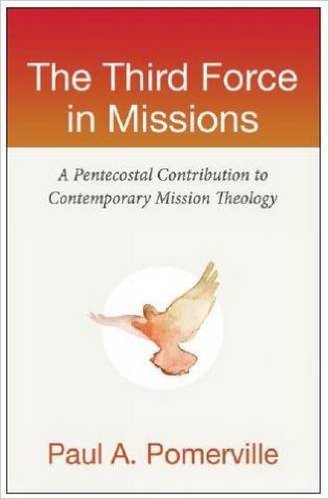
Read the review by Anna M. Droll.
Paul Pomerville: The central thesis of The Third Force in Missions concerned the Pentecostal contribution to mission theology. At the time the first edition was written (1983) there were doubts as to whether there even was a Pentecostal contribution to mission theology. My contention at that time was that Pentecostal-charismatic Christians made up one-third of the world’s evangelical Christians and their growth was evidence of a potential Pentecostal contribution. However, the unprecedented Pentecostal-charismatic movement in the Southern Hemisphere today, the “third wave” of Pentecostal-charismatic renewal has proven the question of a Pentecostal contribution to be a “moot point.” Today, 800 million-plus Pentecostal-charismatic Christians are now a “first force” in Christian missions. It is clear that this unprecedented rapidly growing movement south of the equator was not due to “theology,” but rather the Pentecostal-charismatic experience with the Holy Spirit. Obviously, there is a “Pentecostal theology” undergirding the Pentecostal-charismatic movement that emphasizes the role of the Holy Spirit that two of the most influential theologies in the Northern hemisphere have not emphasized, but rather have neglected and outright denied—1) Western rationalistic scholastic theology of the post-Reformation period and 2) dispensational theology.
Theology matters; if theologies are deficient in the doctrine of this “missionary Spirit” they hinder the missionary cause. Ironically, a strong influence of dispensational theology continues today like an albatross around the necks of evangelicals and strangely also around the necks of American classical Pentecostals. Therefore, due to the influence of these two streams of theology (rationalistic scholastic theology and dispensational theology) the Pentecostal experience of the Spirit in Christian America has emerged in a historical context of doubt as to its authenticity. Pentecostals in America view the Pentecostal experience as both a “renewal” and an experience “subsequent” to salvation. However, they do not view the Pentecostal experience this way in the global South. Especially after the “third wave” of Pentecostal-charismatic renewal, the Southern Hemisphere’s “faith-context” for receiving the Pentecostal experience was that it was part-and-parcel of the gospel message, the same normative Christian experience of the Spirit that was revealed in the New Testament.
PneumaReview.com: Why do you think two-thirds of the total number of Pentecostal-Charismatic Christians are found in the global South? What factors have contributed to making this so.
Paul Pomerville: First, I would say that the existence of the large numbers of Pentecostal-charismatic Christians in the global South is due to both the sovereign act of God pouring out his Spirit and also the unique “faith context” of those Christians in the global South who experienced the outpouring of the Spirit in the “third wave” early in the twenty-first century. I don’t think that these two factors contradict each other, or that it must be an either/or. The answers that I gave to your previous question goes a long way in explaining why two-thirds of Pentecostal-Charismatic Christians are in the global South and why the vitality of the Christian faith has shifted from the Northern Hemisphere to the Southern Hemisphere—Spirit-deficient theologies. Why did this incredible movement take place in the Southern Hemisphere and not in the Northern Hemisphere (the West)? In the West, scholastic, rationalistic theology from the post-Reformation period neglected and all-but ruled out the experience of the Holy Spirit. The influence of this rationalistic stream of theology strongly influenced American evangelicals at the beginning of the nineteenth century and continues to do so today, as does the influence of dispensational theology which denies the Pentecostal experience today.
Regarding the “sovereign nature” of the outpouring of the Spirit that I mentioned previously, in the history of Western missions all of the churches in the global South—traditional churches planted by Western missionaries, as well as those planted by Pentecostal missionaries and also churches emerging independent of Western missions—experienced the first and second waves of Pentecostal renewal at the same time as Christians in the Western world experienced them (early 1900s classical Pentecostal movement and the mid-1960s the Charismatic Movement in mainline churches). Some of the independent churches in the global South like the African Independent Churches represented hundreds of millions of Pentecostal-charismatic Christians and some of these churches had no historical causal connection with Pentecostal missions from the West. Many had become “breakaway” independent churches from the mission denominations, because of their unwanted insistence in expressing their Christian faith through their local cultures (unwanted by Western missionaries). Also, in their quest to find “Christian” answers to the world of spirits that harass them daily, often Western missionaries did not have answers to those questions because of their rationalistic theology. Then, around the turn of the twenty-first century it was the way all of these churches responded to the third wave of Pentecostal outpouring of the Spirit that reveals why two-thirds of all Pentecostal-charismatic Christians are in the global South.
Those having an expectant eager faith who received the Pentecostal-charismatic experience did not think of their experience as “subsequent” to receiving Jesus as their savior or as a historical “renewal” of the Spirit, but rather as normative New Testament Christian experience. They saw the good news that Jesus declared was the presence of a powerful kingdom in their lives, the rule of a powerful God. After reading about the Pentecost story they understood that Jesus’ good news of the kingdom of God meant that (l) Jesus died for their sins on the cross and (2) they were given the gift of the Pentecostal-charismatic Holy Spirit to enable them to overcome the power of Satan in their lives and to carry out Christ’s mission. This was the gospel that they shared with their animistic spirit-oriented near neighbors and it ignited a firestorm of Spirit-enabled missions that swept across the global South. This powerful Christian movement in the poverty belt of the global South is strategically poised for the evangelization of Islam, whose societies in spite of their belief in Islam are often animistic, believing in a world of spirits, and poor. Therefore, not only did Pentecostal-charismatic Christianity numerically shift to the global South but also the Christian mission did. It was the global South’s distinct Spirit-oriented, holistic, event-oriented worldview—without the influence of the Northern rationalistic-oriented and logical-time oriented worldview—that enabled them to receive the twofold good news of the kingdom of God, sins forgiven and the gift of the Pentecostal-Charismatic Spirit simultaneously.
PneumaReview.com: Why has there been a great silence about the Holy Spirit in the church in the West?
This is the stream of rationalistic theology that has influenced evangelicals since the beginning of the nineteenth century, largely through the influence of the Harvard theologians who used this rationalistic theology in a defense of the Christian faith against attacks on the inspiration of the Scriptures. Evangelical theologian Bernard Ramm spoke of this scholastic influence when he said that the doctrine of the internal witness of the Holy Spirit (with respect to Scripture’s inspiration) had almost disappeared from evangelical literature and theology. Therefore, Pentecostalism was a historical “correction,” revealing this Spirit-deficiency in Western theology but also revealing that the Pentecostal experience was an enablement for Christ’s mission to the world; the Pentecostal experience was an intense experience with a missionary Spirit.
PneumaReview.com: In the book you maintain that the theme of the kingdom of God is vital for the mission of the church. Please explain.
When Jesus proclaimed the arrival of the good news of the kingdom in the Synoptic Gospels, his whole ministry in those documents emphasized the power of the kingdom over the power of Satan. When the Pharisees saw the miraculous ministry of Jesus they challenged him by saying that he was casting out demons by the power of Satan. He answered, “If it is by the Spirit of God that I drive out demons, then the kingdom of God has come upon you.” The Holy Spirit and the powerful kingdom of God are inseparable in his mind and became the central topic his teaching, describing the kingdom of God as an inner kingdom of the heart where the Holy Spirit reigns in Christians. His whole ministry of healings, casting out demons, raising the dead in the Gospels was a demonstration of his kingdom’s power over the god of this world and evil spirits. Even as a preliminary experience with the power of the kingdom, before Pentecost, Luke chapter 10 records Jesus sending out his disciples among Gentiles with the “power of the kingdom” and they personally experienced the kingdom’s power over Satan. When Jesus was with the disciples, the message of his suffering death on the cross was left until the end of his ministry in the Synoptic Gospels. He did this because in the development of the disciple’s faith early on this was prominent in his mind and also because of their false view that he the Messiah would establish an earthly Jewish kingdom; therefore, they were unable to understand or bear this “cross message.” When they heard him first speak of the cross they did not understand it and challenged Jesus. The message that Jesus proclaimed and the message the disciples proclaimed when they were sent out (in Luke chapter 10) was simply: “Repent, the kingdom of God is here” and that message was confirmed by the miraculous power of the Holy Spirit. It is the imposition of a Western rationalistic-logical and time-oriented worldview on the gospel story that presents a fragmented view of the gospel. On the other hand, the gospel story is based on a supernatural-oriented, holistic-event orientation of the New Testament documents (the worldview of the apostles).
Therefore, the Holy Spirit is the impetus for Christ’s mission, the Spirit-empowered church is the means for mission, and the Spirit himself is its Chief Strategist. He is a missionary Spirit. Biblical theology is the Pentecostal basis for belief and practice; obviously, a theology deficiency in the doctrine of the Holy Spirit impedes both the belief and the practice of missions (your second question). Not only is the biblical theme of the kingdom of God in both Old and New Testaments appropriate for a “theology of mission,” showing the new people of God born, empowered and led by the Spirit for Christ’s mission to the world, but it is also appropriate and central for developing a full-blown Pentecostal biblical theology that should replace so-called biblical pseudo-dispensational theology.
PneumaReview.com: How must the church in the West change in order to maximize the effectiveness in working to fulfill the Great Commission?
PneumaReview.com: What special contribution can the Pentecostal movement make to the church at large?
Paul Pomerville: If the focus of this question is on the worldwide Pentecostal movement, it can provide the church at large an awareness of the indispensable role of the Holy Spirit in Christian theology, the spiritual life of the church and its mission. As mentioned in the book, Pentecostals providing an up-to-date statistical picture of the worldwide Pentecostal movement would help in bringing this awareness which to date evangelicals have not accurately presented.
If the focus of the question is on the Pentecostal movement in the West, a contribution would be possible if Pentecostals would avoid ethnocentrism in critiquing the Pentecostal-charismatic movement in the global South, applying their Western Pentecostal theology and experience from the first two waves of Pentecostal-charismatic renewal as normative and perennial. Like Western rationalistic theology, Pentecostal theology and experience in the West are also “contextualizations,” a historical example of Pentecostal theology and experience. What is normative and perennial is the New Testament documents and a NT Spirit-oriented biblical theology. However, the historic example of the renewal of the Pentecostal-charismatic experience in the West and the theologies following may be instructive in helping theologians and churchmen of the global South to understand the “contextualization phenomenon” and avoid an excessive impact of their cultures in their theological work.
A major contribution for the Pentecostal movement for the church at large would be to develop a “Pentecostal” biblical theology that would replace dispensational theology and unmask its influence in the church at large. It is a gross understatement to say that this theology is a major hindrance to the Christian mission. Dispensational theology not only denies the Pentecostal-charismatic experience today, but in its excessive Israel-focused theology (rather than Christ-focused) it has hindered the church’s mission in the Islamic world which today numbers nearly 2.5 billion adherents. The influence of that Israel-focused theology “married” to a pseudo-Christian Zionism with an excessive pro-Israeli America presents a gospel that is not “good news” to Muslims and is not a real option for belief in the world of Islam. The same “perfect storm” of excessive Israel-influence has caused evangelicals to be “on the wrong side” of the Israeli-Palestinian Conflict. I have written a book to counter this perfect storm of Israel-influence among evangelicals: The New Testament Case against Christian Zionism: A Christian View of the Israeli-Palestinian Conflict [Editor’s note: Read Eric Newberg’s review].
This should be a Christian concern and this kind of social injustice and oppression is within the purview a biblical theology of mission. The Pentecostal-charismatic movement in the global South has demonstrated the effectiveness of such a full-rounded mission theology in their pursuit of justice for the poor in the governments of countries of the global South—Latin American countries, as well as in Northern Asia such as Korea, for instance. The Pentecostal-charismatic movement there is making a contribution to the “church at large.” Contemporary evangelical-Pentecostal missiologists speak of this effort in addressing matters of social injustice as the “cultural mandate” along with the “evangelistic mandate” in referring to a complete or holistic theology of mission. Just as Jesus and the apostles carried on the tradition of the Scriptures in focusing on the poor and injustice toward the poor, the Holy Spirit has led Christians in the global South to focus on the poor, the social class most represented by the countries of the global South, and incidentally, the population most receptive to the gospel of the kingdom of God.
PR
Note from the Editor: Special thanks to John P. Lathrop for his assistance with this interview and all he does to support the ministry of PneumaReview.com.