Samuel Adams: The Reality of God and Historical Method

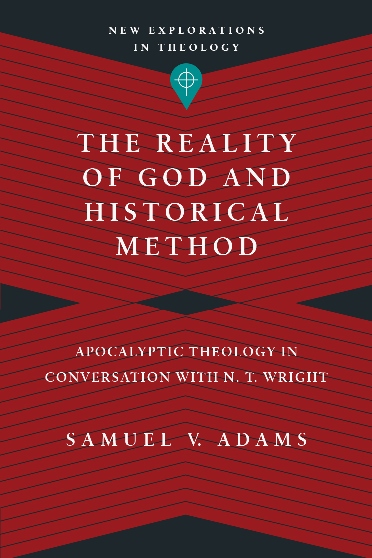
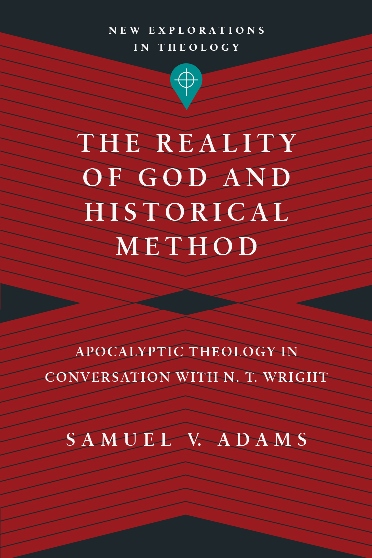 Samuel V. Adams, The Reality of God and Historical Method: Apocalyptic Theology in Conversation with N.T. Wright, New Explorations in Theology (Downers Grove, IL: InterVarsity Press, 2015), 291 pages.
In this intriguing book, Samuel Adams tries to figure out what it means to do history about the Bible if we assume that God actually exists. The proposition is an interesting and important one: biblical studies has a legacy of being forced to decide whether to approach its object of study either theologically or historically, with the implication that historical approaches are not intended to reckon with the reality of God. In this revision of his PhD thesis, completed under the supervision of Alan Torrance at the University of St. Andrews, Adams picks at the historical method of popular biblical scholar N.T. Wright to ask whether his account of history can cope with a God who is more than simply an element in the worldviews of the biblical authors. Ultimately, Adams believes that Wright’s Critical Realist approach to history is insufficient when applied to knowing God as it does not take account of the implications of making God the object of knowledge. Having diagnosed the problem Adams sets out to offer a solution, situating himself as a theologian who is attempting to resolve a problem built into Wright’s method by drawing on the resources of apocalyptic theology (181-2). This is a bold claim, considering the status of Wright.
Adams begins by describing Wright’s approach to history. He is particularly interested in what the former Bishop of Durham has to say about how we come to know things. Wright argues that knowledge is gained when we come into contact with things outside ourselves, and Adams rightly diagnoses here the epistemological underpinning of Wright’s project. Although Adams does not dispute that Wright’s approach helps him understand what the biblical writers intended to say, he does not think it can address the ‘reality’ which they were writing about: it addresses their worldviews, rather than the subject matter of the text.
Following Torrance, Adams sees this as ‘God-talk-talk’ (talk about what people have said about God) rather than ‘God-talk’ (talk about God). For example, Adams accepts that Wright can understand the apocalyptic worldview of the writer of revelation, but argues that this is completely different from understanding the revelation (‘apocalypse’) of God in Christ. Although Wright wants to move from the history of Jesus to talk about his status as Christ, Adams argues that his theological comments are actually only comments about the worldviews of the biblical authors (56) and never quite manage to become truly theological statements. Wright describes descriptions of God, not God – despite his claims to the contrary.
Here, Adams comes to his main criticism: Wright’s method is naturalist because “the knowledge of God is treated no differently than the knowledge of reality external to the knower in general” (74-5). Rather than allowing God – as a unique object of knowledge – to shape the way he is known, Adams sees Wright as imposing an inappropriate way of knowing onto God. Because of the importance of ‘contact’ to Wright’s own account of knowledge, Adams goes on to argue that this is actually self-contradictory: Wright has previously argued that we come to know things through contact with external reality, so surely such a different reality should be known differently?
For Adams, Wright does not recognize this important point. His failure to do so is a vital flaw in his method. Instead of adequately differentiating between different metaphysical and ontological orders of external reality, Wright lumps them all together (67). For this reason, Adams asks “how does God’s reality impinge upon and even determine the way in which he is known?” (64), and sees this key question as actually arising from within Wright’s own approach.
True to his word, Adams attempts to address this supposed aporia in Wright’s method by offering an alternate theological epistemology. Against a hermeneutical approach which emphasizes the importance of context, Adams looks for an alternative, revelation-based way to know God. Here, he draws heavily on Barthian influences – like much of apocalyptic theology. For Adams, following an interpretive trajectory inspired by the work of J. Louis Martyn (114) and associated with Douglas Campbell, Martinus C. De Boer, Beverly Roberts Gaventa, and Ernst Käsemann (120, n.33), “apocalyptic names a unique event, the revelation of God in Jesus the messiah, which brings with it its own self-determining context” (115). Adams does acknowledge that Wright has had a sustained and occasionally intense engagement with various of these thinkers (e.g. 112-13), but aims for “a certain rapprochement” (170) between the positions. He tries to achieve this by placing an account of theological knowledge fitted to the unique requirements of having God as its object at the heart of Wright’s own method – though it is not clear that Wright would thank him for his efforts.
Adams’ account draws on Thomas F. Torrance and Søren Kierkegaard in chapter two to argue that human knowledge of God depends on the prior action of God in salvation to give the elect the ability to know. This means that God provides both revelation, and the way to understand revelation – much the same way as a cinema might provide 3D glasses along with the film itself. Positively, this means that knowledge of God is based solely on the gracious act of God, and cannot be approached any other way. On the other hand, Adams is not really breaking much new ground here: at various points, his argument effectively rehearses Barth’s infamous engagement with Emil Brunner regarding the possibility of natural theology. His argument has typically Barthian drawbacks, too. When speaking from a ‘theological perspective’, Adams occasionally appears to be speaking from inside the mind of God in a unique way. Similarly, his insistence that knowledge of God can be understood only within its self-provided context seems to undermine the relevance of anything that might reasonably be expected to pass as history.
In chapters three and four, Adams follows Barth’s understanding of creation as gaining its meaning in light of the resurrection and considers the theological implications of his epistemological position according to a ‘soteriology-Christology-creation’ sequence. In these chapters, Adams lays the groundwork for his later treatment of history. The most significant move he makes comes in his treatment of new creation. He sees the new breaking radically with the old: the in-breaking of the new creation is an eschatological event. This means that only from God’s perspective – which Adams somehow seems to share – can continuity be discerned between BC and AD. Only from here is the salvation historical status of both pre- and post-Easter history as expressions of the freely given love of God visible.
In chapter five, Adams tries to explain how one should write and understand history assuming the reality of God as a theological given. Here, he makes explicit the implied assertion that history must look very different when done theologically. He argues that the cross marks the end of human history and that, as a result no knowledge of Christ whatsoever can be derived from it. Accordingly, Adams argues that the way Wright limits theology to an element of the biblical authors’ worldviews is actually anti-theological. Adams claims that knowledge of God must be approached differently, but does not put forward an alternative historical method: “Hearing and proclamation might be better. Prayer and doxology come to mind as well” (227; italics original).
This is an exciting and frustrating book, and the tension can be seen in the difference between its title and subtitle. The broad question of the title is one which is vitally important in our current academic climate. Indeed, Adams does well to ask how the reality of God should impact historical-critical research. This is a vital question believing scholars would be foolish to ignore. The answer he gives – summed up in his subtitle – is the weaker for being easily dismissible, as it appears to assume direct knowledge of God. As a result, Adams occasionally seems to be writing from a God’s-eye perspective and simply replaces history with theology. This is ultimately unconvincing, as the Christian faith is intimately tied to the historical reality of Jesus Christ.
Reviewed by Mark Wreford
Publisher’s page: http://www.ivpress.com/cgi-ivpress/book.pl/code=4914