
Gregory Boyd: The Myth of a Christian Nation

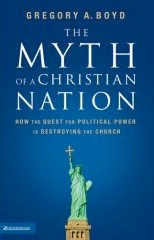 Gregory A. Boyd, The Myth of a Christian Nation: How the Quest for Political Power is Destroying the Church (Grand Rapids: Zondervan, 2005), 207 pages.
When you were a child did your mother ever make you take bad tasting medicine? And when you complained about the bad taste did she ever tell you “That’s because it’s good for you”? If so, then you may recognize a similar response to this book by Greg Boyd. At least I did. Gregory A. Boyd is founder and senior pastor of Woodland Hills (mega) Church in St Paul, Minnesota, founder and president of Christus Victor Ministries, former professor of theology at Bethel College (St Paul), and author of numerous books, including the international bestseller Letters from a Skeptic. And he is no stranger to controversy. For example, he has been embroiled in the debate over divine omniscience as a proponent of openness theism. Considered by some a post-evangelical liberal, Boyd here bucks the tide and attacks the religious right for over identifying the Kingdom of God with partisan politics. While many Pentecostal/charismatics will undoubtedly disagree with much of what he says about specific issues, perhaps they will intuitively agree that he may be right about his main point: Kingdom-of-God citizens ought to be dramatically different from kingdom-of-the-world citizens in their approach to power.
 Boyd begins by explaining how this particular book arose out of a split in his Woodland Hills congregation over a series of sermons he preached about religion and politics. His central thesis is that American Evangelicalism is “guilty of nationalistic and political idolatry.” Then he argues that the kingdom of this world is a “power over” kingdom exercising rule over others as exemplified in human governments and nations, which are to a large extent diabolically backed, while the Kingdom of God is a “power under” kingdom practicing submission as exemplified in the cross. Their stark contrast calls for Christians to make a clear choice. Next he argues that Kingdom-of-God citizens ought to be more concerned with keeping their kingdom holy than gaining political clout. He chides the Church for behaving more like “conquering warlords” than “resident aliens,” that is, for a history of militancy, and insists the “taking America back for God” ideology is misguided and mistaken. For him the country never has been Christian, and probably should not be so anyway. This explains his title and recurring theme on “the myth of a Christian nation.” For him, the idea of America being Christian in anything but the most general sense is a foul fabrication of a national civil religion designed to get the people to do the government’s self-serving will for supposedly altruistic purposes. And he really becomes inflamed on “chief sinners” acting as “moral guardians.” In his judgment the Church has little or no business concerning itself with issues of national morality. Christians who speak out against abortion or gay rights are simply exposing themselves and the Church to charges of hypocrisy and self-righteousness. Boyd concludes the book with an argument that under no conditions could a Christian justifiably participate in any form of violence. That would exchange the “power under” Kingdom of God for a “power over” kingdom of this world. Not only does he prohibit participation in war, but also any level of membership in the military or the right to defend one’s own life and family—though he admits to a personal struggle on this last issue.
Boyd skillfully employs everything from the Bible, the Church Fathers, and ancient Greek literature and philosophy to world history and contemporary economics, political science, and personal anecdotes to prove his points. However, he shows an inordinate dependence on certain thinkers, for example, John Howard Yoder especially, and Stanley Hauerwas also, widely noted for radical and liberal ideas on religion and politics. He does not refute in any depth expert opposing viewpoints. For example, Boyd doesn’t at all touch much less discuss well known and widely acclaimed Christian political theologies such as Abraham Kuyper’s “sphere sovereignty,” Richard Niebuhr’s classic study Christ and Culture, or Jürgen Moltmann’s theology of hope and liberation. And on Augustine’s “just war” theory, he employs more irony than argumentation. Admirably, Greg Boyd shares his heart in honesty and humility, but he has a tendency to overstate his case. For example, he emphatically and repeatedly argues that John 18:36 shows Christians should be absolute pacifists, that is, total non-combatants in any kind of military conflict between earthly nations. Yet even a cursory glance at that text reveals Jesus only stated that his kingdom has heavenly origins and is not advanced or defended by earthly force (cf. J. Ramsey Michaels, New International Biblical Commentary). All that can be conscientiously gleaned from this verse is that Christianity is not sustained or spread by the sword. I often felt Boyd’s biblical, theological, and logical arguments fell into this same kind of category: they made good points but he pushed them beyond their proper boundaries.
I must mention what to me are two important points, one positive and the other negative. First, Boyd is not improbably performing an important service simply by pushing Evangelicals to examine underlying assumptions and presuppositions about religion and politics in the USA. That’s a good thing, a healthy thing, for all of us. And I’m sure he’s right about our often going overboard. Second, sometimes Boyd’s approach sounds suspiciously like a more sophisticated version of the old liberal attempt to drive religion into the closet, making it a private affair bracketed out of the public square. And that’s not a good thing, or a healthy thing, for any of us. I seem to recall Daniel was both a saint and a statesman (Dan 1:17-21; 5:10-12; 6:1-3). And, as Boyd candidly confesses, he definitely focuses on debunking the Christian religious right with all its perceived failings but doesn’t bother to address failings of the religious left. My own committee experience suggests radical religious leftists are at least as fatally flawed as radical religious rightists. But then that’s three things.
This is a disturbing book. And probably for that reason, like bad tasting medicine, it is a needed book. It’s written on a generally readable level but the endnotes are overdone and there is no index. For stalwart citizens really willing to work through their presuppositions and responsibilities regarding their dual roles as Christians and Americans, I recommend it. But remember: unlike your mother’s medicine, you don’t have to swallow it all for it to help.
Reviewed by Tony Richie
Preview The Myth of a Christian Nation: books.google.com/books/about/The_Myth_of_a_Christian_Nation.html?id=DrPWy_j8UqgC