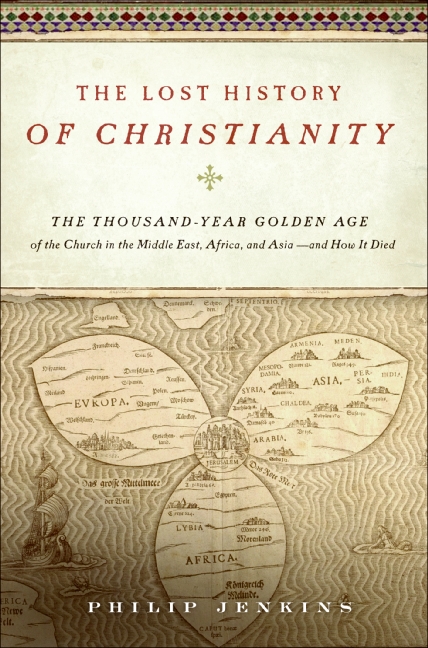
Holy Warriors by Jonathan Phillips and The Lost History of Christianity by Philip Jenkins


 Jonathan Phillips, Holy Warriors: A Modern History of the Crusades (London: The Bodley Head, Random House, 2009), 424 pages, ISBN 9780224079372.
Philip Jenkins, The Lost History of Christianity: The Thousand Year Golden Age of the Church in the Middle East, Africa and Asia—and How It Died (New York: HarperOne, 2008), 315 pages, ISBN 9780061472800.
If you would read back-to-back, as I did recently, the two books reviewed here, one by a historian of the Crusades and another by a Church historian on the Eastern Church, you will surely broaden your knowledge of world history and gain a surprising perspective on both ecumenism and the prospects of peace with religious extremism.
Both of these books are a good overview of the battlefield called “jihad” by Muslims and “Crusade” by Christians and contain insights into the mistakes made as well as ways people have been successful in working together, though the mistakes far outweigh what went right. Jonathan Phillips is the expert on Crusades history and European medieval secular and religious politics, while Philip Jenkins addresses religious matters in-depth.
If we might borrow from Socrates’ saying, “The unexamined life is not worth living,” we ought to grasp that no movement in the history of humanity was either simple or pure. Phillips does a good job of sustaining the point that both the call to Crusade by popes and the response from the nobles and people was a mixture of sincerely held religious beliefs and the desire for success, power and wealth. Moderns like to say that the Crusades show what is wrong with religion and the Church, but leave out (probably from ignorance) that the Crusades began with a request from Christians in the Middle East, not a European desire for a blood frenzy. However, what Pope Urban II in 1095 decided to do with the appeal from Emperor Alexius of Constantinople and each and every occasion for “taking the cross’ until the reconquest of Granada in 1492 was a mixture of piety and pride resulting in the waste of human lives as well as multiple failures in the goals they hoped to achieve. For example, what the Emperor had in mind was a special forces team of perhaps 300 knights but what happened was one of history’s first carefully orchestrated international public relations campaigns, resulting in an army of tens of thousands of princes and peasants on a long march to Jerusalem. The misdeeds and missteps along the way are well known, but Phillips’ research is highly informative and I learned a great deal. As he points out, it is amazing that those in the First Crusade were successful at all, yet they were the most successful of all.
After the First Crusade, Holy Warriors covers the relations between Muslims and the Franks in the Levant, gives a portrait of Queen Melisende of Jerusalem and her reign, the desire for a Second Crusade, and draws interesting portraits of two larger than life warrior-Kings, Saladin and Richard the Lionheart. It continues with the Third and Fourth Crusades, the Sack of Constantinople, Frederick II, the Fifth Crusade and the Recovery of Jerusalem, the Crusade of Louis IX and the rise of the Sultan Baibars as well as giving information on smaller crusades of which most of us are unaware. The next to last chapters covers a longer period from the trial of the Templars to the time of Ferdinand and Isabella, and the last chapter brings us up to date covering the idea of Crusade from the era of Sir Walter Scott to Osama bin Laden to and George W. Bush. It ends with a succinct conclusion.
If you are familiar with Philip Jenkins’ previous works, you already know how he offers his global perspective on Christianity and how trends in religion affect culture. Having an eye on the past is a reasonable and reliable way to learn future possibilities for the Church. The Church of the East had a long interaction with Islam and Dr. Jenkins provides innumerable insights. Having recently read a half dozen works on the history of Muslim-Christian relations, it is safe to say Jenkins’ work ranks among the best. The publisher calls it “groundbreaking” and it is that.
Jenkins’ narrative removes numerous preconceived Western notions in The Lost History of Christianity; for example, since the majority of the world’s Christians lived in Europe from the 15th century to the 20th, the West assumed it was always that way. By using a relatively unknown historical figure, Timothy, the Catholicos (primate) of the Church of the East (what we in the West would consider to be Nestorian but as Jenkins points out, that also is not as simple as we would believe). Timothy was a contemporary of Charlemagne and oversaw a church that extended over a much larger area than the Pope. His was a dynamic, growing parish that reached from Jerusalem in the West to Armenia, Turkistan, Persia, Tibet, Patna (on the Ganges in India) and Khanbalik (Beijing, China). Serving under Timothy were nineteen metropolitans and eighty-five bishops!
Timothy was a scholar and diplomat. Men like him provided the basic scholarship for the so-called Gold Age of Islam. Eastern Christians translated texts from Greek into Arabic, starting the circle of scholarship that would be completed when scholars of the Latin Church rediscovered Aristotle in Arab libraries.
Jenkins deals admirably with many misperceptions about the region and about Islam. For example, he notes that many liberals like to say that Islam is a religion of peace, but he shows that while Christians who submitted to Islamic authority and paid the dhimmi tax were treated fairly well, there was harsh treatment from the beginning. For example, at the Battle of Yarmuk in 636 perhaps 50,000 Byzantine Christian soldiers were massacred. While city dwellers who paid the dhimmi tax were spared, Muslim armies showed no mercy to Christians in villages and rural areas. Also, the Christian Church was destroyed in North Africa. While Copts were able to keep churches in Egypt, persecution was sporadic and local. The treatment of Christians by Muslims degenerated as the centuries went by. With time, Islam forgot the heritage and beliefs they shared with Arab Christians. Jenkins provides too many examples to mention that counter the argument that Islam is a religion of peace (of course, history does not bear out any claim Christians might make on that title.)
Many Christians as well as Muslims would be shocked to learn how much they once shared, and Jenkins enumerates the commonalities. Jesus is mentioned some 70 times in the Koran; Jesus is one of the six “prophets” of Islam; Jesus is going to be the judge on the Last Day. More than that, perhaps all of the five “pillars” of Islam are based on Christian practice which came from Jewish tradition, such as fasting, praying while prostrated, pilgrimage, giving alms, etc. When Christians first heard of Islam in the 7th Century, they took it to be a variant form of Christianity. After all, they acknowledged Jesus and the Virgin Mary and gave preferential treatment to Christians in Dar al Islam.
In many ways Christians today could learn to see Islam for what is positive and begin to build more bridges. What are the alternative ways to treat a religion with a billion adherents? Another Crusade?
We need this reminder that Turkey, Armenia and Iraq had a large Christian presence until the early decades of the 20th Century. The disintegration of the Ottoman Empire and the threat of occupation by European powers led to the brutal genocide of Christians in what had been one of the earliest centers of Christianity, Northern Mesopotamia and Armenia. This is an example of powers reacting badly in another stressful period, the fall of the Ottoman Empire.
We live in a similarly stressed period today. In the past, alignment of religion with state was the status quo, but today it is increasingly unthinkable. Is there an alternative to peace other than pursuing freedom of conscience, religious freedom and secular government in every nation including the Islamic countries? In my opinion, we would all benefit by recognizing Islam and Christianity are not in conflict today because they do not understand each other, this is the situation between all religious communities, and it has ever been this way.
I would not want to give the impression that the struggle between Islam and Christianity is the only or even the main topic of Lost History. The Church of the East was conversant with diverse nations, religions, and cultures. Jenkins provides translations of texts which would otherwise lie in some faraway library. Letters from a leader in one empire to another are fascinating and he gives examples of inter-faith dialogues we can hardly imagine. However, the lesson is clear: people of one faith not only need not fear being in dialogue with other religions, indeed it is a way forward, and Jenkins is very good at explicating that this is not done by watering down your own.
If there is a path to peace, it is more than likely to come by learning from our failures to appreciate the good in each other’s community and to realize the commonalities we share while not giving up anything authentic in our own. In doing this we can help inoculate our cultures from the demagoguery of greedy politicians and religious hooligans who play off the ignorance of the population (which in general has no interest in studying theological niceties).
If the West could arm itself with knowledge over its own religious history and its intercourse with Judaism and Islam, it would perhaps not have to supervise the shipments of so many other weapons. Books, not bombs may be the way to go. It would be wise if more statesmen would begin reading works by historians and Church historians to learn how to keep one eye on the past when thinking of the future.
Reviewed by Eric J. Swensson
Additional reading:

 Ussama Makdisi, Artillery of Heaven: American Missionaries and the Failed Conversion of the Middle East (Ithaca: Cornell University Press, 2008), 262 pages, ISBN 9780801446214.
Habib Badr, ed., Christianity: A History in the Middle East, Middle East Council of Churches (World Council of Churches, 2006), 934 pages, ISBN 9782825414248.
Preview Holy Warriors online at: books.google.com/books?id=Rg3XP_rQS6oC
Publisher’s page for The Lost History of Christianity: www.harpercollins.com/book/index.aspx?isbn=9780061472800