Roger Olson and Christian Winn: Reclaiming Pietism

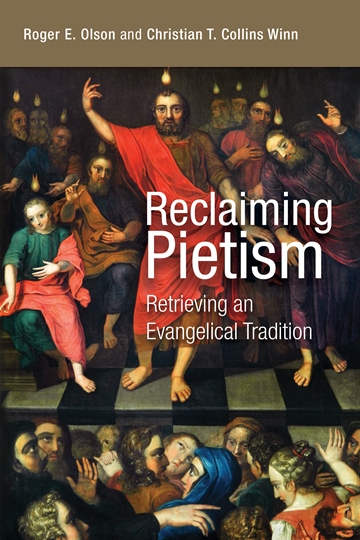
 Roger E. Olson and Christian T. Collins Winn, Reclaiming Pietism: Retrieving an Evangelical Tradition (Eerdmans, 2015), 204 pages, ISBN 9780802869098.
If my mainline seminary education was typical, very little is taught about Pietism. When I found a dingy copy of Pia Desideria at a used book sale while on vacation a few years after graduation, I recognized the title and its author, Philipp Jakob Spener, but could not remember much else. Reading it, I had the reaction that quite a few people still have. The book was obviously written centuries ago, and while it doesn’t have that “contemporary air” that reviewers are always finding in old books, some of what Spener addressed had direct application to our present situation.
And so began my interest in “the flowering of the German Lutheran Churchly Pietists” a period from 1675-1725, roughly spanning the careers of Spener and August Hermann Francke. I still await the awakening of fellow clergy and our professors to its benefits. There have been a few stirrings. Bethel had a conference on “The Pietist Impulse” in 2009, and a collection of articles was released in 2011 as The Pietist Impulse in Christianity. The label Pietism is tossed around a bit in social media, and I was even interviewed recently for a podcast, but for the most part, pietism is spoken of as a form of legalism, basically. We also hear that pietists are anti-intellectual, are all about having a religious experience, they don’t care about the Sacraments, and all sorts of things that I do not see in my historical research. Of course, the problem here is we are talking about is a movement spanning four hundred years, and radicals who really were “enthusiasts” are included under that label, but we should follow the advice that a movement is known by its broad middle and not its fringes.
Roger Olson and Christian Winn have attempted to explain how a “good word got a bad reputation” in the readable, historical and theological work Reclaiming Pietism. It will have to be seen if this 2015 offering from Wm. B. Eerdmans is up to the task of its title. After all, as they say, not even religious scholars in the United States today know what Pietism is. That is a little odd since the two most influential forms of Christianity here were Puritanism and Pietism. No American history course is complete without a segment on the Puritans, yet as Olson and Winn point out there is a good case to be made that Pietism was just as influential if not more so.
It is as if Pietism fell off the radar. When mentioned at all, it is a pejorative term. It may be surprising for Americans to learn that Pietism studies are taken seriously in Germany. They see, as we should, that it was important to their development. It is perhaps worth noting that the Wikipedia page for the former dean of Pietism research in America is in German.
In Germany in the 1980s and 1990s Martin Brecht and Johannes Wallmann had a long debate whether the movement should be dated from the time of Johan Arndt and include Reformed thinkers from Britain and the Netherlands, or if it was begun by Philipp Jakob Spener and properly understood as having Lutheran roots. Germans followed the papers from Brecht and Wallman with great interest and academics took sides. Only a handful of people here know anything about this.
If for no other reason than giving educators a resource to fill that blank, Reclaiming Pietism meets a need. However, since it is a clearly written, historical survey taking advantage of the work of Stoeffler from about fifty years ago and the more recent work of Douglas Shantz, Jonathan Strom and others, it may well excite even more research. Olson and Winn are leading scholars themselves in the new Pietism research, Winn having been a student of Donald Dayton at Drew concentrating in the work of the Blumhardts before teaching at Bethel University in St. Paul, and Olson having a long career as an educator and author, now teaching at Baylor.
Reclaiming Pietism has eight chapters dealing with precursors of Pietism, origins, the hallmarks of Continental Pietism, its spread to Britain and North America, Pietism in the 19th century and then closes with a look at how Pietism lives on in the work of four recent theologians.
As one would expect from Olson and Winn, all the bases are covered. Key figures and movements are all there, and the reader gets the information they need, covering the span of seven centuries. To understand Pietism one has to understand the forerunners of the Reformation. In many ways researching Pietism is the same as studying the history of Protestantism. Stoeffler liked to use a quote from Michel Godfroid, “To write the history of Pietism is to write the history of modern Protestantism.”
I once had Timotheus Verinus recommended to me as a resource. My interlocutor said it would straighten me out, i.e. show me the evils of Pietism. It was enlightening, but not in the way he intended. I came away with an ever greater knowledge of how distasteful doctrinal arguments are. Valentin Loescher (Löscher) attacked Pietism, Calvinism, Catholicism, anything that did not agree with his doctrine. I had studied his journal Unschuldigen Nachrichten for my Kinderbeten research. He had a dim view of the praying children’s revival, as did all of Lutheran Orthodoxy because they were praying in public. Yet Loescher told his readers they “should not throw out the baby with the bathwater,” something Lutheran Orthodoxy does, then and now. That is, except for when they are being pietists.
At the close of the preface of the English translation of Timotheus Verinus, the translators inform us that the battle between Loescher and the Pietists ended once they came to see they had a mutual enemy which was much more of a danger, that is, The Enlightenment. One has to wonder if the differences between the two were so great if they could join forces like that. Of course, the philosophers of the Enlightenment did capture the mindset of academics and nobility alike and eventually, by the 19th-20th century, led to a mainly secular Germany. As we in the United States see secularism taking hold of the public square, pastors and other concerned Christians might come to understand that the practical, devotional route taken by the pietists has much to commend it. Some of what pietists were guilty of is exactly what is necessary in our churches today. In a narcissistic age, a focus on Jesus, daily prayer and Bible study, and the ministry of all believers is a simple, yet effective, corrective course to sail.
In closing, the key to what sets apart those labeled “Pietist” from those labeled “Orthodoxy” is the former urged personal and societal transformation. One either believes it is possible, or they don’t. Spener wrote relentlessly about the New Man. Francke had an actual stated goal of global transformation. Loescher’s account of the Pietist awakenings show that while his main stated concern is maintaining good Lutheran doctrine, in the same breath his other concern is that these “false teachers” have caused people to vacate the congregations of Orthodoxy for Pietist ones. Therefore, the objections were not just doctrinal, the concern was for maintaining the status quo. Another unstated concern was who was to be appointed to church pulpits and university chairs, pietist or orthodox, another matter of profession and party politics. Individual pietists were not immune to those temptations; however, the emphasis on the continual renewal of church and society through transformed believers superseded personal and institutional concerns.
Finally, I would like to say is natural for the human mind to label things to quickly process information, and there is a need to organize information for learning, but using labels primarily or only in the pejorative sense and not even properly understanding the label, this behavior is wrong and should stop. Perhaps this book will help.
Reviewed by Eric Jonas Swensson
Publisher’s page: http://www.eerdmans.com/Products/6909/reclaiming-pietism.aspx
Watch a 2015 interview with authors: https://youtu.be/nNf2xoSmigs