Lee Strobel: The Case for Miracles
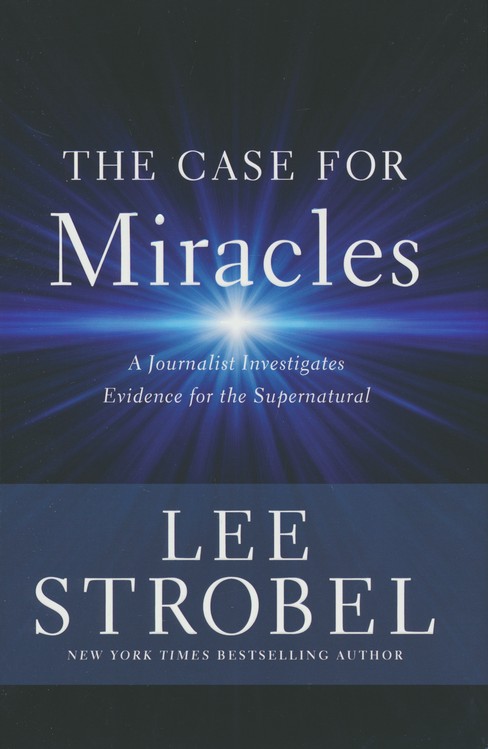
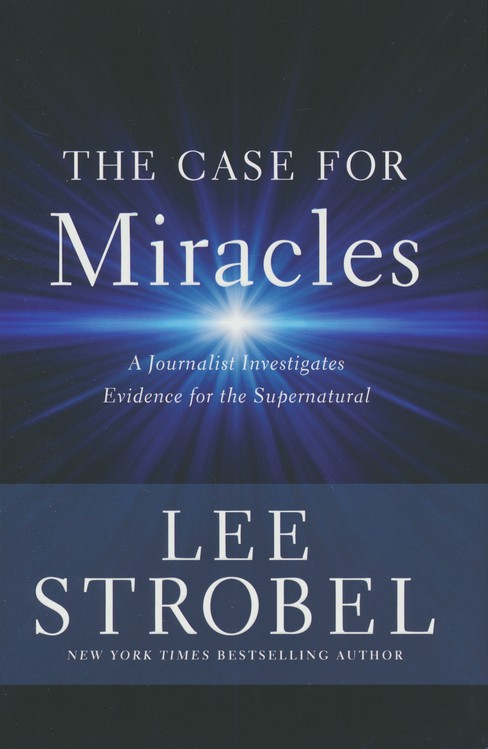 Lee Strobel, The Case for Miracles: A Journalist Investigates Evidence for the Supernatural (Zondervan, 2018), 320 pages, ISBN 9780310259183
The Case for Miracles marks the latest installment in Lee Strobel’s series of “The Case for…” books. Strobel, a former atheist and award winning legal editor of the Chicago Tribune, is probably best known for his 1998 book, The Case for Christ, and with over twenty books under his belt, he has established himself as a well-respected voice in the world of Christian apologetics.
What makes Strobel’s “cases” so compelling is the fact that, as a journalist with a legal background and the former perspective of an atheist, he tries to employ an objective approach to all his work by taking on the role almost akin to that of a private investigator.
As has come to be expected by those familiar with Strobel’s work, The Case for Miracles takes the form of a series of interviews that function as the various chapters of the book. He takes the bold step of first interviewing Dr. Michael Shermer, founder of The Skeptics Society and editor-in-chief of the magazine, Skeptic. Interestingly, Shermer comes from an antipodal position of being a former Christian turned agnostic. Shermer’s skepticism was cemented with unanswered prayer regarding his college sweetheart who was paralyzed in a car accident. As is often the case with so many who have tuned their back on God, it begins with the perceived radio silence of a God they used to think existed.

Shermer makes what appears to be some cogent arguments against the existence of miracles. He cites anecdotal evidence as questionable and inconclusive and goes on to reference The Study of the Therapeutic Effects of Intercessory Prayer (STEP). Through the Harvard Medical School, STEP was a ten-year, $2.4 million clinical trial of the effects of prayer involving 1,802 cardiac bypass patients at six hospitals (p. 51). The results showed that “there was no difference in the rate of complications for patients who were prayed for and those who were not.” (p. 51). Translate that as ‘prayer changes nothing’, or in Shermer’s words, “That’s not good for your side, Lee.” (p. 52). Shermer goes on to acknowledge the work of Scottish philosopher, David Hume, as influential on his view towards miracles or anything supernatural, saying, “Oh yeah. I think his treatise against miracles is pretty much a knockdown argument. Everything else is a footnote.” (p. 54).
While the first three chapters are dedicated to expounding Michael Shermer’s criterion for miracles being unlikely to impossible, the rest of the book focuses on the evidence that favors miracles. Strobel begins with interviewing Dr. Craig Keener.

Craig Keener, a prolific New Testament scholar and author, has among many works, penned a two-volume epic study of miracles. He is quick to refute Hume’s “knockdown” argument against the validity of miracles. “Hume defines miracle as a violation of natural law, and he defines natural law as being principles that cannot be violated. So, he’s ruling out the possibility of miracles at the outset. He’s assuming that which he’s already stated he will prove—which is circular reasoning. In fact, it’s an anti-supernatural bias, not a cogent philosophical argument.” Keener goes on to cite a number of modern-day miracles that he has investigated. One of the most impressive and moving miracles documents the case of a woman who, due to multiple sclerosis, had deteriorated to the point of death and was in hospice care confined to a bed and unable to care for herself. After a radio station of Moody Bible Institute put out a prayer request for the woman and some 450 Christians shared they were praying for the woman, she heard a voice from behind her say, “My child get up and walk” (p. 103). What resulted was a full and complete recovery that, thirty years later, still confounds the medical community. There are years of medical records to substantiate the illness and recovery, and the attestation of board certified surgeons with thousands of operations under their belts.
Not content to dismantle Hume’s outdated treatise on miracles, Strobel next targets the veracity and reliability of the STEP research referenced earlier by Shermer. To do this he interviews Dr. Candy Gunther Brown, professor of religious studies at Indiana University. Brown is an interesting choice, as she shares, “I do not assume the existence or nonexistence of a deity or other superhuman forces…What I argue is that people’s religious beliefs often have real world effects than can be studied empirically.” (p. 124). While Craig Keener was clearly coming from a pro-miracle, Christian perspective, Brown is used as a counterweight in an attempt to remain neutral and open to where the evidence might lead.
As often is the case, there are two sides to every story and the story of STEP is no exception. Brown undermines the conclusiveness of the STEP research by noting that there have been other professional and peer-reviewed studies that have shown that prayer does increase better outcomes among sick patients. The holes in the STEP research began to show when it is pointed out by Brown that most of the participants would not be considered believing Christians who believed in a personal God and in the possibility of miracles. “In the end, does the study tell us anything that’s helpful?” asks Strobel. “Well,” replies Brown, “it is instructive on how not to conduct a study of Christian prayer” (p. 131).
While much of the authors work so far functions as an apologetic for the existence and reality of miracles, the third part of the book takes a grander scale examining the origins of the universe and the fine-tuning of life. Strobel then returns to the veracity of Jesus’ resurrection and the reliability of the gospels and eyewitness testimony. At this point in the book, one begins to wonder if the scope is too ambitious with the author trying to cover too many bases.
One of the most touching and poignant chapters is one of the final entitled, “When Miracles Don’t Happen.” Dr. Douglas R. Groothuis, a renowned Christian apologist and philosopher, shares his heartbreaking story of dealing with his wife’s struggles with fibromyalgia and her slide into dementia. “Have we prayed for relief from her pain? Continually. Have we beseeched God for healing? Often and fervently. Have we seen any improvement? Quite the opposite” (p. 235). This last chapter, before Strobel asks us to draw a verdict, is a stark reminder that, while miracles may be real, many prayers seemingly go unanswered and that there is a profound mystery as to why God acts as He does.
The Case for Miracles is a highly accessible read, which makes a compelling case for the existence and continuance of miracles today. If you consider yourself a cessationist, this book will be a challenge to your theology in a healthy and robust way. For doubters, skeptics, agnostics and atheists, this will also be a challenging debate. From a skeptical point of view, it would have been healthier and more objective to have a few more voices from the side of Michael Shermer, who questions the credibility of miracles. Strobel, however, is ultimately trying to make a convincing apologetic for miracles and in that endeavor, he succeeds admirably.
Reviewed by Daniel Snape