
Mark Cartledge: Testimony in the Spirit
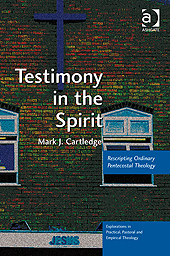 Mark J. Cartledge, Testimony in the Spirit: Rescripting Ordinary Pentecostal Theology. Explorations in Practical, Pastoral and Empirical Theology (Surrey, England: Ashgate, 2010), 219 pages, ISBN: 9780754663522.
At least three aspects reward the reader of Testimony in the Spirit: the book is testimonial, methodological, and interdisciplinary. Cartledge explores the everyday beliefs and practices of a classical Pentecostal church in the United Kingdom. Hockley Pentecostal Church, an established British congregation in the Assemblies of God, forms the context for an attempt to “rescript ordinary Pentecostal theology.” This task aims at the construction of a broader practical-theological account of Pentecostal identity. If successful, the book would offer insights not merely in the lives and thoughts of individuals but in the life-patterns of Pentecostal/charismatic Christianity by sophisticated means of engaging everyday Pentecostal discourse.
The heart of the book is—as the title tells—the testimony of Pentecostal/charismatic Christians. Using testimony for the construction of theology is not new, but it is generally not held in high esteem among scholars. For this reason, Cartledge places the research in the context of practical theology, an empirical sub-discipline of theological studies. Here the testimonies become integrated in the larger task of reflection on a number of key themes in the Pentecostal/charismatic life: worship, conversion, baptism in the Spirit, healing, life and witness, world mission and the second coming of Christ. A chapter is dedicated to each of these themes, framed by an introduction, a methodological chapter at the beginning, and a conclusion. Reading through the key themes alone is a rewarding experience that introduces the reader to Pentecostal theology in a manner that seems more genuine to Pentecostal experience than analytic or systematic inquiry. At the same time, the testimonial theology provided in these chapters is not the final goal of the book. Rather, the listening, recording, and reflecting on such testimonies are transformed by a method that seeks to close the gap between Pentecostal spirituality and Pentecostal theological discourse.
The methodological proposal of the book is another significant reward for the reader. Cartledge focuses on the idea of “ordinary theology” proposed by Jeff Astley and develops it further with the help of the concept of “rescripting” proposed by David Martin. What is significant about these two proposals is that each of them emerged from the particular context of Pentecostalism rather than a general methodological framework. Ordinary theology is concerned with the grassroots ideas of Pentecostal theology, the lived, everyday religion that is based on experiences, attitudes, values, commitments, and practices rather than the systematic, academic discourse of doctrine. The task of “rescripting” this ordinary theology suggests a significant step of caution in dealing with Pentecostal theology that is hesitant to move too quickly toward interpretation by means of standard concepts. Instead, the telling of testimony is taken respectfully and authentically as the central expression of the faith among Pentecostal/charismatic Christians. Rescripting moves the testimonies carefully toward deeper theological reflection and provides gradually a larger image of theological discourse as it may be typical among Pentecostals. The result is a critically constructive study of Pentecostal spirituality that advances “ordinary” theological thought and praxis toward integrative ideas and proposals of renewing Christian faith and doctrine.
The rescripting of Pentecostal testimonies proceeds in a decidedly interdisciplinary fashion. The levels of discourse in the book at no point remain purely testimonial. Instead, each chapter proceeds in a parallel fashion from testimonies to rescripting of the testimonies. The process includes placing each key theme in the broader context of British Pentecostalism, offering multi-disciplinary theories to engage the key theme, and providing resources from existing proposals of Pentecostal theology with regard to each theme. Ordinary theology is thus brought into dialogue with discourse in the church, the theological academy, and the social and human sciences.
Not every reader will be interested in reaping the three rewards of the book outlined above. Appreciating what the book has to offer challenges the “ordinary” reader to move toward the level of academic discourse, while the academic audience is challenged to listen discerningly to Pentecostal testimony on the ground. Neither side is readily acquainted with the other; stereotypes and misrepresentations hold grassroots testimony and academic theology at a distance. Yet, the book suggests that rescripting ordinary theology allows for recommendations for a renewed congregational praxis that is of benefit to the diverse audiences. In this sense, the greatest benefit of Testimony in the Spirit is perhaps the bridging of theological publics where church, academy, and society can engage in a joint venture that takes all sides seriously. At the same time, the book suggests that engaging Pentecostal theology is an exercise that begins on the ground and not in the academy. It is the ordinary theology of Pentecostal congregations where a fully sustained Pentecostal theology emerges. At the very least, the reader will close the book with the intention to listen more attentively to the testimonies in the Spirit as they are found every day in the various congregations, churches, assemblies, fellowships, and ecclesial bodies of the global phenomenon of Pentecostal/charismatic Christianity.
Reviewed by Wolfgang Vondey
Preview this book: books.google.com/books?id=XYHi0ne6qTcC
Publisher page: www.ashgate.com/isbn/9780754663522