New Threats to the Gospel After Suppression and Expansion

Reappraising the Christian Faith During Late Antiquity: AD 175-400.
Christian historian, Woodrow Walton, invites us to take another look at the early church and the struggles it faced as it emerged from the Apostolic Age and became the state religion of the crumbling Roman Empire. Part of The Gospel in History series.
What is attempted here is to reappraise the condition of the church as it spread the gospel of our Lord Jesus Christ in the years after the persecutions meted out to the Christians by Domitian and subsequent to the attacks made by critics of the gospel by both the powers that be and those of philosophical bent. This goes beyond the period of the first apologists of the faith, as for instance, Justin Martyr, and Tertullian, and extends into the period when the gospel had to face off the spiritualizing gnostic mentality which invaded the Mediterranean world out of Persia and beyond with the return of Roman forces after armed conflicts with Persian armies. The role that Irenaeus of Lyons had in his polemic Contra Haeresies (“Against Heresies”) was crucial for the future of the gospel.
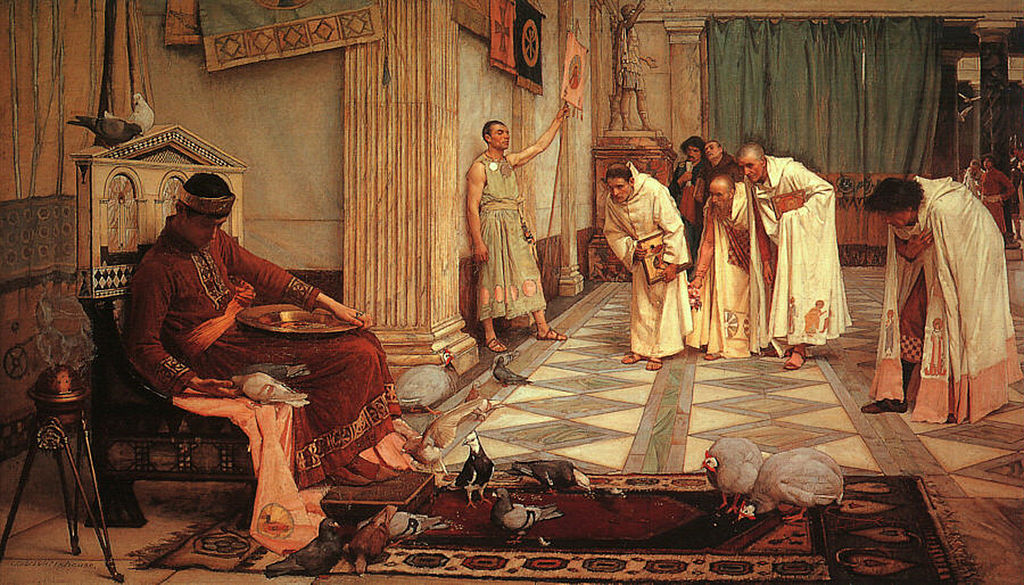
Image: Wikimedia Commons.
The subversive effects of Gnosticism in both its Docetic (that the humanity Jesus or his material body was only an illusion) and non-Docetic forms and of esoteric pantheism were great. Syncretism during the reign of Alexander Severus was also challenged by the church’s leaders and apologists. Mithraism and syncretism returned with Roman soldiers from differing parts of the empire.
The Gospel of Jesus Christ also contended with eastern-type spiritualities coming out of Persia, India, and elsewhere. This writer argues that “Spirit,” as spoken of in the Bible, refers to the Personhood of God as revealed in the person and work of Jesus Christ. This stands in stark contrast to the way “spirit” is defined by the New Age spirituality of Marilyn Ferguson, pantheism, panentheism, the self-engrossed spiritualism of the Yoga practitioners, and the intuitive spirituality marketed by popularizers such as Tolle and Chopra. A contemporary defender of biblical spirituality against the mentalities of these teachers is Ravi Zacharias, particularly in his book Why Jesus?: Rediscovering His Truth in an Age of Mass Marketed Spirituality.
At some undisclosed time persecutions broke out against Christians in the Roman province of Egypt and around Alexandria. Mark’s death is believed to have taken place here. Persecutions also broke out in the Roman province of Cyrene (modern Libya) where Benghazi was later built during Moslem times.
Tertullian, the Roman lawyer turn Christian, defended the Christians against the Roman officials who initiated campaigns against Christians. It was Tertullian, who wrote in a letter to the effect that the blood of the martyrs is the seed of the church. It was not until the time of Diocletian toward the end of the 3rd century that persecutions were widespread from the Atlantic into the Middle East.
What is remarkable, the Christian faith not only survived but spread further afield from Roman Britain into what is now Azerbaijan. It is a good lesson for those who are concerned about the actions of ISIS today. The Christian faith survived, expanded, and outlived those who persecuted them. The fear mongers of the 21st century need to take a lesson from their second, third, and fourth century forbears of the faith. The Christian faith also eased south toward the African sahel from Libya and southeastward into the Sudan and the Ethiopian mountain. It was during the time of Irenaeus that Christianity encountered another foreboding threat from the spread of a Persian-bred spiritualism known as Mithraism. Gnosticism rode piggy-back upon the Mithras religion of Persia which Roman soldiers brought back into the Roman Empire after fighting the Sassanid Persians along the borderlands of what is now Syria, Iraq, and Persia.
When the gospel spread into those regions, some believers took Jesus’ words about Spirit and Truth and twisted them into their own understandings of spirit and truth in which spirit is that which is supernatural and truth as something intuitive. From this twist, Gnosticism emerged and it has plagued the church from the time of Irenaeus to the present.
Irenaeus of Lyons, about A.D. 187, wrote an apologetic against the inroads Gnosticism had made. His Contra Haeresies (“Against Heresies”) became an effective defense of the Christian Gospel. In the New Testament and in the Hebrew Scriptures, Spirit refers to the breath of God which gives life to body and personality.
Truth was not something of an insight into another reality, supernatural or other. Both the Hebraic word for “truth” (emet) and the Greek term for truth (aletheia) refer to nakedness, and are antonyms to hiddenness. Remember how Adam and Eve hid themselves or thought they were hidden from the sight of God? Neither Spirit or Truth refers to something supernatural or mysterious.
 The heart of the matter is that in the spread of the gospel there has to be a clear understanding of the Near Eastern dialectical language in which the Bible was written. It is neither linear, as in Indo-European languages, nor related to any of the languages of central, southern, or far eastern Asia. Indo-European languages often deal in abstractions. The word “meditate” as found in the English Bibles is a sorry substitute for the biblical meaning of “chewing on” or “mulling over,” which reflects the pastoral nature of the biblical world. To mull over the Word of the Lord is a far better reflection of what Joshua counsels in Joshua 1 or what the psalmist is conveying. If there is no instruction on the biblical mind and language, the reader within another culture will superimpose his own indigenous meaning upon the biblical text or the gospel message. This is what happened when the gospel was directed to hearers or readers in a country outside of the gospel’s original homeland. Fortunately, in the spread of the gospel westward, there was enough of a dominant lingua franca understood from the eastern shoreline of the Mediterranean to the Atlantic: namely Greek. Fortunately, for Latin speakers, there were similarities of terms as in pater (Latin) and patros (Greek) to ease the transmission of the gospel. Consider how Simon Peter, Mark, and Andrew, though being Jews, had either Latin or Greek first names.
Once you get out of the homeland of the Mediterranean, as much as you would want to have an indigenous church outside the bounds of the homeland, you have to be careful that the hearer does not introduce his own habits of reference in receiving the biblical message. The spirituality of the Persian and of the Bactrian hinterlands (modern Afghanistan) affected how they received the gospel and Gnosticism hitched a ride on it. The Nag Hammadi letters reflect the impact of Gnosticism, assuring us that Irenaeus of Lyon and the Council of Carthage were right in rejecting those second, third, and fourth century forgeries. However, they linger on even today through writers such as Elaine Pagels, who consider them legitimate gospels.
The same holds true for the spread of the gospel within the Celtic world. However, the spirituality of the countryside was held at bay, thanks to the monasteries and learned monks of Armagh in Ireland and then in England. It has only been in the years between the nineteenth and twenty-first centuries that the Celtic and Brythonic pantheism and panentheism has come to the forefront of attention through the Romantic poets of the nineteenth century and in the ideas of the New Age movement of the late Marilyn Ferguson. More recently, at the dawn of the 21st century, came the spiritualities of Deepak Chopra, Tolle, and Oprah Winfrey which bear no resemblance to the Holy Spirit of which the Bible speaks. For the most part they are introspective and self-induced and in no way upward looking or outward looking. They fool the unsuspecting by inducing people into a self-centered lifestyle with no devotion toward the Lord Jesus Christ but on having a self-satisfying life for one’s own self and no one else.
Late Antiquity had Christian apologists who withstood such inroads. Among them were John Chrysostom, Augustine of Hippo, Patrick of Wales most often associated with Armagh in northern Ireland, and several others. Devotion extended upward to Jesus and outward to others in loving service. They opposed anything that was inward and introspective. In the 700s, John of Damascus took another tack in the attack against mysticism, the paranormal, and a feel-good spirituality.
We in the church need to be less spiritually-minded and more Christ-minded, to live within his presence. People who fancy themselves more spiritual than those they call carnally-minded need to take heed lest they fall. It is a form of pride and fosters an aura of elitism which has no place in the body of Christ.
Similarly, we need to be less institutionally-minded and more community-minded as the Body of Christ. Institutionally we render ourselves ineffective as witnesses to the Lord Jesus Christ. By involvement with civil government, as what has happened in the west, or by a case of “caesaropapism” which hurt the Orthodox for many years, we absent ourselves from our actual calling. The Orthodox, to their credit, often called civilian rulers into question as did John Chrysostom and was just as eloquent and outspoken in exile. Ambrose, in the West, rebuked Theodosius. Similarly, we do not want to withdraw into the desert of “the separation of church and state” and stay there. The City of God is a transcendent reality having a colonial status in this world as pictured in Paul’s letter to the Philippians. The powerful effect is that of an influence beyond measure without getting mired within political contests.
The syncretism which Alexander Severus favored had a motto like “all roads lead to God,” a false teaching still with us today. However, this can and should be challenged because all roads do not lead to God. God has drawn near to us in the Person of Jesus. Only He has revealed the heart of God toward mankind. In the words of theologian Leander Keck, Jesus is the face of God. If ministers, teachers, pastors, evangelists, and counselors stick to the basics tenets of our Christian faith, without getting upset over theological differences among ourselves, we not only will have a powerful impact upon the present world, we will also learn from each other. We, in the West, want to understand the Cross of Christ, whether we be Protestant or Catholic. In the East, we want to stand under the Cross before coming to any understanding. Each person’s life is different and Jesus meets us in our differences and that makes all the difference both within the community of believers and without in the unbelieving world.
PR