
Otis Fisher: The Role of the Spirit in the World and Life

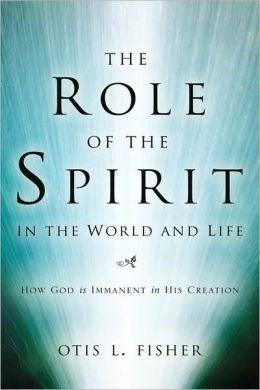 Otis L. Fisher, The Role of the Spirit in the World and Life: How God is Immanent in His Creation (Longwood, FL: Xulon Press, 2004), 159 pages.
Otis L. Fisher, associate pastor in Churchville, VA and graduate of Louisville Presbyterian Seminary, writing to a broad Christian audience has undertaken a greatly needed task—establishing a foundation for the role of the Holy Spirit in all of life. The book can be roughly divided into two parts. Chapters one through five focus on the role of the Spirit in areas other than the life of the Christian believer or the Church in general. Chapter three expresses this well as it develops a holistic understanding of creation and the material world in such a way that the Spirit is explained as centrally connected to the physical world. Fisher says, “The Spirit then is left as the energizing component by which all things come into existence” (p. 50). Chapter four, employing the natural sciences and physics, concludes with the assertion that the Spirit is “fundamental to the basis of the universe” (p. 63). In chapter five, “The Spirit in Animate and Human Life” elaborates on the concept of breath in conjunction with the Greek word pneuma and the Hebrew word ruach to develop the foundation for one’s utter dependence on the Spirit for the continuance of daily existence.
The second half of the book becomes problematic as issues more personal are addressed, i.e. the role of the Spirit in church life, salvation, sanctification, and the future. While the author demonstrates a strong grasp of the Scriptures throughout his book, he does not recognize the personal nature of the Spirit as a living, relational, and dynamic reality in the life of the believer and the Church as regularly seen in Acts and the Pauline epistles. A consistent explanation of the Spirit’s role by Fisher is, “It is through the Spirit that we know and experience God” (p. 117). While this sounds like a personal description of the Spirit’s activity, the author consistently applies such understanding in impersonal ways: a field force (p. 145), a process of spiritual growth (p. 119), vitality, courage, strength, and hope (p. 121). Even chapters eight and nine on sanctification continue to address the role of the Spirit in a fundamentally impersonal manner.
The Spirit’s activity is primarily described as a spiritual growth force or process that occurs in relation to one’s reading of and meditation on the Bible. Such linkage results in a rigidly static understanding of a Spirit-led life (i.e. the Spirit’s activity is primarily limited to times of reading and meditating on the Bible). However, the Scriptures are full of dynamic implications of Spirit-filled living for the Christian and the corporate Church. Some examples of dynamic Spirit-filled living can be seen through a Spirit-empowered prayer life either with or without tongues (Eph. 6:18), through a prophetic anointing where one hears the voice of the Lord via a quickening of the Spirit (Acts 15:28), or through a daily sense of comfort, encouragement, and counsel as Jesus described the role of the Spirit He was to send (John 14, 16).
The author’s understanding of glossolalia as described in chapter six affirms the role of the Spirit in this charismata, though he seemed to do so reluctantly. Fisher describes the gift of tongues primarily at a psycho-emotional level when he says, “It appears to be a situation in which the individual is so overwhelmed with the emotion, the thought and glory of the wonder of God that one loses to some extent immediate control of the faculty of speech and movements of the body. Speaking in tongues, I think is to some degree analogous to the physical problem of stuttering. Stuttering, some authorities would say is more of an emotional trauma than physical” (p. 88). Further attempting to affirm the value of this gift, the most the author can say is, “It is an emotional outpouring that has questionable value but it still is a reflection of the presence of the Holy Spirit in the believer and should not be entirely ruled out in the life of the faith community” (p. 89). Such efforts to affirm but not truly affirm, leaves the reader confused as to what the author is trying to say.
As a resource, the first half of the book was most helpful and insightful in describing a subject not often discussed—the role of the Spirit in creation and the universe—however the second half was less helpful. The greatest weakness of the book was the incomplete development of the Spirit’s activity on a personally relational level with individual believers and the Church corporately. Thus in terms of personal relevance the reader is left with a subordinated understanding of the Spirit in relation to the Father and Son so that He is declared as essential and vital yet treated as impersonal and merely functional. It is obvious that Fisher put much time, effort, research, and thought into this book (even a cursory review of his sources will show this). However, it is unfortunate that one also finds numerous errors of grammar and punctuation; such oversights communicate a lack of editorial oversight.
The final chapter of the book, “The Spirit in the Future,” was Fisher’s best attempt to incorporate an understanding of the Spirit on personal terms with the believer. He speaks of Paul’s description of the Spirit given as a “seal” and a “guarantee” of that which is to come (2 Corinthians 1:22) and the same again in Ephesians 1:13-14. While this was the author’s strongest explanation of the Spirit as a present reality described in terms more personal than previous chapters, such development was still limited as it was understood primarily as a guarantee of the fullness later received in heaven. The extent of this guarantee was not developed, so again the reader is left wondering just what role the Spirit personally plays in an individual’s life. Fisher concludes with a powerful statement of the Spirit, albeit one which believers must wait for. In the final words of the last chapter he says, “It is not only that the power of the Spirit of God will recreate this earthly world but it will be the possession of the life giving force and ever renewing energy of the Holy Spirit that will give us eternal, everlasting life; that will make us immortal.” Pentecostal, Charismatic, and Eastern Christianity could just as easily make the same statement yet fully intend such realization as an immediate reality available to every believer. It is unfortunate that Fisher did not engage these traditions in this work on the Spirit; they each provide a rich theology and experience of the Spirit-led life. Such ecumenical interaction could have provided a foundation for the personal relationship of the Holy Spirit that this book lacked.
Reviewed by David Trementozzi