Revival, Truth, and Persecution: An interview with Eugene Bach

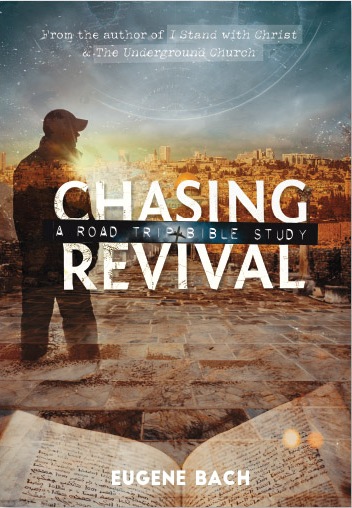
PneumaReview.com: The Back to Jerusalem ministry that you work with recently released a new study resource called Chasing Revival: A Road Trip Bible Study, where did the idea for this resource come from?
 Eugene Bach: I travel more than 300 days a year for ministry and see a lot of different types of Christians. I speak at big churches and small churches. I work with underground house church Christians in Iran and traditional conservative churches in Europe and as different as they are all are, there is a common thread that binds us all together – our desire to see revival.
It is a universal desire among Christians world-wide.
I have been working in China for almost 20 years and during this time I have witnessed the world’s largest revival. Being involved with grassroots missions in China has thrown me into the fires of cultural immersion and allowed me to experience this revival firsthand as it was happening.
Traveling with Chinese missionaries into many closed nations has provided me with a unique perspective of the pain that exists in nations where revival has tarried.
Six years ago, I decided to start from the beginning, trace the history of revival, identify it’s characteristics, and see what we could learn to help push forward into the nations that have not yet experienced revival.
PneumaReview.com: The word “revival” means many things to many people. How would you define it?
Eugene Bach: I want to be very careful to not create a rigid definition of revival that excludes a movement of God, so for our road trip Bible study, we start in the book of Acts chapter 1 and follow what happens in the first century church.
During our road trip Bible study, Chasing Revival, we found this definition to be more accurate than others.
We believe that revival is not necessarily spontaneous – appearing out of thin air, but is rather continuation of what Jesus promised in Acts chapter 1. The revivals happening in China today are not new, but their roots can be traced back to Acts 1 in Jerusalem 2,000 years ago.
PneumaReview.com: What are some of the places you traveled to while making Chasing Revival?
Eugene Bach: We started in Jerusalem and followed the book of Acts into Judea, Samaria, Asia Minor, and to the “ends of the world.” This led us in a mainly western direction.
Although some disciples went eastward, their works were not recorded in canonical writings. Instead, Luke transitions from Peter – who traveled west – to Paul – who travels further west.
In Acts 16:6-10 we see that Paul wanted to go “east” but the Holy Spirit stopped him. Then he attempted to go north to Bithynia, but was stopped by the spirit of Jesus. Instead, he traveled west to Europe.
This led me on a journey following the history of the church as it spread from the Middle East to Africa, Europe, the Americas, and then around to Asia. In Asia we currently have both the world’s largest revival (China) and the world’s largest church (South Korea), but between Asia and Jerusalem is the notorious 10/40 Window. This is the area that is resisting revival and is the last frontier for missions.
I traveled for more than six years to more than 20 countries following the history of revival, and I barely scratched the surface in this road trip Bible study.
PneumaReview.com: What would you say are some of the key factors that have caused the gospel to spread?
Eugene Bach: There were several factors that we find in our study, but the one factor that I found over and over again is one that I wish I had not – persecution. Unfortunately, every instance I found of revival, I found persecution to be her constant companion.
PneumaReview.com: At any point in your research did you find a time or a place where the importance of the ministry of the Holy Spirit was particularly highlighted?
Eugene Bach: Every instance where we found revival, we found evidence of the Holy Spirit. We did however find that it was very important to not try to dictate how the Holy Spirit moves and operates, because at each step in history, we found that the way the Holy Spirit works is unique to the people being ministered to.
We did not find a Holy Spirit ‘formula’ that manifested the same way each time. What we found in our study was that the operation of the Holy Ghost in history has been proven to be as diverse as His presence throughout Scripture.
PneumaReview.com: What, if any, connection have you found between revival and persecution?
Eugene Bach: Day 18 of the road trip Bible Study is labeled: “Revivals Contagion – Persecution.”
The connection between revival and persecution was a bit scary, because our Western society seems to have a strong aversion to persecution. I only say that because of our current debate about what we find offensive.
This portion takes a bit more unpacking and does not fit as nicely into a two paragraph answer.
There are moments when our ignorance makes truth hurtful and offensive and we, in the West, can feel persecuted.
Our lack of understanding of God can make His actions seem offensive to us. If I am honest, His seeming silence and absence on so many matters are often times offensive to us, and few things in modern society today are more egregious than being offensive. On many college campuses today, being offensive, is considered to be the highest of crimes.
To be offended in modern society is such a high crime because the emotional welfare of man reigns supreme, but as Christians we do not have the same privilege. We do not have the right not to be offended.
Compounding the problem is that a casual phrase or even a look can be offensive; those are called micro-aggressions. Micro-aggressive phrases are banned on campus, and students who use them are considered to be violating the safe space of other students.
These so-called safe spaces are not merely relegated to university campuses, but this idea is also rearing its head in Christian churches. Churches too have succumbed to the idea that they must become safe spaces that attempt to insulate their congregants from things that might hurt their feelings.
How can we rightly evaluate the impact of the Gospel if the Gospel is found offensive by the world and we have insulated ourselves from that which is offensive? It is impossible—which is exactly how the world would like it to be.
When we are evaluating the impact of the Gospel, we cannot put our feelings before revelation. The light is offensive to the darkness; therefore, the teachings of the Bible will be offensive to society. If the church caters to the desires of society’s wishes, then the majority of what Jesus taught will be labeled offensive.
As harsh as it might seem, what I have come to believe from this study is that anyone who requires a safe space and cannot deal with the realities of being offended, cannot participate in the Great Commission. They cannot share in the suffering of Jesus that brings about revival, because there are no safe spaces in the Bible, and there are definitely no safe spaces in the calling God has put on our life.
If our walk with God leads to revival, it will entail a degree of suffering because our service to Truth will be offensive to the world.
It is the lack of a safe space that leads us into the will of God and exposes us to persecution, but this is the beginning of revival.
And I get it. It’s hard to embrace suffering. And I understand that the Bible is full of love, grace, mercy, etc. Don’t get me wrong; this is the central message of the Gospel. But the Gospel message is also truth, and truth is true regardless of how we feel. Truth couldn’t care less about our feelings.
God’s Word is truth, and it doesn’t stop being true just because we might be offended. And if our feelings are hurt by God’s Word, it is not the Word of God that needs to change to adjust to our feelings, but our feelings that need to adjust to fit the truth of God’s Word.
Now, do not misunderstand. I am not saying that we should preach truth to intentionally hurt others. I am reminding us all that we need to be ready to expose ourselves to pain for the sake of searching out the truth. We cannot continue to create culturally homogenous environments that cater to the world and neglect the true teachings of Christ because of our fear of offending the very world that we are called to save. Why would a rescuer desire to mimic a drowning man in an attempt to save him? The truth only has power to change societies when it is shared, not when it is diluted, so let us cast off anything that keeps the Gospel from being productive.
Let us reject all that obstructs the truth from releasing revival into our society and let us more forward boldly proclaiming the true Gospel of Jesus Christ.
PneumaReview.com: What was the most surprising thing that you learned in the process of making of this new resource?
Eugene Bach: What I learned about homosexuality and the early persecution of the church probably surprised me the most.
When I first started this journey, I never dreamed that I would discover the history about homosexuality and persecution against early believers – but that is exactly what I found.
What I stumbled across while researching the history of revival blew me away and challenges the things that I have been told about homosexuality in the church.
Before I began this study, I thought of homosexuality as a modern-day phenomenon. Of course I knew that it had always existed, but I never thought it was something that was widely accepted the way it is now. But as I walked in Paul’s footsteps prior to the outbreak of revival in Europe, I realized I was wrong.
The pieces started to come together when I traveled throughout the ancient Roman Empire, in places like Rome, Assos, and Mitylene. When I studied the history, I discovered that homosexuality was not only practiced, it was institutionalized. Not only were same-sex relationships common and acceptable, but Roman males often proved their power, dominance, and virility through forcing their male slaves to serve their desires. Their conquests were sometimes celebrated through homosexual acts, and young male slaves were the most prized possessions. It was even commonly practiced among the military ranks, as homosexuality was even associated with entrance into the military.
In the recess of my mind, I guess I had always thought of homosexuals as being victims – being wrongly abused throughout history, but that idea came unraveled as I dug deeper in to church history. What I found was very disturbing. Early Christians were victims of homosexual rulers.
I was completely caught off guard to learn this aspect of Roman and European culture prior to the days of revival. I was totally unaware that homosexuality was in fact more accepted during the days of Paul than it is today, not the other way around.
When Paul went to Rome, he was facing sexual practices that were not only instituted at the highest levels of power but were deified. He addressed it in his letters to the early church. When I learned this information, it made his words in Scripture take on completely new meaning.
This dark hole of history went even deeper. This information blew my modern ideas about homosexuality out of the water and challenged me to my core.
I share in more detail about what I found on Day 34 of the Chasing Revival study.
PneumaReview.com: Is there anything else that you would like to tell our readers about Chasing Revival?
Eugene Bach: There are several good Bible studies out there today, but Chasing Revival is different in the way it explores reals questions and does not spoon-feed easy answers to the reader. It is written with the belief that disagreement can lead to the best deep dive studies. We ask difficult theological questions and are not afraid to start heated disagreements in finding the answers.
The study was not done systematically. We asked question regarding revival and searched through history for the answers. Some sections are longer and some sections are shorter. We did not try to shorten chapters to fit a predetermined word count and we did not shy away from brevity when a lengthy answer was not needed.
Chasing Revival will most likely not be a best seller, but it was a labor of love to the study of revival that we very much needed for our own answers for Back to Jerusalem.
PneumaReview.com: Please tell our readers where they can purchase this resource.
Eugene Bach: The 61 Day Devotional can be purchased separately, or the entire study including the devotional, work book, and 9 part video series for small Bible study groups can be purchased only at: https://backtojerusalem.com/product/chasing-revival-a-road-trip-bible-study/