
Messianic Pictures in the Temple Sacrificial System


Artwork by Steve Grier © 1997 RBC Ministries. Used by permission.
“… all things which are written about Me in the Law of Moses and the Prophets and the Psalms must be fulfilled.” (Luke 24:44 NAS)
These words of Jesus are both wonderful and mysterious. It is easy to see the messianic implications of a passage such as Psalms 22 or Isaiah 53, and the Savior’s great work in bringing those promises into reality.
Certainly even, we can comprehend passages of the Torah (the five books of Moses) which clearly refer to the Christ. No one can doubt the intent of Moses in Deuteronomy 18:15: “The LORD your God will raise up for you a prophet like me from among you, from your countrymen, you shall listen to him.” Even the Jewish sages—who do not yet recognize Jesus as Redeemer–acknowledge that Moses was speaking of the coming king of Israel, the Messiah.
Yet, what about a complex book like Leviticus? Do these pages truly speak of the Savior of all mankind? In Luke 24:27 we are told, “And beginning with Moses and with all the prophets, [Jesus] explained to them the things concerning Himself in all the Scriptures.” Our challenge in this document is to find Jesus, even in such a difficult and arduous book as Leviticus.
“Leviticus” in the Hebrew Bible is rendered Vayikra, which means, “and He called.” We leave Exodus with a Tabernacle emanating the awesome power of God with such intensity, that not even Moses could approach. Many rabbis teach that Vayikra began immediately where Exodus ends; that amidst the spectacular manifestation of His Shekinah glory—Vayikra, “and He called to Moses and spoke to him from the tent of meeting.” (Leviticus 1:1)
Only three times in Scripture does God call out to Moses. He often spoke with His servant, but in forty years of leading Israel from Egypt to Israel, rarely did He call to him. In each case, the matter for which Moses was summoned was deeply significant. In the case of Leviticus 1:1, the Supreme Being wanted to detail the ritual and regulations of the sacrificial system. A seemingly crude and barbaric service of bloodletting by today’s sterile, steak-wrapped-in-cellophane FDA standards, but a magnificent picture of the coming work of the Messiah.
While we may not appreciate the concept of sacrifices, they were the means by which our Creator brought life and light into the world. They should never be confused with occult ritual which is at war with the Kingdom of Life. “What fellowship has light with darkness?” (2 Corinthians 6:14)
With that said, let’s move ahead in our examination to discover Jesus in the book of Leviticus. Chapters 1-5 reveal five different types of sacrifices and, therefore, five different characteristics of the sacrificial system. There is a great deal of documentation on how the offerings where to be made, what was acceptable and what was not. We want to focus on why.
Precedent
The first why might well be, “Why have sacrifices at all? Certainly God could have ordained a more humane way of making atonement!”
Ultimately he did, in the life, death, and resurrection of Jesus our Messiah. But just like our own American justice system, there must always be precedent. In Scripture, our God of justice always builds “his case” on previous Divine revelation. The Almighty magnifies–or builds upon–something already in place; whether in the creation account where the Spirit is hovering over the waters, or when Jesus takes a few loaves and fishes to feed the multitudes. God always starts with something and fashions more out of it. This is a key concept in our own legal system. By understanding the foreshadows we can more easily grasp and appreciate the substance, which is Christ our Lord (Col. 2:17).
It is no less is true with the sacrifices, which begin in the Garden of Eden: “And the LORD God made garments of skin for Adam and his wife, and clothed them.” (Genesis 3:21) There was a sacrifice made in order for Adam and Eve to be “covered.”1 Cain and Abel teach a little bit more about proper attitudes in the sacrifices. Noah demonstrates clean and unclean animals and the sacrifices of thanksgiving. Along comes Abraham and we have a greater glimpse and comprehension. The Passover lamb in the great Exodus from Egypt augments our appreciation. Leviticus 1-5 continues in this biblical tradition, as the Most High follows His own custom, to build on precedent. Even in the millennial temple, Ezekiel demonstrated that the Messiah himself will offer up the sacrifices, no doubt building upon precedent already formed in the Old and New Testaments.
 The term sacrifice is weak in our English language, but very powerful in the original Hebrew. The script of the Older Testament for sacrifice or offering is korban, the root of which means, “to draw near.” The substitutionary sacrifice of animals was instituted by the Judge of all the earth so that sinful man could “draw near,” and enter into relationship with Him. This is the precedent Jesus would build upon. upon which Jesus would build.
“He is able to save forever those who draw near to God through Him since He always lives to make intercession for them. For it was fitting that we should have such a high priest, holy, innocent, undefiled ,separated from sinners and exalted above the heavens; who does not need daily, like those high priests, to offer up sacrifices… because this He did once for all when He offered up Himself.” (Hebrews 7:25-28)
The Levitical sacrifices permitted God’s people to “draw near.” Our sacrifice, Jesus, fulfilled this in a more complete way, permitting each of us, even among the Gentiles to “draw near” to the King of kings and LORD of lords with convenience undreamed of by the ancient Israelites!
With these foundations in place—that God builds on what has gone on before, and that His desire is to draw near to His creation—mankind—we are ready to plunge into the teachings revealed in the sacrificial system.
Burnt Offerings
The olah offering was purely a voluntary offering, out of the convictions of one’s heart. Many renowned Jewish rabbis teach that if one entertained impure thoughts, the olah offering afforded him the opportunity to repent privately, and give this free-will offering to signify his “newness of life.”
Jesus addresses this same human tendency in Matthew 5:22, “But I say to you that everyone who is angry with his brother shall be guilty… and whoever shall say ‘You fool,’ shall be guilty enough to go into the fiery hell.”
Matthew 5:27, 28 is likewise well known in regard to the sins of the imagination: “You have heard that it was said, ‘You shall not commit adultery;’ but I say to you, that everyone who looks on a woman to lust for her has committed adultery with her already in his heart.” These are the types of sins where the olah offering would be appropriate. “Shall not God search this out? for he knoweth the secrets of the heart.”2
The olah offering was indicative of “newness of life” in another unique way. In Exodus 18:12, Moses’ father-in-law, Jethro, makes an elevation offering unto the Lord. Many rabbis teach that this was done because Jethro became a Jewish “convert,” and until the destruction of the second Temple, the olah offering became the required sacrifice for all Gentile conversions (for this sacrifice was voluntary and it indicated “newness of life”).
This is the teaching of the Levitical sacrifice. Does it speak of Messiah? Of course!
The olah offering is voluntary. This characteristic is seen in Jesus in John 10:17, 18, “For this reason the Father loves Me, because I lay down My life that I may take it again. No one has taken it away form Me, but I lay it down on my own initiative.”
—John 10:17, 18
Similarly, the olah offering is an “elevation” offering, it is literally lifted up. Jesus said, “When you lift up the Son of Man, then you will know that I am He,” (John 8:28) “And I, if I be lifted up from the earth, will draw all men to Myself.” (John 12:32). He is the only true sacrifice suitable for Gentile conversions into the faith.
Meal Offerings
The second chapter of Leviticus addresses the meal offering, or grain offering; minchah in the Hebrew. There are many unique characteristics about the minchah offerings. First, they were baked into ten loaves, the symbolic number of completeness. The “loaves” were baked without yeast, leaven being symbolic of sin. The finished dough was then “anointed” with pure olive oil.
Finally, the minchah, or meal offering, was just that—an offering. It was not required. It did not atone for any sins. It was a gift or a tribute from the conscientious Jewish citizen. In this way, it parallels the admonition of Paul, “God bids us to offer ourselves as a living sacrifice which is our reasonable service of worship” (Romans 12:12).
Peace Offering
Next on our list of Temple sacrifices is the peace offering from Leviticus 3. Some translations render this as “fellowship offering,” which is relevant inasmuch as this is the outcome of the offering. However, the Hebrew, shlamin carries with it the same root Hebrew word shalom, which literally means “peace.”
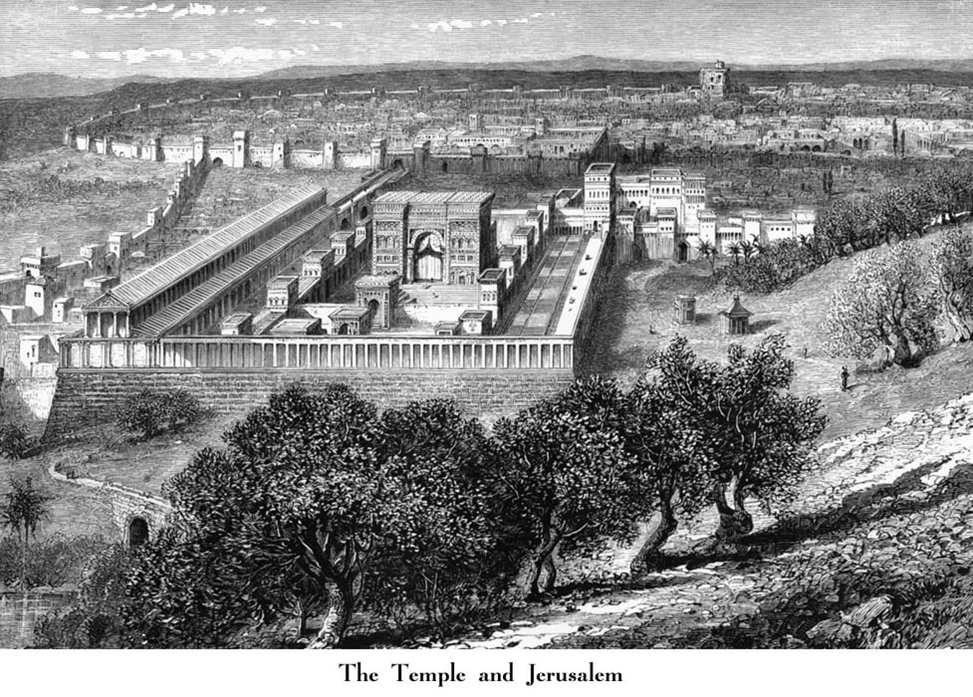 Of the sacrifices reviewed so far, this is the first one not burned entirely. It is intended to be shared and eaten by the Levites, the person making the sacrifice, and often, his friends and family. The relevance of “fellowship” is clear, as all who are in a right relationship are fellow partakers in the meal: very much a foreshadowing of the Lord’s Supper, or communion.
But as far as it reveals the character of the Christ, we must look to the “peace” nomenclature. Paul reminds us, “Having been justified by faith, we have peace with God through the Lord Jesus the Messiah.” (Romans 8:1) This fulfills the very promise of Jesus in John 14:27, “My peace I give you.”
The “peace,” or Sabbath rest, is to be a part of our new nature, an evidence and testimony of our joy and salvation in Jesus. But like the olah offering already discussed, it is dependent on our thought processes, where we invest our imaginations. Philippians 4:8-9 encourages us along these lines: “Finally, brothers, whatever is true, whatever is noble, whatever is right, whatever is pure, whatever is lovely, whatever is admirable—if anything is excellent or praiseworthy—think about such things. Whatever you have learned or received or heard from me, or seen in me—put it into practice. And the God of peace will be with you.” Proverbs puts it just as well, “For as he thinks within himself, so he is” (Prov. 23:7).
We are half way through our journey of the sacrifices and their revelation of the Messiah. Before we can continue with the sin offering of Leviticus chapter four, however, we need to lay additional ground work to fully understand the sacrifice of the Messiah. Two topics need to be addressed: the biblical concept of clean and unclean, and the purpose behind the types on animals being offered.
Clean Versus Unclean
The concept of clean and unclean is first found in the Noah account, when God commands him to take additional clean animals onto the ark. So the bulls, goats, and sheep didn’t go aboard two-by-two, but in groups of seven!
Unclean, in the biblical sense of the word, meant coming into contact with the kingdom of death. The female cycle means that a “life potential,” the egg, has died and is being expelled. The woman has not sinned, but has come into contact with “death.”
Any form of blood, therefore, the symbol of life in Leviticus 17:14, is “off limits” to the community of the redeemed. This concept was familiar to the Apostles, who commanded the new Gentile Christians in the Jerusalem Council in Acts to “abstain from blood.”
Being ritually unclean, and therefore forbidden from the Temple services, meant that a person had come into contact with “death,” either literally or symbolically. “Unclean” did not imply sinfulness. The Temple Mount, representing the Kingdom of God on earth, cannot coexist with the kingdom of death, just we, through faith in Jesus are to be dead to the flesh, living in newness of life, a new creation in Messiah (2 Cor. 5:17, Gal 6:15).
Types of Animals Used
The types of animals the Most High chose to be used as sacrifices were also specific and significant. There were bulls, male goats, female goats, and pigeons or turtledoves. An understanding of the animals and their relationship to the sacrifice will be helpful in understanding not only the Bible better, but also, Jesus’ relationship to the ritual.
Would that Christian history had been so optimistic in its relationship with the Jewish people. For hundreds of years, sacrifices were offered for the salvation and eventual sanctification of the Gentiles, a hope realized in the death and resurrection of the Jewish Messiah. We Christians owe a great debt of gratitude to our Jewish brethren, as Jesus rightly reminds us, “salvation is from the Jews.” (John 4:22)
As for the High Priest, we read that he had to offer up a bull for his own transgressions and then, he could offer up the other sacrifices. The bull was the highest order of sacrifice, reserved for the one who represented the entire nation. As the representative of the citizenship, no “ordinary” sacrifice would do.
After the bull came the male goat. This was reserved for the leadership of the nation of Israel. Inasmuch as the male represented authority, it was fitting for the kings, elders, and judges to bring a sacrifice accorded to their rank.
— Jewish Theologian Abraham Heschel
What a wonderful illustration of the perfect sacrifice offered once and for all, Jesus, whose blood covers a multitude of sins: ones we remember and ones we have no idea we even committed. As much mercy as we see in the Temple sacrifices, unmerited and undeserved, how much more is it made manifest in the sacrifice, Jesus the Christ?
Finally, we have the pigeons or turtledoves. These were also a part of the Almighty’s mercy, since not everyone could afford a goat. These innocent, clean birds were a way that even the poor could have a part in atonement and the Tabernacle/Temple ritual. In this way we see that God desires for all people–both rich and poor–to have access to Him, and to be able to “draw near.” Even in the Levitical system, in His inestimable mercy, God made provision.
The avian sacrifices also give us a glimpse of the economical class of Jesus’ parents, Joseph and Mary. “And when the days for their purification according to the law of Moses were completed, they brought Him up to Jerusalem to present Him to the Lord (as it is written in the Law of the Lord, ‘Every [first-born] male that opens the womb shall be called holy to the Lord’), and to offer a sacrifice according to what was said in the Law of the Lord, ‘A pair of turtledoves, or two young pigeons.” (Luke 2:22-24)
Sin Offerings
In Leviticus 4, we encounter the next sacrificial offering, almost universally translated as the “sin offering.” This ritual, referred to as the hatat was the first in our study that was required by God. The olah, minchah, and shlamin offerings were all voluntary offerings brought to the Lord from a sense of personal conviction. The hatat, however, carried a unique weight, and it was obligatory.
Another unique aspect of the sin offering was, as already discussed above in the she-goat offering, this was an all encompassing ritual, designed to atone for the sins committed in ignorance, also called the sins of omission. In God’s desire for His people to “draw near,” He provided for all aspects of human imperfection—including those sins of which His people were ignorant of having perpetrated. It is a true proverb that “ignorance is no excuse of the law.” God, in His infinite mercy covered even the minutia we so easily overlook. How much more so, then, with The perfect covering of The perfect sacrifice, Jesus.
A third aspect of the hatat offering was that it rendered a person considered ceremonially unclean, clean. Any contamination acquired through contact with blood, death, or other manifestation of the kingdom of death outlined in God’s holy Torah, was rendered not merely inconsequential, but exactly the opposite: the unclean was transferred out of the kingdom of death into the kingdom of light and life
We find this observance in Luke 2:22 “When the time of their purification according to the Law of Moses had been completed…” Joseph and Mary presented two pigeons, because they were poor, to the Temple priests in accordance with the Law of Moses. Did they do this because they had sinned? No. Childbirth is a perfectly natural occurrence and an event to be celebrated. However, anyone who has ever given birth knows, there is a lot of blood! Considering this hatat offering a sin offering exclusively is too narrow in scope, and a reflects the limitation of our English language. The hatat, as already discussed, rendered that which was ritually unclean—because of blood—clean. Mary had not sinned, but she had come into contact with a lot of blood.
1 John 1:9 reads, “If we confess our sins, He is faithful and just to forgive our sins and to cleanse us from all unrighteousness.” It would seem, through the Messiah, that were are made clean, even from the unrighteousness we don’t even know about. What an awesome God we serve!
The path of salvation made for the Gentiles is directly tied to the hatat work of Jesus. Following his vision of the unclean animals, Peter realizes that God’s desire is for the gospel to be given to the unclean—the Gentiles. “But a voice from heaven answered a second time, ‘What God has cleansed, no longer consider unholy.’”3 Peter later explains his vision, “And he said to them, ‘You yourselves know how unlawful it is for a man who is a Jew to associate with a foreigner or to visit him; and yet God has shown me that I should not call any man unholy or unclean.’”4
“Brethren, you know that in the early days God made a choice among you, that by my mouth the Gentiles would hear the word of the gospel and believe. And God, who knows the heart, testified to them giving them the Holy Spirit, just as He also did to us; and He made no distinction between us and them, cleansing their hearts by faith.”5 In this Scripture, the concrete was set. The legalistic theology of the influencing Judaizers6 would not, and could not be allowed to undo what Christ had done on the cross—transferring those who were unclean and in the kingdom of death, and making them “clean,” as citizens in a new kingdom. “For He rescued us from the domain of darkness, and transferred us to the kingdom of His beloved Son.”7
Guilt Offerings
The guilt offering, or asham in the Hebrew, was God’s vehicle for handling those sins of which we knew we were guilty. We had purposely rebelled and acted contrary to God’s will. Guilt was on our heads, symbolically, blood on our hands. At some point, though, we realized our sin and the weight of its penalty and repented—turned the other way. Before Christ, however, the only way to demonstrate our repentance and have the sin(s) covered was through blood sacrifice, the asham offering.
The repentant brought his offering to the priests, pressed his hands on the animal’s head, symbolically transferring the blood of his hands—his sin—onto the innocent creature. For the sacrifice to be considered legitimate, the sinner had to identify with the atoning animal.
The guilt offering sacrifice came with a price. Many of the “Don’ts” in the Torah carry a price. “If you do this, then you must offer a sacrifice and pay this penalty.” There was a monetary consideration that was connected with the asham.
We find a glimpse of this in Matthew 5:23, 24 “If therefore you are presenting your offering at the altar, and there remember that your brother has something against you, leave your offering there before the altar, and go your way; first be reconciled to your brother, and then come and present your offering.” It is God’s desire that all fellow believers be reconciled one to another. This is no less true in a New Testament faith. Certainly, the cross covers our sins and God has forgotten them. “For I will forgive their wickedness and will remember their sins no more” (Jer. 31:34).
This characteristic of the asham offering is wonderfully illustrated through the death of our Messiah. Matthew 20:28 says that, “the Son of Man did not come to be served, but to serve, and to give His life a ransom for many.” He sought us out and He paid the price.
In the prophetic writings of Isaiah, we find that the Messiah must, in fact, be the guilt offering. In 53:10, we read, “… if he [Messiah] would render himself a guilt offering.” The Hebrew word is none other than asham, which, according to Jewish for of interpretation, would imply all the other offerings as well.9 That means that Jesus would have to become the burnt, meal, peace, sin, and guilt offering, just as we have been examining here. Certainly, as we began our study, he came to fulfill “… all things which are written about Me in the Law of Moses and the Prophets.”
The Guilt offering was the final sacrifice offered up each day. Historical records state that in the Second Temple period, the High Priest would complete the daily bloodletting at about the ninth hour (3:00 PM). This asham offering, guiltless and blameless, was killed as a substitutionary atonement for the people. When the ritual was over, the High Priest would say, “It is finished.” The Bible tells us that Jesus also died at the ninth hour, uttering the same words as our High Priest, “It is finished” (Mark 15:34, John 19:30).
Thanksgiving Offerings
The last in our list of daily offerings is in Leviticus, chapter seven; the Thanksgiving offering. Like the olah and minchah offerings, the Thanksgiving offering, or todah in the Hebrew, is a free-will offering, coming from the innermost desire of one’s heart to give praise and thanksgiving to God.
These were commonly brought to the temple when something “wonderful” had happened in some one’s life. A betrothal, a wedding, the birth of a child, a successful business venture, or the like. They were not required, but came from an intense sense of gratefulness for all that the Sovereign King had done.
As believers in Jesus, in the great work He has done on our behalf, for the promise of His return and our eternal place with Him, we too should be before God with continual thanksgiving, as Colossians 2: 6,7 says, “Therefore as you have received Jesus Christ the Lord, so walk … overflowing with thanksgiving.”
Precedent Revisited
Earlier it was discussed that God always builds upon what is already established; that there is always a precedent in creation. Now that we have a clearer understanding of the sacrifices, let’s take a look at what God has built.
We have already discovered that the first sacrifice was made not for the Jews of the Tabernacle period, but for Adam and Eve, garments of skin to atone for—or cover—the sin of their nakedness. Here we find not only the foundational precedent for sacrifices, but for the commandments regarding modesty.
From here we move on to the drama of Cain and Abel in the fourth chapter of Genesis. Much speculation has gone into the sibling conflict which brought murder into the world. The key to understanding the conflict, and therefore its significance in the sacrificial system, is found in verses three and four:
“And in the process of time it came to pass, that Cain brought of the fruit of the ground an offering unto the LORD. And Abel, he also brought of the firstlings of his flock and the fat thereof. And the LORD had respect unto Abel and to his offering.”
Strong’s Concordance gives several appropriate definitions for “the fat” of Abel’s offering. The Hebrew, cheleb is likewise translated as, “best, finest, and choicest.” This gives us a glimpse into a number of important lessons.
Abel didn’t bring just any sacrifice, only the first and finest would do. The “first” being a presentation of his firstfruits, or what we might refer to today as a tithe. The “finest,” represents a precedent in Torah where only a spotless animal, without flaw—like our Messiah—will do.
As the Hebrew illustrates, cheleb intimates the finest and first, but it equally means “fat.” In the commandments, the fat of the sacrifices was always reserved for the altar, a pleasing aroma which ascended to God.10 If you’ve ever barbecued on the grill, you now how aromatic that can be—even drawing the salivating attention of your neighbors!
The most important lesson for us about Abel’s sacrifice is that Abel was expressing sacrificial love. He was willing to give his first and finest to the Almighty. His sacrifice was accepted not because of its components or ritual, not on the basis of works, but because of the condition of Abel’s heart. It is in this regard that the Old Testament reminds us, “The sacrifices of God are a broken spirit; A broken and a contrite heart, O God, You will not despise.”11
Now we move on to Noah, who “found grace in the eyes of the LORD.”12 Even before the commandments of which animals are acceptable for sacrifice or to eat, before the legal identification of clean and unclean, we have Noah and the ark.
“… of every clean animal take unto you seven pairs.”13
After the flood waters subsided and all living creatures left the ark, Noah took of the clean, innocent animals, built an altar and made sacrifices. With what we know now about the nature of the Temple sacrifices, one of the functions of the hatat sacrifice is that it renders what had been unclean, the earth, and makes it ceremonially clean. Certainly this is what God accomplished through the flood.
Perhaps more importantly, and of particular relevance to us, and precedent for the patriarch Abraham, is that because there were seven pair of clean animals on board the ark, offering the sacrifice not only didn’t seal the fate of the creature, condemning it to extinction, but just as God did with Abraham, God Himself provided the sacrifice.
“And Abraham said, ‘My son, God will provide himself a lamb for a burnt offering:’” 14
In this same way, through Jesus, God provided for us not because of our worth or our good deeds, but like Noah, because we “found grace in the eyes of the LORD.” Even as far back as the flood, the Author of life was preparing both the way, and the sacrifice.
From Noah, we move forward to the time of Abraham and Genesis chapter fifteen. Here we discover the very order of the animals of the latter Levitical sacrifice.
“And he [God] said unto him, Take me an heifer of three years old, and a she goat of three years old, and a ram of three years old, and a turtledove, and a young pigeon.”15
As we have already studied, these are the animals, in their rank and position for the ritual and Temple that was still centuries away. It was in this Genesis fifteen account that God entered an unconditional covenant with Abraham through an all encompassing sacrifice, with Abraham being the beneficiary of the promises being made by God. All Abraham had to do was exercise faith in God. “For we say, ‘faith was credited to Abraham as righteousness’” (Romans 4:9, Genesis 15:6).
Here, in the covenant making, are all of the sacrificial animals we find in Leviticus. Was this an accident, a coincidence, or a plan of the Omnipotent One? Our God is the same yesterday, today, and tomorrow. He is changeless and very predictable, and the threads of His grace are woven into the tapestry of Scripture, from these pictures in Genesis, all the way through Revelation, for all to see—and believe!
In the order given in Genesis 15, and the animals in Leviticus, we find relevance for the mighty ruler, the priests, the commoner, and yes, even the poor. In this covenant with Abraham, we have the picture being intended for all class of Jewish people. All men (and women) were symbolically and prophetically accounted for and provided for. This precedent was built upon in the Levitical sacrificial system, still a part of the original covenant, renewed, if you will, in the Temple service.
How much more so, then, is this thread of grace magnified through the substitutionary atonement of Jesus the Anointed One. Messiah is rightfully identified as each of the sacrifices, having become the guilt offering, as according to prophecy, for all people both great and small, rich and poor, Jew and non-Jew. As Paul said, “… if you belong to Christ, then you are Abraham’s descendants, heirs according to promise” (Galatians 3:29).
What a wonderful picture of the redemption hoped for by the Old Testament saints, and there for us to realize—and find redemption—through faith in the death and resurrection of our Messiah, Jesus!
And just as with Adam and Eve, with Abel, with Noah, and with Abraham, God was the Provider. No less is true today. We have the word of the apostle John, “In the beginning was the Word, and the Word was with God, and the Word was God. The same was in the beginning with God. All things were made by him; and without him was not any thing made that was made. In him was life; and the life was the light of men.”16
In a similar way, God provided the sacrifice, and the order of all time, so that we too might enter into an unconditional covenant with the God of all creation, the God of Abraham, Isaac, and Jacob, through the perfect sacrifice, Jesus the Messiah.
Closure
Early on in this look at the sacrificial system, the question was posed, “why?” “Why have sacrifices at all?”
There is a unique characteristic in human nature that has acquired a modern tag: closure. There is something in the human psyche that requires a clean, understood, and absolute end to any given event.
We are creatures that need to know it’s over. There is nothing else to watch, nothing else to do, no more to be said, it is finished.
Often in our faith walk, we feel like there is something more we should be doing. We find ourselves feeling guilty at times because we have convinced ourselves that somehow, God demands more out of us. We “do” in the hopes of earning the Lord’s favor, but it never seems to be quite enough. Eventually, this results in burned-out Christians who become of no use to the Kingdom. Some even fall away completely, entering into sin and actually working against God.
In the Temple era, if a person had sinned, had become unclean, or simply wanted to say thank you to God, there was the altar and the priesthood. You could bring in your goat, lamb, or pigeon, and go through the ritual. At some point, the sacrifice was made, and according to Scripture, there was closure. You could leave the Temple Mount certain that your prayers had been heard and that you were forgiven, clean, or your thanksgiving received by the Almighty.
And at the ninth hour, the High Priest would bring closure to the daily sacrifices with the words, “It is finished.” He could then retire to the holy place, bringing holy incense to the altar and watch the smoke ascend. All Israel knew, when the saw the smoke rising up from the Holy Place, that the work was over.
We, as believers, must know also that as the Messiah said, “It is finished.” Over several millennia, the Lord of Hosts conceived, and then grew the sacrificial system in a tiny, insignificant country, among an obstinate people insistent on doing things their way, often in a rebellious way. But are we any different?
The groundwork was laid, the foundation put in place, the building built year by year, prophecy by prophecy, until in the fullness of time, the Creator laid aside His glory and became man. He dwelt among us, as a Jew, in the synagogue, in the Temple, among the children of Abraham. He was the Torah, the living Law and the living Word, and the pages of the “Law of Moses and the Prophets and the Psalms” were brought to fruition.
Ultimately, like so many lambs before Him, the Son of God, was “Like a lamb that is led to slaughter, And like a sheep that is silent before its shearers, So He did not open His mouth” (Isaiah 53:7). The pattern had been laid down, the precedent was entrenched. Now it needed closure, both for then and for now.
The Lamb of God was slain. And the One who was without sin, took our sin and proclaimed, “‘It is finished!’ And He bowed His head and gave up His spirit” (John 19:30).
“But Christ being come an high priest of good things to come, by a greater and more perfect tabernacle, not made with hands, that is to say, not of this building; Neither by the blood of goats and calves, but by his own blood he entered in once into the holy place, having obtained eternal redemption for us. For if the blood of bulls and of goats, and the ashes of an heifer sprinkling the unclean, sanctifieth to the purifying of the flesh: How much more shall the blood of Christ, who through the eternal Spirit offered himself without spot to God, purge your conscience from dead works to serve the living God?” (Hebrews 9:11-14)
For you, for me, for all you who believe, there is nothing left to do. There is nothing we can add to or take away from. The work has been accomplished. It is finished.
PR
Notes
All Scripture references are from the New American Standard Bible unless noted otherwise.
1 The Hebrew connotation here is a kippur, a covering similar to that which covers, or atones, for sin. It was a literal covering for their nakedness, but it was also a spiritual kippur, covering their sin.
2 Psalm 44:21
3 Acts 11:9
4 Acts 10:28
5 Acts 15:7-9
6 Acts 15:1
7 Colossians 1:13
8 Colossians 1:22
9 One could not merely come into the Temple to offer an asham sacrifice. If the asham was the goal, all the other, lower order (by comparison) sacrifices were a part of the process. The repentant would have to start with the Burnt offering and work his way up to the Guilt offering. The entire sequence of events was interconnected. The Guilt offering, therefore, assumed all the other offerings as well.
10 Exodus 29:13 , 29:22, Lev 1:8, 1:12, 1:16, 3:3, 3:4, etc.
11 Psalm 51:17
12 Genesis 6:8
13 Genesis 7:2
14 Genesis 22:8
15 Genesis 15:9
16 John 1:1-4
Bibliography
Thus Shalt Thou Serve, by C.W. Slemming (Ft. Washington, PA: Christian Literature Crusade, 1974).
The Temple, by Alfred Edersheim (Grand Rapids: Wm. B. Eerdmans Publishing Company, 1994).
The Mishnah (New York: Judaica Press, Ltd., 1964).
The Torah Club (Jerusalem: First Fruits of Zion, Israel (distribution office: Littleton, CO), 1995).
To learn more about the redemptive pictures and messianic promises inherent in the biblical holidays of Leviticus 23, read these on-line study booklets by Kevin Williams (published by RBC Ministries):
Fall Feasts Rosh Hoshanah, Yom Kippur, TabernaclesSpring Feasts Passover, Unleavened Bread, First Fruits, and Pentecost.