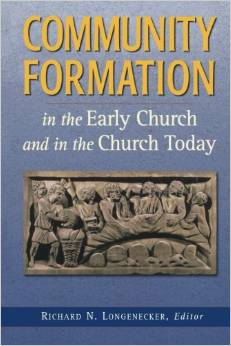
Richard Longenecker: Community Formation in the Early Church and in the Church Today

 Richard N. Longenecker, ed., Community Formation in the Early Church and in the Church Today (Peabody, MA: Hendrickson Publishers, 2002), 251 + xix pages, ISBN 9780801046964.
The new believer is not likely to progress far in his or her spiritual walk before coming across someone calling the church today to return to our New Testament roots. One of the foundations of this call is the desire to discover (or rediscover) what may be called “the New Testament model” of church structure and Christian community. Some have even gone so far as to suggest the abolition of church buildings and worship centers and the return to small home groups as “the only true New Testament norm” for Christian fellowship.
Regardless of whether there is validity to these claims or not, a number of questions still remain: Does the New Testament present the 21st century church with a model for Christian community? If so, is it a normative model, exclusive of any other structures? Or is there a freedom to be enjoyed in how the church today can be structured? Is the decision to be based on theological bases, sociological bases, both, or neither? It is obvious that the most basic of observations reveal a wide variety of church structures along denominational lines, and even within those same denominations.
These are important questions to the life and ministry of the church in general and every Christian in particular, and that church (and Christian) has been blessed with a collection of twelve essays, from a variety of Canadian and American scholars, which examines these questions in detail. The general perspective that developed from these studies (originally presented in June 2000 at the Bingham Colloquium, held at McMaster Divinity College in Hamilton, Ontario, Canada) is that Christian community formation is based on both the biblical doctrine of the gospel and the sociological elements that define each society in which that gospel is presented and followed.
As editor, Longenecker has grouped these essays into four natural sections. Beginning with the social context of the Greco-Roman world in the first few centuries of the church’s existence, the first three essay take us on a walk through the various communities, fellowships, and “voluntary associations” which were in abundance at that time and place. By way of archaeological descriptions and discussions, the reader discovers how closely the early church structures resembled similar structures of which the first Christians were well aware.
Archaeological examination is closely followed by biblical examination in the second section of the book. The fact that Christianity (and the church) stands or falls on the person of Jesus Christ, leads to the natural and necessary corollary that the ministry of the church should be guided and shaped by the ministry of Christ. “The paradigm of ministry for Christians was established by Jesus himself, whose example was followed—even though not always successfully or willingly—by his disciples and those who came to believe in him. Every model of ministry, therefore, if it is to be truly Christian, must be guided by the teaching and example of Jesus” (p. 59). Following on the heels of Jesus’ ministry was the ministry of his disciples, and Longenecker himself contributes a chapter on the vision and image of the church described by the apostle Paul in his missionary letters. The New Testament portion of the book continues with a look into Luke’s theology of ministry and leadership as presented in the book of Acts, and concludes with a look into the various elements of the New Testament congregations as described by Paul in his pastoral epistles.
It goes without saying that the church did not cease its existence at the end of the first century of the Christian era, nor did church leaders cease to write epistles and historical records. Indeed, the first three centuries after Christ present us with a plethora of writings from which we can gain a more complete understanding of how the various paradigms of church leadership and ministries were developed in those formative years, a topic covered by the two chapters which make up Section Three. Finally, the last section brings the reader back into the present-day, by a discussion of the three major types of church government and leadership present in protestantism today: episcopalian, presbyterian, and congregational. Although on the surface, these three would seem to be mutually exclusive, in actual fact they are very much related to and similar to each other, having the same aim: the glorification of the Head of the Body, Christ Jesus.
Both clergy and laity will benefit from this book. It places the church firmly on its theological, historical, and sociological foundations. This book shows how the threads of time and place do not necessarily separate us from the structures and congregants of 2000 years ago, but how those threads instead form a connection between all churches and all Christians past, present, and future. Instead of trying to snip off a small piece of the string for ourselves, we can instead follow it and allow it to draw us back ultimately to the one through whom it all began, and to whom we all owe our very existence.
Reviewed by Mike J. Knowles