
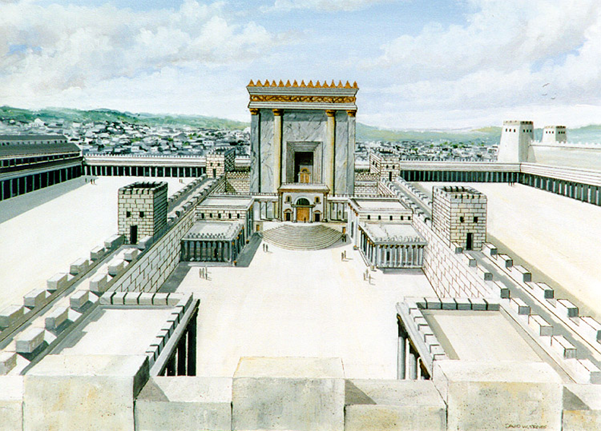
Spiritual Ecstasy: Israeli Spirituality in the Days of Jesus the Messiah, by Kevin Williams

Were Pharisees opposed to anything supernatural?
[Author’s Note: The following text is neither an endorsement nor a censure of Jewish mysticism as practiced today or during the biblical era. Rather, it is an attempt to present the facts of a multi-faceted and ancient religious philosophy in a short, manageable format for the Pneuma Review.]
 Mysticism today connotes different things to different audiences. For some, it embodies the “New Age” movement, bordering on—if not leaping over—the edge of witchcraft. For others in more traditional forms of Christianity mysticism is ingrained into their culture, and rumored now again in the media with a crying icon or the silhouette of the Madonna “witnessed” on the side of a building or ink stain. In their faith, this expression of mysticism confirms their religion. C. S. Lewis, a committed Anglican, wrote: “The true religion gives value to its own mysticism; mysticism does not validate the religion in which it happens to occur” (Letters to Malcolm: Chiefly on Prayer, page 65).
For our purposes, we are going to have an introductory examination of Jewish mysticism and its effect—if any—on the Christian faith. “Introductory” because with volumes of commentary on the subject spanning thousands of years, and us with only these few pages, an introduction is the best for which we can hope.
Perhaps, though, this introduction will motivate some to explore the subject further. For those I offer one piece of advice: do so prayerfully, leaning ever on the Holy Spirit so that, “He will guide you into all the truth” (John 16:13). When examining Jewish mysticism, all that glimmers is not gold. While it may appear attractive and “spiritual,” it may or may not actually be so. Paul teaches us that a “partial hardening has happened to Israel” (Romans 11:25). Partial is not a full hardening, neither is it full spirituality. There is gold and there is fools’ gold. Use wisdom so that you are not led astray.
The heading, Spiritual Ecstasy, was not an easy title upon which to settle for this article. Today, “ecstasy” brings with it negative connotations of illegal narcotics and sensual innuendo. However, to allow modern base behaviors to hijack a word does not change the fact that in the age of the second temple in Jerusalem, what we might call spiritual expression or charismata, was in those days known among the Hebrews as “Spiritual ecstasy.” Though many today have divorced the very concept that Jewish men and women in the days before, during, and following Jesus’ atoning incarnation believed in or practiced any godly form of spirituality, the recorded history says otherwise, and the term “spiritual ecstasy” appears frequently in the ancient extra biblical texts.
Similarly, this “spiritual ecstasy” has continued in certain circles of Jewish orthodoxy today. In what might be considered a paradox, those with the most religious fervor—in the sense of strict adherence to the Pentateuch and a complex code of oral traditions—do believe in and pursue what they refer to as “Spiritual ecstasy.” From their perspective, both now as well as in the ancient observances, anything that comes into contact with the divine must somehow transcend its mundane nature—including mankind.
So it is with this intention in mind that the title Spiritual Ecstasy is employed as an attempt to maintain continuity with the understanding of some of our fellow heirs of Father Abraham—the Jewish people.
Modern archeology and the discovery of the Dead Sea Scrolls demonstrates very clearly that “spirituality” was alive and well among the reclusive Jewish Essenes. Their texts refer to the armies of light warring with the armies of darkness; an almost fanatical commitment to fasting to attain enlightenment; and their obsessive devotion to ritual baths in order to maintain spiritual purity.
According to Josephus and Philo, the Essenes, who possessed books of mysteries and knew secrets which they did not dare to disclose … [their] scrupulous cleanliness in clothing and food, industry, systematic daily routine, homage to light, and particular veneration of the Sabbath, were the chief features (A History of Jewish Mysticism, Ernst Müller, ©1946, Barnes & Noble Books, New York, NY, p. 44).
Yet within Second Temple mainstream Jewish sects—most notably the Pharisees—there was not only an appreciation for, but an active pursuit of “spirituality” that rose above what we might read about in the New Testament. In fact, the Pharisees, as described in Matthew, Mark, Luke, and John, can easily lead one to believe that the P’rushim (as they were known in Israel) were void of any spiritual understanding or appreciation, and therefore, devoid of the work of the Holy Spirit.
On the surface, we may reach the same conclusion that many have: that the Pharisees were opposed to all things spiritual. However, as we investigate sources outside of the gospel accounts, we find vibrant spirituality.
In the Talmud we learn by name of certain possessors of a mystic tradition who came from the ranks of the Pharisees. These men exhibit for the most part a double character, since many of them are at the same time prominent representatives of the strict ritual-halachist point of view. It would seem that within the larger schools of scholars there were formed special circles for the cultivation of the secret doctrine, consisting of scholars who in other respects also were in close contact with each other” (A History of Jewish Mysticism, Ernst Müller, ©1946, Barnes & Nobel Books, New York, NY, p. 44).
The Sefer Yetzirah (Book of Creation), Sitre Torah (Mysteries of the Torah), and others form the basis for a collection known as the Zohar (The Book of Splendor), a study in Jewish Mysticism, portions of which date back to the Second Temple Period. The anonymous portions of Zohar are typically attributed to the Tannaitic period and more specifically, the disciples of Hillel and such teachers as Rabbi Heir, Rabbi Judah Ha-Nasi, and possibly Rabbi Gamliel, the Apostle Paul’s teacher.
Zohar is concerned with interpreting the Bible in mystical and allegorical terms and has had wide influence among Jewish and Christian scholars.
Christianity, too, was interested in Jewish mysticism and it used the teachings of Kabbalah for the interpretation of various Christian doctrines (The New Jewish Encyclopedia, David Bridger, ©1962, Behrman House, Inc., New York, NY, p. 258, 541).
That Jewish mysticism—Kabbalah—has had any role in Christian scholarship likely comes as a great surprise to many. But here are a few examples:
1. Shekinah (Hebrew: “indwelling”) is not a biblical word, but its concept and application come from the Jewish mystical writings.
2. Logos (Greek: Word) is a common enough word in Christian circles, lifted from the beginning of John’s gospel. John’s use of the Greek, however, likely had its foundation in Jewish mystical theology through a concept known in the Aramaic as, memra—“Word of God.” Memra indicates anything from God, but distinct from God, revealing God’s character. Therefore any miracle, any angel, a prophecy, the text of the Bible itself, and ultimately, the Messiah, were all manifestations of the memra, distinct from God,1 but revealing His character and will.
3. Chayot (holy beings in animal form) are the mysterious beings found in Ezekiel, Daniel, and in the New Testament, in John’s Revelation. They were often human in form, but with the head, or heads, of animals. John’s incorporation and appreciation of these “beings” would not be unusual to Jewish scholars of his day. Chayot fit well into their understanding of spirituality.
4. Sorath (666) is a demonic bearer of this number under the mystic system of Gematria (numerology) and was applied to Roman Emperor Nero, as done by many Christian preterists today. John’s vision of 666 may not have formed in a vacuum, being found consistent with Jewish spiritualism. Kabbalah is a term found often in modern society, as it seems to be the fad religion of America’s high society. We can see in the unredeemed human condition a yearning to fill an empty soul with spirituality and, “The Kabbalah prescribed methods for attaining the Holy Spirit …”2 These celebrities may have turned their backs on Jesus Christ as Savior, but still recognize and yearn for something that looks like the work of the Holy Spirit.
A Satmar friend of mine (Satmar are the strictest of the Hassidics) is amazed by this phenomenon. As he has said, “Kabbalah, Kabbalah, Kabbalah—everyone wants to know Kabbalah. Men are driven insane by Kabbalah!” This would likely be a good place to pause for some clarification. This article is no endorsement of Kabbalah nor those who appear in the press as celebrity practitioners of Jewish mysticism such as Madonna, Roseanne Barr, or Barbara Streisand. Neither is it an attempt to establish a new doctrine for any Christian. However, coming to realize that mystical Judaism has had an impact on Christianity should come as no greater surprise than the fact that Catholicism, Martin Luther, or John Calvin have also made a lasting impression, though many denominations today claim to be neither Catholic, Lutheran, nor Calvinistic.
Consider for instance the Tetragrammaton, the four-letter, biblical name of God (Yud Hay Vav Hay), known today as Jehovah, Yahweh, or written as “Lord.” It is a well-known fact that in the biblical era, only the High Priest knew the pronunciation of this ineffable Name, because it was a widely held spiritual principle that this Name afforded the user immense creative powers.
In an attempt to explain how Jesus could work miracles, even to the raising of the dead, the Talmud claims that Jesus crept into the Holy Place, overheard the High Priest using the Tetragrammaton, and among some rather gory details of the fictional events, employed it among the people to heal the lepers, cure the blind, and raise the dead. So on the one hand, the authors of the Talmud do not deny that Jesus did real miracles, but they attribute them to the misuse of God’s Holy Name.
Yet today’s Kabbalist might be very comfortable with Jesus words, “I am the vine, you are the branches; he who abides in Me, and I in him, he bears much fruit; for apart from Me you can do nothing. … If you abide in Me, and My words abide in you, ask whatever you wish, and it shall be done for you.” (John 15:5-7). This teaching is an apt description of one of their doctrines known as devekut, a Hebrew word that means, “cleaving.” The Kabbalists understood devekut as an ecstatic state. The human soul is hewn out of the divine, and it finds it true home in God. Devekut therefore represents the highest spiritual state through which the mystic attains to eternal life while still alive by keeping God continually in his consciousness. In the more ecstatic experiences of devekut, the body is in a trance-like state while the soul, by cleaving to God in thought, is able to bring the divine power down into this world and, afterwards, to work miracles. Some of these alleged spiritual manifestations include “tongues of flame,” ecstatic dancing, and prophetic utterances.
Here is one example or a prophetic utterance from 4 Ezra, also known as the Second Book of Esdras, written around 70 CE:
And it came to pass after seven days that I dreamed a dream by night: and I beheld, and lo! There arose a violent wind from the sea, and stirred all its waves. And the wind caused the likeness of a form of a man to come out of the heart of the seas. And this Man flew with the clouds of heaven. And wherever he turned his countenance to look, everything seen by him trembled; and whithersoever the voice went out of his mouth, all that heard his voice melted away, as the wax melts when it feels the fire. And after this I beheld that there was gathered from the four winds of heaven an innumerable multitude of men to make war against that Man who came up out of the sea. … And I saw that he cut out for himself a great mountain and flew up upon it. … And when he saw the assault of the multitude as they came, he neither lifted his hand, nor held spear nor any warlike weapon; but I saw only how he sent out of his mouth as it were a fiery stream, and out of his lips a flaming breath, and out of his tongue he shot forth a storm of sparks. … And these fell upon the assault of the multitude … and burned them all up. …
These are the interpretations of the vision: Whereas you did see a Man coming up from the heart of the sea: this is he whom the Most High is keeping many ages and through whom He will deliver His creation, and the same shall order the survivors … .
But he shall stand upon the summit of Mount Zion. And Zion shall come and shall be made manifest to all men, prepared and built, even as you did see the mountain cut out without hands. But he, My Son, shall reprove the nations that are come for their ungodliness (4 Ezra 13:1-9, 25-26, 35-36).
While not considered canon by either the Jewish or Christian camps, this book does represent Jewish prophetic thought contemporary to the authors of the New Testament. Some elements still have a familiar ring to Christian ears.
For the believer in Messiah Jesus, devekut has many familiar concepts. One might say that if in a state of devekut, he or she would have faith sufficient enough to move a mountain.
Jewish Mysticism is that form of the Jewish religion which, like the mysticisms of other religions, seeks especially to cultivate personal communion between the worshipper and God. This communion is of course an essential feature of the ordinary talmudical Judaism also. But whereas in talmudical Judaism it is subsidiary to the observance of the precepts, and to some extent an offshoot of it, in mysticism it takes the first place and can itself become the source of religious practice and observance. Hence the distinguishing mark of mysticism in Judaism as in other religions is a peculiar intensity of religious feeling, rising frequently to ecstasy, which gives to it a dynamic force unknown to the ordinary religion (A History of Jewish Mysticism, Ernst Müller, ©1946, Barnes & Nobel Books, New York, NY, p. 9).
Consider John’s text, “I am the Alpha and the Omega,” says the Lord God, “who is and who was and who is to come, the Almighty” (Revelation 1:8). To the Jewish mystic, this “first and last,” represented by the Greek words Alpha and Omega fit perfectly into a pattern that appears over and again in the Hebrew text—the Aleph-Tav. This mysterious combination, the first and last letters of the Hebrew alphabet, is littered throughout the Old Testament. It has no translation, and therefore does not appear in the English.
However, in Kabbalah, the doctrine of Et (Aleph-Tav) is interpreted to signify the cosmic forces of creation. For the Messiah to identify himself as this mystical, “first and last” places him squarely in the creation account, a fact John confirms in his gospel. “He was in the beginning with God. All things came into being by Him, and apart from Him nothing came into being that has come into being (John 1:2-3).
Zechariah 12:10 reads in the English, “And I will pour out on the house of David and on the inhabitants of Jerusalem, the Spirit of grace and of supplication, so that they will look on Me whom they have pierced.” What is not seen in the English is mystically apparent in the Hebrew. To rephrase, the text could just as easily read, “… so that they will look on Me—aleph tav (Et)—whom they have pierced.” This then becomes a mystical clue that God, the One pierced is the aleph tav, the first and the last. Et has no English counterpart, but it clearly offers mystical elucidation if one is reading the original Hebrew.
Both inside the Scriptures and in the extra-biblical documents, one does not need to dig very deeply to find a level of spirituality that was a part of the daily life of Jewish men and women. In the days of the gospel accounts spirituality could be found among both commoner or the Pharisee. That sense of spirituality continues to have an impact on the faith and theology of Christian and Jewish men and women 2,000 years later.
In modern Orthodox Jewry such symbols as the mezuzah (the scroll case affixed to a home’s doorpost) is considered among the mystics as a kind of spiritual force field, holding evil spirits at bay outside the house. Another frequently employed practice is to spit on the ground to ward off curses. Many assign a guardian to keep watch over the dead until burial so that no demonic spirit may enter the body. All orthodox funerals processions pass over a body of living water—a stream or a pond—believing that no evil presence can cross mayim chayim, and therefore, will be unable to interfere with the burial. None of these concepts have a basis in biblical truth, but have been brought up through the religious traditions—mystical practices alive and well in the world of Jewish orthodoxy.
To summarize, we do the Pharisees of Jesus’ day—and the Hebrew people as a whole—a great disservice if we believe them to have been unspiritual and devoid of mysticism. They were in fact, as immersed in spirituality as many true Christians today. For many, their mystical beliefs held that the Messiah would heal the lame, give sight to the blind, restore hearing to the deaf, cure lepers, and raise the dead to life. This was commonly held mystical thought. That Jesus could do these things was as much an affirmation of their religion, as their religion was an affirmation of Jesus’ own Messiahship. To reiterate C. S. Lewis, “The true religion gives value to its own mysticism; mysticism does not validate the religion in which it happens to occur.”
PR
Notes
1 “The Logos of Philo that both can be conceived as a genuine reflection of the Deity, what would be called in the Christian-apocalyptic sense a ‘Son of God’” (A History of Jewish Mysticism, Ernst Müller, ©1946, Barnes & Nobel Books, New York, NY, p. 53-54).
2 Dictionary of Jewish Lore and Legend, Alan Untermann, ©1991, Barnes & Nobel Books, New York, NY, p. 168
3 Editor’s note: See “Mayim Chayim: The Living Waters” by Kevin Williams, appearing in the Fall 1999 (2:4) issue of the Pneuma Review.







Interesting article. I'm curious. Is anyone doing any serious academic research on similarities and differences between early Christian and Jewish mysticism from a Pentecostal/Charismatic standpoint?
Great insight. I would only add to this Eastern Orthodox mysticism (not to be mistaken with Greek Orthodox or Catholic mysticism) for.ex. St. Symeon the New Theologian, On the Mystical Life: The Ethical Discourses http://bit.ly/1aq4BBo
Interesting article. I’m curious. Is anyone doing any serious academic research on similarities and differences between early Christian and Jewish mysticism from a Pentecostal/Charismatic standpoint?