The Duration of Prophecy: How Long Will Prophecy Be Used in the Church? (Part 3) by Wayne A. Grudem

Part 3 and conclusion of Professor Grudem’s exegetical study of 1 Corinthians 13. The Duration of Prophecy: How Long Will Prophecy Be Used in the Church?

The Relationship between the Gift of Prophecy and Scripture
In addition to the interpretation of 1 Corinthians 13:8-13, there is one other area of concern to the question of whether prophecy should continue being used in the church today. That area is the relationship between New Testament congregational prophecy and Scripture.
Does the continuation of prophecy challenge the sufficiency of Scripture or the closed canon?
Those who take a cessationist view of prophecy argue that once the last New Testament book was written (probably the book of Revelation around a.d. 90), then there were to be no more “words of God” spoken or written in the church. Scripture was the complete and sufficient source of God’s words for his people, and to add any more words from continuing prophetic utterances would be, in effect, either to add to Scripture or to compete with Scripture. In both cases, the sufficiency of Scripture itself would be challenged, and, in practice, its unique authority in our lives.
If New Testament congregational prophecy was like Old Testament prophecy and New Testament apostolic words in its authority, then this cessationist objection would indeed be true. If New Testament prophets today, for example, spoke words that we knew were the very words of God, then these words would be equal to Scripture in authority, and we would be obligated to write them down and add them to our Bibles whenever we heard them. But if we are convinced that God stopped causing Scripture to be written when the book of Revelation was completed, then we have to say that this kind of speech, uttering the very words of God, cannot happen today. And any claims to have new Scripture, new words of God, must be rejected as false.
This question is very important, because the claim that New Testament prophecy had authority equal to Scripture is the basis of perhaps every cessationist argument written today. Yet it must be noted that charismatics themselves do not seem to view prophecy that way. George Mallone writes, “To my knowledge no noncessationist in the mainstream of Christianity claims that revelation today is equal with Scripture.”14 Perhaps it would be good for those arguing against continuing prophecy today to give a more sympathetic hearing to the most responsible charismatic spokesmen, simply for the purpose of being able to respond to something that charismatics actually believe (even if not always expressed in theologically precise form) instead of responding to something that cessationists say that charismatics believe or say that charismatics should believe.
Furthermore, aside from the question of current practice or belief, we have seen in chapters 3 and 4 that ordinary congregational prophecy in New Testament churches did not have the authority of Scripture. It was not spoken in words that were the very words of God, but rather in merely human words. And because it has this character, there is no reason to think that it would not continue in the church right up until Christ returns. It does not threaten or compete with Scripture in authority but is subject to Scripture as well as to the mature judgment of the congregation.
Moreover, the functions of apostolic teaching and congregational prophecy were different. The cessationist view depends on the supposition that the function of prophecy was to provide the church with divinely authoritative guidance until such guidance could be derived from a collection of apostolic writings. But in the examples of New Testament prophecy that we have looked at in chapters 5–8, it was evident that the function of congregational prophecy was often to provide very specific, localized information that was needed for the edification of the church and that could only be acquired through a revelation from the Holy Spirit. Access to the major doctrinal teachings contained in the apostolic writings would not make this sort of prophecy obsolete or useless.
The question of guidance
Yet one more concern comes up. It can be argued that even if those who use the gift of prophecy today say that it does not equal Scripture in authority, in fact it functions in their lives to compete with or even replace Scripture in giving guidance concerning God’s will. Thus, prophecy today, it is said, challenges the doctrine of the sufficiency of Scripture for guidance in our lives.
Here it must be admitted that many mistakes have been made in the history of the church. John MacArthur points to the way in which the idea of further revelations has given rise to many heretical movements in the church.15
But here the question must be: Are abuses necessary to the functioning of the gift of prophecy? If we are to argue that mistakes and abuses of a gift or function make the gift or function itself invalid, then we would have to reject Bible teaching (for many Bible teachers have taught error and started cults) and church administration and offices too (for many church officers have led people astray or have abused the privileges of their office). The abuse of a gift does not mean that we must prohibit the proper use of the gift unless it can be shown that there cannot be proper use—that all use has to be abuse.
Moreover, specifically with respect to guidance, it is good to note how cautious many in the charismatic movement are about the use of prophecy to give specific guidance. Several quotations will illustrate this point.
Don Basham:
Personally, I feel most comfortable with prophecies which do not predict or offer direction since I’m aware of the tremendous dangers inherent in such messages. . . . I believe God is very sparing in His use of them. My personal experience has been that I’ve heard eight or ten times as many erroneous prediction prophecies as valid ones. . . .
What should our response be when someone prophesies over us? If the prophecy contains predictions or direction we should neither accept it nor reject it. We should rather place it in our “pending file” and pray and trust the Lord to confirm it out of the mouths of at least two other witnesses if it is of Him. We should never act hastily on the basis of an unconfirmed predictive or directive prophecy, regardless of how inspired it may sound.16
Michael Harper:
Prophecies which tell other people what they are to do—are to be regarded with great suspicion.17
Dennis and Rita Bennett:
We should also be careful of personal, directive prophecy, especially outside the ministry of a mature and submitted man of God. Unrestrained “personal prophecy” did much to undermine the movement of the Holy Spirit which began at the turn of the century. . . . Christians are certainly given words for one another “in the Lord” . . . and such words can be most refreshing and helpful, but there must be a witness of the Spirit on the part of the person receiving the words, and extreme caution should be used in receiving any alleged directive or predictive prophecy. Never undertake any project simply because you were told to by presumed prophetic utterance or interpretation of tongues, or by a presumed word of wisdom, or knowledge. Never do something just because a friend comes to you and says: “The Lord told me to tell you to do thus and thus.” If the Lord has instructions for you, He will give you a witness in your own heart, in which case the words coming from a friend . . . will be a confirmation to what God has already been showing you. Your guidance must also agree with Scripture. . . .18
Donald Gee:
[There are] grave problems raised by the habit of giving and receiving personal “messages” of guidance through the gifts of the Spirit. . . . The Bible gives a place for such direction from the Holy Spirit. . . . But it must be kept in proportion. An examination of the Scriptures will show us that as a matter of fact the early Christians did not continually receive such voices from heaven. In most cases they made their decisions by the use of what we often call “sanctified common-sense” and lived quite normal lives. Many of our efforts where spiritual gifts are concerned arise when we want the extraordinary and exceptional to be made the frequent and habitual. Let all who develop excessive desire for “messages” through the gifts take warning from the wreckage of past generations as well as of contemporaries. . . . The Holy Scriptures are a lamp unto our feet and a light unto our path.19
Donald Bridge:
“Illuminism” is a centuries-old phrase to describe something which is not at all new. . . . It is the claim to direct personal revelations from God which transcend the “ordinary” experiences of disciplined prayer and Bible-study. . . . The illuminist constantly finds that “God tells him” to do things. . . . Illuminists are often very sincere, very dedicated, and possessed of a commitment to obey God that shames more cautious Christians. Nevertheless they are treading a dangerous path. Their ancestors have trodden it before, and always with disastrous results in the long run. Inner feelings and special promptings are by their very nature subjective. The Bible provides our objective guide.20
Donald Bridge and David Phypers:
Any attempt to give highly specific instructions to the group, or to individuals in it, under the guise of prophecy should be strenuously discouraged by the leaders of the meeting because of problems which will almost invariably arise as a result. . . . In our experience, while prophecies have sometimes spoken very directly to individuals’ needs, the Christians giving the prophecies have always been personally unaware of those needs, and each prophecy has always been couched in general terms perfectly acceptable to the whole gathering. Only later has the specific usefulness of the prophecy been realized when the Christian particularly spoken to has testified to its helpfulness.21
These quotations illustrate a cautious and hesitant view toward receiving guidance through prophecy. They indicate an awareness among many in the charismatic movement that the primary function of prophecy is not guidance or prediction but “upbuilding, encouragement, and comfort” (1 Cor. 14:13) (see chapter 7, above) as the Holy Spirit brings to mind things that by themselves may seem quite ordinary and hardly unusual or dramatic, but that are meeting specific needs of the moment in the congregation and are being “quickened” or made unusually effective in the hearts of God’s people by the same Holy Spirit.
On the other hand, even among very “Reformed” cessationists, there is a willingness to admit some kind of continuing “illumination” by the Holy Spirit in believers’ lives. For example, Richard Gaffin says:
Often, too, what is seen as prophecy is actually a spontaneous, Spirit-worked application of Scripture, a more or less sudden grasp of the bearing that biblical teaching has on a particular situation or problem. All Christians need to be open to these more spontaneous workings of the Spirit.22
And Robert Reymond defines “illumination” as “the Holy Spirit’s enabling of Christians generally to understand, to recall to mind, and to apply the Scriptures they have studied.”23
But if these writers will allow for the present activity of the Holy Spirit enabling Christians to understand, or recall to mind, or apply, or grasp the teachings of Scripture, then there does not seem to be such a great difference in principle between what they are saying and what many in the charismatic movement are doing (even though there will probably be some remaining differences over the precise way guidance functions—yet this is not so much a difference about prophecy as about guidance generally, and particularly the way guidance from Scripture relates to guidance from advice, counsel, conscience, circumstances, sermons, etc.). The larger point is that what Gaffin and Reymond here call “illumination” it seems the New Testament would call a “revelation,” and what they would call a “spoken report of such illumination” it seems the New Testament would call a “prophecy.”
So I wonder if there may be room for more joint theological reflection on this area. Charismatics would have to realize that cessationists are skeptical about the scope and frequency of such “illumination,” whether it is right to call it New Testament prophecy, whether it really does have value for the church, and whether we are right to seek it. And cessationists would have to realize that their own highly developed and carefully formulated doctrine of the sufficiency of Scripture in guidance is not usually shared or even understood by much of evangelicalism, including those in the charismatic movement. Nevertheless, perhaps the Reformed idea of “illumination” is not far from what is happening in prophecy today, and may provide a category in which it would not be seen to challenge the sufficiency of Scripture.
As another model for comparison, it is helpful to hear the conclusion of Donald Bridge:
What authority does prophecy carry? The same authority as that of any other Christian activity in the church, like leadership, counselling, teaching. . . . If it is true, it will prove to be true. Spiritual people will respond warmly to it. Wise and proven leaders will approve and confirm it. The enlightened conscience will embrace it.24
When this perspective on guidance in prophecy is coupled with the many biblical evidences we have seen concerning the non-divinely authoritative nature of prophecy in the New Testament, there seems to be no reason to object to its continuing use today.
So in the larger area of the relationship between the gift of prophecy and Scripture, we see no reason to think that prophecy would cease. Just as it functioned simultaneously with the actual presence of living apostles in the churches and did not compete with or pose a challenge to the unique ruling authority of the apostles, so today prophecy can exist and function simultaneously with the presence of the completed, written Scripture in our churches without challenging or competing with the unique ruling authority that Scripture and Scripture alone has in our lives.
Spiritual Gifts as Characteristic of the New Covenant Age
One further consideration is appropriate here. The New Testament many times indicates that one distinctive characteristic of the New Covenant age (the period between Pentecost and Christ’s return, also called the “church age”) is the possession of spiritual gifts by all God’s people.
Therefore, once the New Covenant age is inaugurated at Pentecost, the Holy Spirit is poured out in power on the church, and one result is that God’s people are given gifts such as prophecy, speaking in tongues, and seeing visions (Acts 2:1-21). Another result is special power for gospel proclamation (Acts 1:8; cf. 2:37, 47; 4:4; etc.).
Spiritual gifts also characterize the receipt of the Holy Spirit by others in the New Testament, such as the household of Cornelius (Acts 10:46) or the disciples in Ephesus (Acts 19:6). The Corinthians experienced the characteristically “New Covenant” experience of the Holy Spirit when they believed the gospel and then in “every way” they were “enriched in Christ in all speech and all knowledge” (1 Cor. 1:5), with the result that Paul could say, “You are not lacking in any spiritual gift, as you wait for the revealing of our Lord Jesus Christ” (1 Cor. 1:7, rsv). In fact, what Paul says about Christians corporately being the “body of Christ,” all with differing gifts, given for the common good (1 Cor. 12:12-31), we rightly understand to be true not just of the church at Corinth but of all churches and all Christians today: To be a New Covenant Christian is to be a spiritually gifted Christian.
Paul affirms the same truth in Ephesians when he says that Christ, in ascending to heaven, “gave gifts to men” (Eph. 4:8, rsv)—gifts that would enable the whole body to work together, so that “when each part is working properly,” the church itself “makes bodily growth and upbuilds itself in love” (Eph. 4:16, rsv). Once again, the possession of various spiritual gifts for the benefit of the whole church is characteristic of the New Testament age.
Now if the apostles were the foundation of the church, and if they had a unique authority to write Scripture for the church for all time, then it is understandable that the office of apostle would not continue beyond the first century, when the last apostle died. In fact, Paul suggests that he is the last one who will ever be appointed as an apostle (see 1 Cor. 15:8, in a context of resurrection appearances to apostles). So we may say either that the office of apostle is no longer present in the church, or (perhaps more correctly) that the office of apostle has now been replaced by the presence of the writings of the apostles (the New Testament) in the church.
But we have no reason to expect that any other gifts have been replaced in this way. In fact, if spiritual gifts are characteristic of the New Covenant age, then our expectation would be that a normally functioning New Covenant church would have the continuing experience of all the gifts mentioned in the New Testament, and that these gifts, characteristic as they are of the church age, would continue in the church up until the time of the Lord’s return. Where the Holy Spirit is at work in New Covenant power, should we not rightly expect to see all the gifts of the Holy Spirit present and functioning in the church?
Summary
In 1 Corinthians 13:8-13 Paul tells the Corinthians that prophecy will continue until but not beyond the time when Christ returns. Thus, it is acceptable to paraphrase 1 Corinthians 13:10, “When Christ returns, the gift of prophecy will cease.” This text, together with the nature of prophecy as not equal to Scripture in authority but valuable for the edification of the church, leads us to conclude that the gift of prophecy will continue to be valid and available for Christians to use right up until the time when the Lord returns.
Application for Today
Once we are aware that prophecy is a gift appropriate for the entire church age (from Pentecost until Christ’s return), we should want to think about how we might encourage its use in our own lives and churches today. If indeed it is God’s intention that this gift continue to be used in the church, then our failure to allow or encourage its use can only result in our spiritual detriment, and we can expect, if we follow scriptural guidelines and avoid abuses, that its renewed use will bring added spiritual blessing and vitality to our churches.
PR
Notes
14. George Mallone, ed., Those Controversial Gifts (Downers Grove, Ill.: InterVarsity, 1983), 21.
15. John F. MacArthur, Jr., The Charismatics: A Doctrinal Perspective (Grand Rapids, Mich.: Zondervan, 1978), chapters 2–6; see especially pages 27ff.
16. Don Basham, “Questions and Answers,” New Wine 9:1 (January 1977): 29.
17. Michael Harper, Prophecy: A Gift for the Body of Christ (Plainfield, N.J.: Logos, 1964), 26.
18. Dennis and Rita Bennett, The Holy Spirit and You (Eastbourne, England: Kingsway; and Plainfield, N.J.: Logos, 1971), 107.
19. Donald Gee, Spiritual Gifts in the Work of Ministry Today (Springfield, Mo.: Gospel Publishing House 1963), 51-52.
20. Bridge, Signs and Wonders Today, 183.
21. Donald Bridge and David Phypers, Spiritual Gifts and the Church (Downers Grove, Ill.: InterVarsity, 1973), 64.
22. Gaffin, Perspectives, 120. Gaffin also allows for the possibility of an unreliable spoken response to something that had been revealed by the Holy Spirit (at least at the time of the New Testament). (See page 66, on Acts 21:4.) But if someone could give an unreliable spoken response to a revelation in the time of the New Testament, could people not do that today as well? And could that not be what is happening in prophecy?
23. Reymond, Continuing Revelations and Miracles, 28-29.
24. Bridge, Signs and Wonders Today, 204.

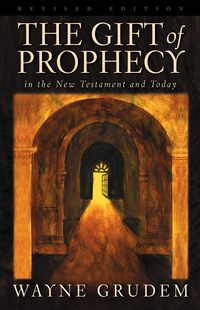
“The Duration of Prophecy” is Chapter 12 of The Gift of Prophecy in the New Testament and Today by Wayne A. Grudem, Copyright © 1988, 2000, Revised Edition, Pp. 400. Used by permission of Crossway Books, a division of Good News Publishers, Wheaton, Illinois 60187. Publisher’s page.