
Should It Sound Like That?

From the Worship Leader series.
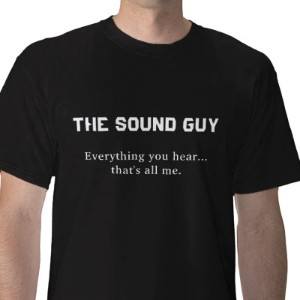
“All the earth shall worship at the throne of the …BZZZZZ!” What in the world was that? All eyes turn to the previously unnoticed sound guy sitting sheepishly at the back of the church.
Feedback, the wah-wahs, boominess in the lead vocalist—these sound distortions rivet everyone’s attention on the sound man and his system. Nothing kills a good worship set like sound trouble. How does a church pick the right equipment anyway?
Though worship is clearly the aim, how we get there can be influenced significantly by the sound equipment a church purchases. Churches congregate in various sizes ranging from home fellowships, to the average Sunday gathering of under one hundred people to megachurches of thousands.
Each church has it’s own specific needs. Some churches are stationary while others have to be set up and torn down Sunday after Sunday. Some bodies have existing sound systems that need upgrading, and others have been allocated funds to purchase new systems. To talk about all the different possibilities would fill a book. So, instead, I want to offer some general guidelines when purchasing sound equipment that I hope will lead to answers that will help.
Quality Before Quantity Whether you are buying a completely new sound system or are upgrading an existing one, the most important thing to remember is: quality before quantity. Too often, churches buy substandard equipment because they want all the nifty components at once. A church is much better off buying a few top-notch pieces of equipment to start and then adding as funds allow. Don’t get me wrong; you need the basics but please make sure that your basics are made up of quality components.
When walking into your local Sound Superstore, here are two options:
System A: For “x” amount of money you can get a “budget” 24 channel board, with 4 “white label” 2×15” mains, 1 16-channel snake, 6 10” monitor wedges, 10 multi-use mics with non-removal 10’ cords, 4 150-watt mono amps, a reverb unit (that sounds like…well…a ‘56 Chevy in a wind tunnel), a 6-band parametric EQ, a refurbished cassette deck and a user manual the size of a tri-city phone book written in a foreign language. Sounds like a killer system, right?
System B: Instead, for the same “x” amount of dollars you get a quality 32×8 console, with 2 2-way mains, 4 monitor wedges and 2 25-watt stereo amps. This configuration doesn’t offer nearly as much equipment but it’s of much higher quality.
Expandability
The next most important thing is expandability. When purchasing a system or some piece of individual equipment, are you keeping in mind what will happen when your needs grow? Let’s say that your church is currently 100 people. What happens in two years when your church is 300 people? Hopefully you are not thinking that you will then have more money to buy a larger system, because that is almost never the case. Another consideration: what about when the band grows from three to eight people? If you bought System A, you will be playing catch-up until the system completely fails, or the poor sound causes a coup in your church. If you bought System B, you now have the capability to grow and expand without investing an obscene amount of capital.
EQ, Reverb, and Hot Tips on How They Work
Another area that we want to touch on is outboard gear, i.e. effects units, EQs, compressors, and so forth. Probably one of the most effective but over used (and incorrectly used) pieces of equipment in a church sound system is the reverb/delay unit. It goes like this: when the music sounds bad, put more reverb on it. Another commonly heard phrase, “It’s feeding back; we need to turn it down.” (Hint: EQ) How about, “I sound like I am in a tin can.” (Hint: EQ & reverb)
So, what is EQ and what is it used for? First, EQ stands for equalization. It is an electronic tool that allows you to manipulate specifically targeted frequencies. Basically, EQ is just a fancy name for tone control. On the most basic mixing consoles, the EQ section is usually divided into three bands: LO, MID, and HIGH. As the quality of the board increases, so does the division of the bands, i.e. LO-MIDs, HIGH-MIDs, and so on. Even your car stereo has an EQ, which is called the bass/treble knob.
The best way to learn how to use the EQ is practicing with it. Play a CD over the sound system. Turn the knobs and listen to how the frequencies change.

After you have a good sound system put together, the most important piece of equipment you can by is a 2-channel 1/3 octave graphic EQ. This component can adapt the system to any acoustical space.
When purchasing anything, do your homework. Find out what the equipment is and is not capable of doing. Most impulse purchases will come back to haunt you. If at all possible, see if you can try the gear out in the store.
I do not want to endorse any particular company or product. A common caveat is, “If it sounds too good to be true it probably is.” What I hate to see is someone walking out of a music store with a piece of equipment that does everything under the sun and then when you hook it up it sounds like you also bought the Pacific Ocean to go along with it.
Magazines like EQ, MIX and Electronic Musician all have reviews and great articles to help you make wise purchases.
The best measurement of successful purchases? A complete worship set where no one turns around to glare at the sound guy!
PR
From Worship Update (3rd Quarter 1997), “Should It Sound Like That???” ©1997 Mercy/Vineyard Publishing, P.O. Box 68025, Anaheim, CA 92817-0825. USA. Used by Permission.