
Richard Twiss: One Church Many Tribes

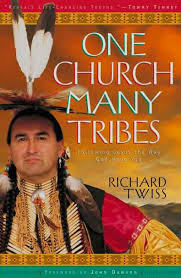 Richard Twiss, One Church Many Tribes: Following Jesus the Way God Made You (Regal Books, 2000), 216 pages.
What can the church of the 21st Century learn from the mistakes of the past?
Richard Twiss could be a budding new personality in the Christian world. I recently noticed his name on a column in Charisma magazine, and this new book has endorsements by many well known, respected Christians and I was asked to review it for the Pneuma Review.
The book features a photograph of Richard all decked out in his native clothes on its cover. Twiss is an American Indian, which is nomenclature he does not like since it tends to demean his culture. He also does not like native American and instead asks all of us that come from family origins different than his, call Richard and others of his culture First Nations People, an expression which I have adopted but still find difficult to use.
Twiss’ book repeats comments I had earlier heard from Pastors who ministered to the First Nations People, comments that deal with the lack of success the church has experienced as it reached out to our country’s original inhabitants. The book also criticizes many of the political decisions the elected and appointed officials of the US have made about First Nations People. Richard resents that his ancestors openly offered friendship to those who left Europe for the new world, but were instead exploited and ignored by what today’s Americans call our founding fathers.

All of us familiar with early and not so early missionary effort realize that the early missionary often confused piety with the fashion that existed in the culture from which the missionary came. That confusion led to banning many local expressions of praise and worship being offered by the new believer to God on High. In retrospect, we now teach our potential missionary to become part of the culture to which they are sent and not to reform the culture. Careful reading of Paul’s theology and his missiology leads to the conclusion that Paul knew and practiced what we missed. Better results are obtained when we work within a culture and not when we attempt to replace that with things dear and familiar to our ideas. The question “How then shall we live?” has answers that vary from people group to people group. Twiss’ book reads easily and quickly. I would describe much of his discussion as a lament over what could have been, a polemic over what should have been and as a hope over what might now be experienced in his native culture. Twiss has a burden for his people and he needs our help and understanding to undo some of the errors that were made trying to reach the First Nations People. It can be done. We can be one people.
Let me illustrate. My immediate family includes African Americans, Chinese, Puerto Ricans, Japanese, Hawaiian, Filipinos and Haoles (me). A number of us go to the largest church on this island. Our pastor is Japanese/Portuguese. His white mainland wife was saved under the ministry of Chief Thum, an Assemblies of God evangelist who preached the Gospel wearing a full Indian headdress and waving a tomahawk. When you see us living and ministering together as family, lovingly accepting our differences and cultural traditions, how could you not want to be a part of that? Our differences beautifully complement each other in the oneness we have in Jesus.
There really is no doubt that those who make up the church have done hurtful and foolish things. There certainly were many mistakes made when Europeans attempted to colonize and evangelize the first people to live in North America. Our Bible says that Jesus came to break down every wall, to make us one people, and that it is good for brothers to dwell in unity.
We all live and learn. We need to learn from our past mistakes and yield to the Spirit’s work in our midst to make us one. After all, a little war paint, some well played drums and great smoke signals are surely more fun than some of the “worship” I have had to endure in the last 40 years. Twiss is on point on the best way to bring the Gospel to another culture.
Reviewed by H. Murray Hohns
Publisher’s page: https://bakerpublishinggroup.com/books/one-church-many-tribes/361101