
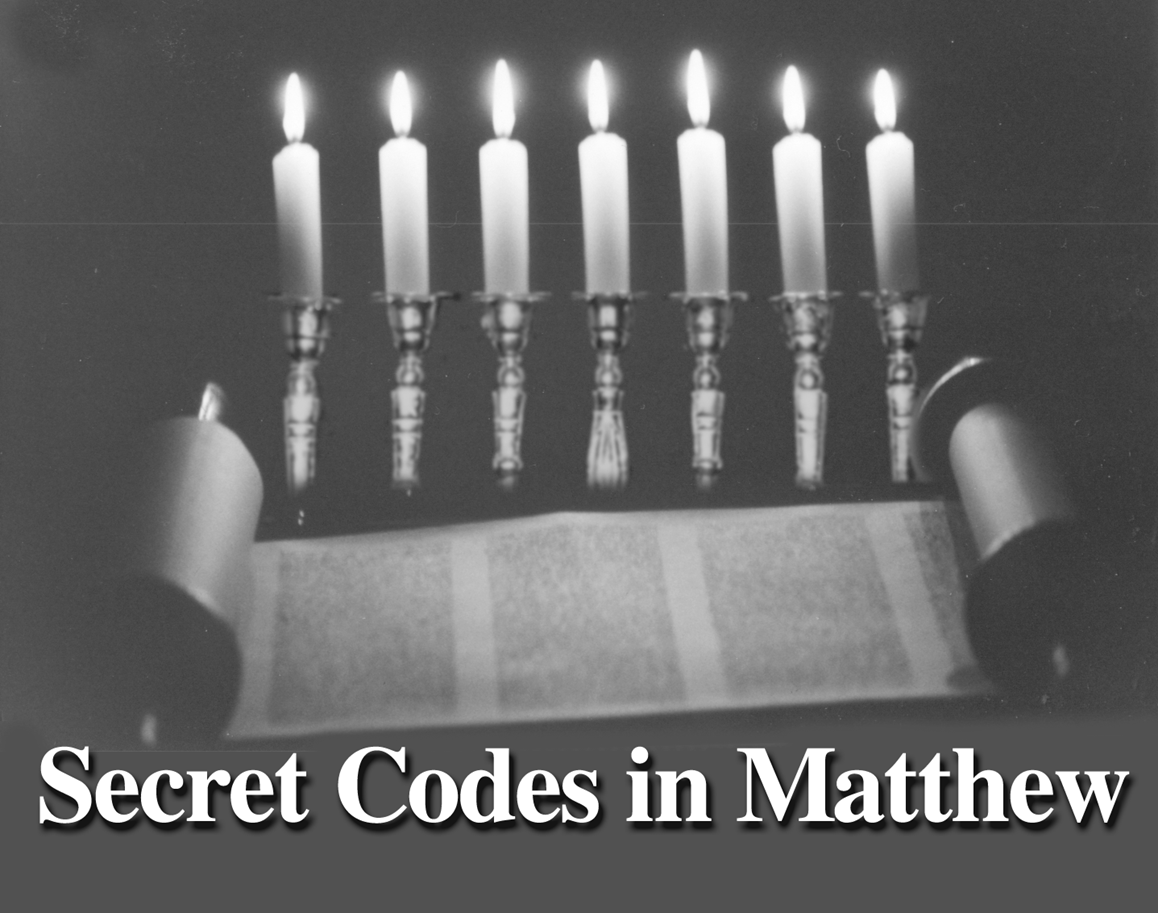
The Secret Codes in Matthew: Examining Israel’s Messiah, Part 17: Matthew 22:1-40, by Kevin M. Williams

Does Messiah pay taxes? Journey through the Gospel to the Hebrews with Kevin Williams and find out.

And Jesus answered and spoke to them again in parables, saying, “The kingdom of heaven may be compared …” (Matthew 22:1-2).
One consistent theme to Yeshua’s (Jesus’) ministry in the book of Matthew is the reality of the Kingdom of heaven. We do well to remember, that from the moment he walked out from his 40 days in the Judean wilderness he taught, “Repent, for the kingdom of heaven is at hand (Matthew 4:17).” The sovereignty of the Most High God was never a question. The validity and continuity of God’s revealed Word was not up for debate. The authority of the Kingdom was never doubted.
Rather, the manifest presence of the Kingdom of Heaven was dearly desired by many Hebrews in those days—as well as today. The yearning was that God would establish His kingdom on earth, and that all the nations of the gentiles would be brought under His banner.
In both Yochanan’s (John’s) and Yeshua’s preaching the reason for urgency to repent is that the Kingdom of Heaven is near. The concept of the Kingdom of God is crucial to understanding the Bible. It refers neither to a place nor to a time, but to a condition in which the rulership of God is acknowledged by humankind.1
We see this zealous belief reiterated in Yeshua’s disciples: “And so when they had come together, they were asking Him, saying, “Lord, is it at this time You are restoring the kingdom to Israel?” (Acts 1:6). Many believers look forward to the day of Messiah’s return, and the complete and absolute establishment of God’s Kingdom here on earth.
And yet “Thy Kingdom come …” drones throughout congregations in the western world in countless churches, denominations, and services. I say it “drones” because it has been said so many times, recited for so many years, and reiterated without conscious thought, that the words have lost their vigor.
Fearful it would be if the kingdom of God were in fact to come and settle on this green globe we call home. Many of the sins we enjoy so liberally would come home to roost in profound and terrible ways. The words “Thy Kingdom come” flow so swiftly from our mouths. Yet, the kingdom we are praying for would bring such change that many, I fear, would scarcely know how to cope. The Kingdom of God on earth means that the Judge is in our midst. His unswerving intolerance for sin would be the rule of the land.
If we read Ezekiel, the coming of the Kingdom of God means that the Temple will be restored, with all its injunctions, requirements, tithes, festivals and sacrifices. How many have even paused to contemplate what that would mean to their daily lives?
The coming Kingdom of God brings with it a level of accountability undreamed of by most, with the Messiah seated on His throne as the conquering King. Are we really ready to bend the knee, not merely in a Sunday-go-to-meetin’ kind of way, but in a manner that is wrought with submission in service to the One True King?
The reality of the Kingdom of Heaven has dwelt among us already in the person of Yeshua the Messiah. He inaugurated a new era in which the hearts of mankind would willingly turn to Him in love and obedience. With that inauguration we have, from time-to-time, caught glimpses of the kingdom. We have seen it on the face of that singer praising His name, felt it in the words of someone’s prayer, or touched it for a moment while reading the Word of God. It was fleeting, but it was real—genuinely and inexplicably real.
Yet it may have been so fleeting, that sometimes we wonder if it really happened at all.
The Kingdom of God is real. We who are of the household of faith are citizens of that kingdom. Its supernatural manifestation does intrude into our “space” from time to time in ways that regularly leave us in awe and amazement.
So then, do we wait? Do we wait for the full reality of that Kingdom to be made manifest here on earth before we begin to act like lawfully entrusted citizens? Is it better to wait for the Messiah to take up his throne here on earth to really “get our act together,” or might it be time to take this faith-thing seriously in the here and now? Do we live in an almost, but not really here Kingdom?
Rabbi Paul does not imply that we are almost but not yet ambassadors for Christ (2 Corinthians 5:20). We are not almost but not yet citizens (Ephesians 2:9). We are not called to behave as almost but not yet partakers in the promises of Abraham (Galatians 3:29). We should not act as almost but not really sharers in the commonwealth of Israel (Ephesians 2:12).
The message of Yeshua was the good news of the Kingdom of God/Heaven. When we read the Messiah’s parables and hear his words, “The kingdom of heaven may be compared to …,” His understanding of the Kingdom was potent, alive, and in their midst.
And Jesus answered and spoke to them again in parables, saying, “The kingdom of heaven may be compared to a king, who gave a wedding feast for his son. And he sent out his slaves to call those who had been invited to the wedding feast, and they were unwilling to come. Again he sent out other slaves saying, ‘Tell those who have been invited, “Behold, I have prepared my dinner; my oxen and my fattened livestock are all butchered and everything is ready; come to the wedding feast.”’ But they paid no attention and went their way, one to his own farm, another to his business, and the rest seized his slaves and mistreated them and killed them.
“But the king was enraged and sent his armies, and destroyed those murderers, and set their city on fire. Then he said to his slaves, ‘The wedding is ready, but those who were invited were not worthy. Go therefore to the main highways, and as many as you find there, invite to the wedding feast.’ And those slaves went out into the streets, and gathered together all they found, both evil and good; and the wedding hall was filled with dinner guests.
“But when the king came in to look over the dinner guests, he saw there a man not dressed in wedding clothes, and he said to him, ‘Friend, how did you come in here without wedding clothes?’ And he was speechless. Then the king said to the servants, ‘Bind him hand and foot, and cast him into the outer darkness; in that place there shall be weeping and gnashing of teeth.’ “For many are called, but few are chosen” (Matthew 22:1-14).
Many lessons have been taught in numerous commentaries on Yeshua’s parables, and no further hermeneutic will be attempted here. But certainly we can see a king and a kingdom that does not tolerate being treated casually. For the king in Yeshua’s parable, there is no “almost” kingdom, or half-hearted kingdom. The citizens are expected to take the king—and the king’s will—very seriously.
Then the Pharisees went and counseled together how they might trap Him in what He said.
And they sent their disciples to Him, along with the Herodians, saying, “Teacher, we know that You are truthful and teach the way of God in truth, and defer to no one; for You are not partial to any. Tell us therefore, what do You think? Is it lawful to give a poll-tax to Caesar, or not?”
But Jesus perceived their malice, and said, “Why are you testing Me, you hypocrites? Show Me the coin used for the poll-tax.” And they brought Him a denarius.
And He said to them, “Whose likeness and inscription is this?”
They said to Him, “Caesar’s.”
Then He said to them, “Then render to Caesar the things that are Caesar’s; and to God the things that are God’s.”
And hearing this, they marveled, and leaving Him, they went away (Matthew 22:15-22).
Any number of hints are given to us here that might be missed by the modern eye. First, the Pharisees are specifically seeking to back Yeshua into a corner, and trap him with his own words. That much is at least obvious from the text. What is not so obvious is that these leading Pharisees sent their disciples (who would have been recognized as Pharisees by virtue of their style of dress) were in the company of Herodians, government officials, the oft adversaries of the Pharisees. An uneasy alliance had been formed to confront this so-called Messiah.
Their question about taxes therefore, was most convenient, having witnesses from the state on hand to testify to Yeshua’s answer. If this man from Galilee answered wrongly, the Herodians would have evidence they could use in court. Evidence the Pharisees could use to their advantage.
According to Dr. Dwight Pryor, a Messianic scholar based out of Dayton, Ohio, the Galilee had been the scene of no fewer than five tax revolts against the Roman authority, all of which had to be put down by military force. The last thing the Herodians, or the Romans would want during such a politically stressful time would be another rebellion. It may well have been the Pharisees’ intention to use this historical predilection to help in their entrapment of the Messiah.
Yeshua sees right through their ploy, “Why are you testing Me, you hypocrites?” But their own folly is about to be laid bare.
The Torah forbids graven images, and the coin in question bore the image of Caesar. Israeli coins bore images of the menorah—the seven-branched candlestick—or the pomegranate. There were no human faces allowed. It is interesting to note that the perfectly Torah-observant Messiah did not have a Roman coin—with its graven images—on his person. He had to ask to be shown one.
Teacher Ray Vanderlaan of Holland, Michigan, is convinced that Yeshua asked the Pharisees for the coin, whom, if they had been true to their convictions, should not have carried graven images either. If one uses the Luke account, the Herodians are not mentioned, and so, perhaps Yeshua did procure the coin from the Pharisees. If so, then their intrigue to incriminate Yeshua demonstrated openly their own religious hypocrisy. Matthew’s account however, gives room for Yeshua to have asked either the Herodians or the Pharisees.
In a shrewd move, Yeshua invokes the theology of the Pharisees. The Talmud, a compendium of Pharisaical belief reads, “In the case of tax-collectors, why should the dictum of Samuel not apply that the law of the State is law?” (Baba Qamma 113a). Elsewhere it is written, “The law of the [secular] government is the law” (N’darim 28a, brackets mine). Yeshua agrees with the Oral Law, the binding principles upon which the Pharisees lived, to answer their question.
In a move the Pharisees could not have been expecting—Yeshua agreed with them! “And hearing this, they marveled.” Yet, conversely, the Herodians found a tax-supporter in a popular rabbi of Israel, and the Pharisees’ plot unraveled.
But Yeshua had other enemies …
On that day some Sadducees (who say there is no resurrection) came to Him and questioned Him, saying, “Teacher, Moses said, ‘If a man dies, having no children, his brother as next of kin shall marry his wife and raise up an offspring to his brother.’
“Now there were seven brothers with us; and the first married and died, and having no offspring left his wife to his brother; so also the second, and the third, down to the seventh. And last of all, the woman died. In the resurrection therefore whose wife of the seven shall she be? For they all had her.”
But Jesus answered and said to them, “You are mistaken, not understanding the Scriptures, or the power of God. For in the resurrection they neither marry, nor are given in marriage, but are like angels in heaven.
“But regarding the resurrection of the dead, have you not read that which was spoken to you by God, saying, ‘I Am the God of Abraham, and the God of Issac, and the God of Jacob? He is not the God of the dead but of the living.”
And when the multitudes heard this, they were astonished at His teaching (Matthew 22:23-32).
Once again, a sect of religious leaders is attempting to trip Yeshua up. Using the doctrine of Leverite marriage (Deuteronomy 25:5-10), they propose an almost preposterous happenstance upon which to base an inconsequential afterlife premise. However, as the Sadducees did not believe in the resurrection of the dead, any answer would have been perceived as irrelevant to them.
The Sadducees viewed only the five books of Moses as Scripturally authoritative. From their perspective, since the resurrection could not be supported solely in the Torah, it was an invention of man. Through their fiction of the woman being passed from brother to brother, they attempted to unravel Yeshua’s theology right there in the presence of the “multitudes.” There may have been some ego involved, as Yeshua had already artfully dealt with the Pharisees and the Herodians “on that same day.” It would not have been beyond the aspirations of the Sadducees to attempt to place themselves at the top of the religious hierarchy.
Yeshua—always the wisest—proves that no one understands the Bible as well as He. His answer about the afterlife was of no relevance to the Sadducees, though I am sure it gave comfort and understanding to those witnesses round about. But the rebuke he uttered, that they did not understand Scripture or the power of God, would most certainly have caught their attention. His use of Exodus 3:6—the Torah—as a proof text for the certainty of an eternal soul “astonished” the multitudes, though Matthew gives no record of how the Sadducees reacted. The Luke account however, adds: “And some of the scribes answered and said, ‘Teacher, You have spoken well.’ For they did not have courage to question Him any longer about anything” (Luke 20:39-40).
The ball was served by the Pharisees, returned by Yeshua. The Sadducees served next, and were given a skilful volley. Now the Pharisees attempt another serve.
But when the Pharisees heard that He had put the Sadducees to silence, they gathered themselves together. And one of them, a lawyer, asked Him a question, testing Him, “Teacher, which is the great commandment in the Law?” (Matthew 22:34-36).
It is well to remember that the Pharisees expected an ally in the Messiah—whomever that might be (from their perspective). Yeshua agreed with them, at least in principle, in the last debate about the poll-tax. He also disagreed with their enemies, the Sadducees. No doubt, He had piqued their interest anew.
Their question, “which is the great commandment?” was a typical question for rabbis in that day. As for rabbis, they were often challenged to boil the Torah down to a summary statement. Rabbi Paul does it in Galatians 5:14, “For the whole Law is fulfilled in one word, in the statement, ‘You shall love your neighbor as yourself.’” James does so as well in James 2:8, “If, however, you are fulfilling the royal law, according to the Scripture, ‘You shall love your neighbor as yourself,’ you are doing well.” Their question was not necessarily so much a challenge to Yeshua’s authority as it was a means of understanding his position—particularly since he had ruffled the feathers of the Sadducees.
Whether discussing Paul, James, or Yeshua, the relevance of the Law—the Torah—is not commuted in any way here, but rather, reinforced (fulfilled) for all time.
And He said to him, “‘You shall love the Lord Your God with all your heart, and with all your soul, and with all your mind.’ “This is the great and foremost commandment. “The second is like it, ‘You shall love your neighbor as yourself.’ “On these two commandments depend the whole Law and the Prophets” (Matthew 22:27-40).
Yeshua’s answer comes from part of the most sacred prayer in all Israel, the Shema (Deuteronomy 6:4-9 in its entirety). Interestingly enough, the second person “You” in this verse is the collective “you,” not the singular. The commandment is for all those listening among the Hebrews and the mixed multitude in their midst, not merely individuals. This was and is what forms the foundation for a Bible-based community.
This Shema remains the most significant prayer in Judaism and is recited daily, at almost all worship services, at prayers and funerals. Yeshua’s answer was an extremely Jewish response, taught to Israelite children as one of the first verses they memorize and last verses they utter before death.
Yeshua was not only establishing a truth for us today, but he was taking a very popular position and establishing himself as a strong, authoritative rabbi. To say, “On these two commandments depend the whole Law and the Prophets,” in no way abrogates their importance (as some today teach that the Torah is non-essential), but rather says, “When you apply the Torah and the Prophets to your life and faith, first run your interpretation through this filter: loving God and neighbor. If your conclusion on the Scripture does not satisfy those two requirements, then you have missed the truth and need to go back and re-evaluate your thinking.”
___
The leaders have had their chance to question Yeshua. In part 18 of The Secret Codes in Matthew: Examining Israel’s Messiah, Yeshua asks his examiners a question, “What do you think about the Christ, whose son is He?”
Notes
1 Jewish New Testament Commentary, David H. Stern, © 1992, Jewish New Testament Publications, p. 16, parenthesis mine.




TW says: "Do you really want His Kingdom to Come?"
TW says: “Do you really want His Kingdom to Come?”