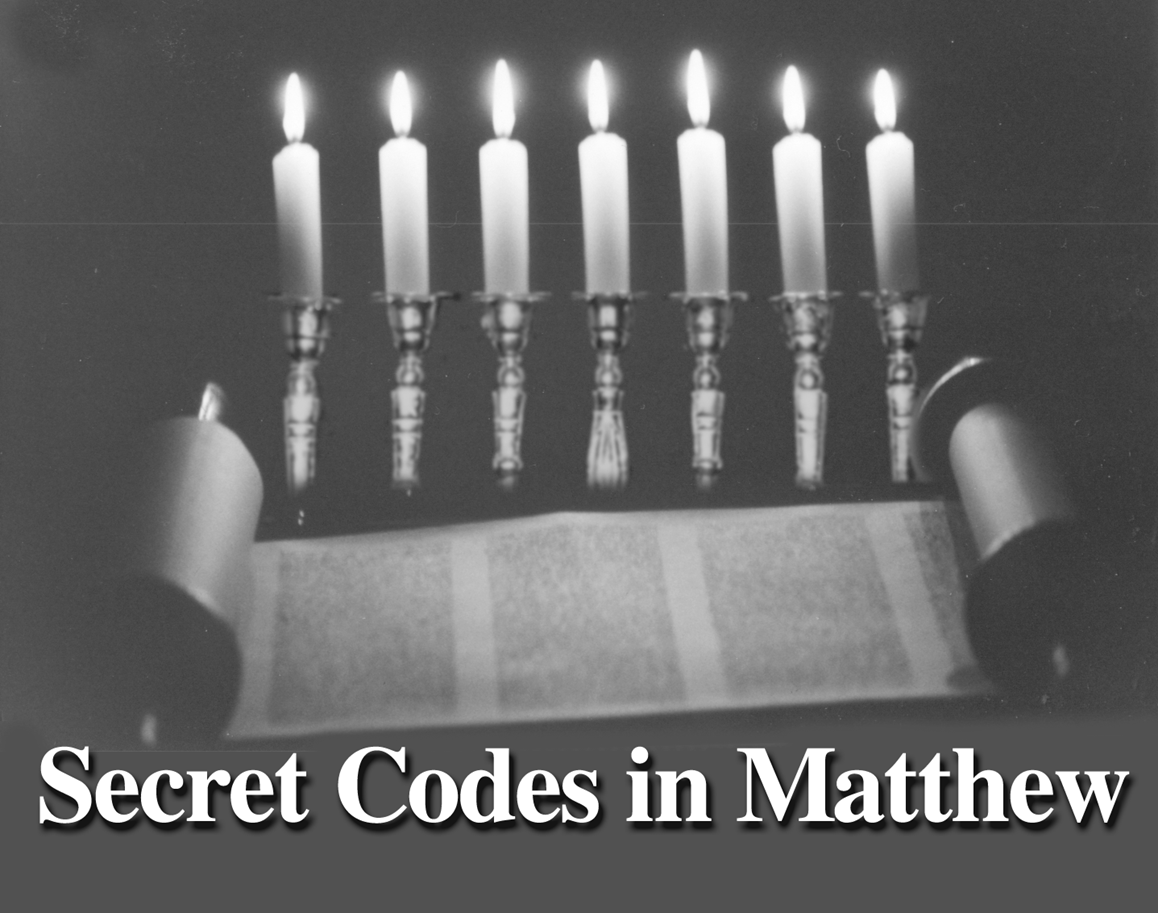
The Secret Codes in Matthew: Examining Israel’s Messiah, Part 21: Matthew 26:31-27:36, by Kevin M. Williams

An examination of Messiah’s night-time trial before the Sanhedrin, pointing to the fulfillment of Messianic prophecy and the travesty of justice that took place.

Then Jesus said to them, “You will all fall away because of Me this night, for it is written, ‘I will strike down the shepherd, and the sheep of the flock shall be scattered.’ But after I have been raised, I will go before you to Galilee” (Matthew 26:31-32).
As we shall soon see, Peter rejected that he would be “scattered,” rather than taking the comfort Yeshua2 offered that even though He would be struck down, He would rise again. To further His comfort, the Messiah tried to help them see that this scattering would fulfill the words of the prophet Zechariah (13:7). The coming execution was—as Yeshua had attempted to help them see before—an inevitable part of the noble plan God had ordained before the foundation of the world.
We also see here in Yeshua, a man who is fully prepared to step through the doors of destiny, without flinching, and still filled with compassion for His disciples.
But Peter answered and said to Him, “Even though all may fall away because of You, I will never fall away.” Jesus said to him, “Truly I say to you that this very night, before a cock crows, you shall deny Me three times.” Peter said to Him, “Even if I have to die with You, I will not deny You.” All the disciples said the same thing too (Matthew 26:33-35).
We can learn this much from Peter, at least: it can be all too easy to boast in the flesh, even with the best of intentions. What Peter—and subsequently the other disciples—were saying, was that the prophetic promise of Zechariah and the affirmation of God’s Messiah could be overthrown by their own human strength.
 This example of human arrogance and lack of spiritual discernment—even from those closest to the Redeemer—leads to a precarious path upon which we may all stumble if we do not constantly test our hearts and our deeds against the Word and the Word made flesh.
To say, “I would never …” is tantamount to throwing down the gauntlet to the Enemy of our souls, an invitation for Satan to test our resolve. How many times have you heard the words, “Well, I’d never” do such-and-such, only to see that very vow overturned in their life. We are all, in some way or another, like Peter.
Then Jesus came with them to a place called Gethsemane, and said to the disciples, “Sit here while I go and pray over there.” And He took with Him Peter and the two sons of Zebedee, and He began to be sorrowful and deeply distressed (Matthew 26:26-37).
Yeshua takes with him Peter, James and John to Gat-Sh’manim in the Hebrew, Gethsemane in its English approximation: the oil press.
In Job 24, we read about the wicked and their sins, and that they produce oil within their walled cities, as at Gethsemane, but in verse 13 we find that they, “rebel against the light; They do not want to know its ways, Nor abide in its paths.”
Here, in the place of the oil press, the Light of the World would feel squeezed. In one hand he held the unswerving loyalty of a heavenly host, and in the other, the impending doom of anguish and humiliation for being nothing other than a healer, a teacher, and a restorer of the Scriptures. God’s unrivaled ambassador, heralding the kingdom of heaven with all its glories, was to face such torture and pain as our modern sensitivities can scarcely imagine.
Oil, symbolic in the Hebraic ritual for the Holy Spirit was pressed here at Gat-Sh’manim. It was pressed still as Yeshua said to His three companions, “The spirit indeed is willing, but the flesh is weak” (Matthew 26:41). The flesh of the olive is indeed weak, and bruises easily, but it is through the pressing and ruining of that fruit’s flesh that oil is produced. Oil, which in its day provided light, restoratives, food, and the base of the holy anointing oil.
Could it be that Yeshua’s choice to bring them to the oil press—Gat-Sh’manim—was another object lesson for his disciples then as well as today?
“Arise, let us be going; behold, the one who betrays Me is at hand” (Matthew 26:46).
 Three times Yeshua had returned to find his faithful three asleep. Yes, it was probably late, and being Passover, they had just finished one of the biggest meals of the year, complete with at least four full cups of fermented wine. You and I would likely have wrestled with sleep too. But it does not seem that they even attempted to stay awake, and in his most conflicted hour, he could not count on his closest friends.
How different from our God. In Psalms 121:4 we read, “Behold, he that keepeth Israel shall neither slumber nor sleep.”
“Betrays” here is paradidomi in the Greek. The Hebrew parallel is ramah, and appears only once in 1 Chronicles 12:17, “If you come peacefully to me to help me, my heart shall be united with you; but if to betray me to my adversaries, since there is no wrong in my hands, may the God of our fathers look on it and decide.” The Hebrew ramah is defined a bit stronger than the Greek paradidomi, meaning that the adversary has been beguiled or deceived. Certainly, we can all agree that Judas has been deceived.
“And while He was still speaking, behold, Judas, one of the twelve, came up, accompanied by a great multitude with swords and clubs, from the chief priests and elders of the people” (Matthew 26:47).
Here they stood, on Gat-Sh’manim, and when the great multitude came. “Multitude” can also be translated as “press.” But Yeshua had already been through the presses. This new “press” would test the disciples—Judas included—and the prophecy of Zechariah.
This was no small contingent of rock throwing vigilantes. These were temple guards, and there were a lot of them.
Judas, in the Greek, but Judah in his native Hebrew means, “he shall be praised.” This betrayal seems the antithesis of his namesake, as well as the Messiah, but it was sealed with a kiss (Matthew 26:48). Yet through this act, Yeshua was lifted up as prophesied, and his name came to be praised.
A kiss of greeting in those days was not at all unusual and was culturally quite acceptable, as it remains in much of the mid-east today. So it would not have struck anyone as unusual when Judas, “immediately he went to Jesus and said, ‘Hail, Rabbi!’ and kissed Him” (Matthew 26:49). It had likely occurred countless times before, but never before with this significance.
Yeshua’s response remains high and without guile, “Friend, do what you have come for” (Matthew 26:50). He calls his betrayer, “friend.” It is human nature to read sarcasm there, but neither the text—nor the character of the Messiah—give us cause to assume cynicism here. Rather, it would seem that he still holds out redemption as a choice Judas could make. As said by David, “If you come peacefully to me to help me, my heart shall be united with you; but if to betray me to my adversaries … may the God of our fathers look on it and decide.”
“Then they came and laid hands on Jesus and seized Him” (Matthew 26:50b).
The hands that had been laid on others to heal, to comfort, and to raise the dead now had unholy hands laid upon him.
From here, it seems chaos erupted as an unnamed disciple produced a sword to cut off one of the slave’s ears (which Yeshua heals, as recorded in Luke 22:51).
Then Jesus said to him, “Put your sword back into its place; for all those who take up the sword shall perish by the sword. Or do you think that I cannot appeal to My Father, and He will at once put at My disposal more than twelve legions of angels? How then shall the Scriptures be fulfilled, that it must happen this way?” (Matthew 26:52-54).
And we find ourselves back were we started, with the remembrance of prophecies of the Messiah’s execution and resurrection. Even in this most desperate hour, the Rabbi continues to teach and assure. Their response? “Then all the disciples left Him and fled” (Matthew 26:56b).
___
And those who had seized Jesus led Him away to Caiaphas, the high priest, where the scribes and the elders were gathered together (Matthew 26:57).
Named Yosef Bar Kayafa in Hebrew, it was Caiaphas whose decayed remains were discovered in 1990, and who passed sentence on the Lawgiver, Yeshua—whose remains would never suffer decay (Psalm 49:9). With clearer hindsight, when we read the events of the Messiah’s trial, we can see the many failings of this kangaroo court. Before we read the account again, let us consider Jewish law and a sanctioned trail of capital crime from Sanhedrin 4:1 (Talmud). The parenthetical letters are mine, and will be used latter as Yeshua’s trail is examined in greater detail.
Non-capital and capital cases are alike in examination and inquiry, for it is written, “Ye shall have one manner of law.”3 In what do non-capital cases differ from capital cases? Non-capital cases (are decided) by three and capital cases by three and twenty (judges). Non-capital cases may begin either with reason for acquittal or for conviction, (a) but capital cases must begin with reasons for acquittal and may not begin with reasons for conviction. In non-capital cases they may reach a verdict either of acquittal or of conviction by the decision of a majority of one; but in capital cases they may reach a verdict of acquittal by the decision of a majority of one, but a verdict of conviction only by the decision of a majority of two. In- non-capital cases they may reverse a verdict either (from conviction) to acquittal or (from acquittal) to conviction; but in capital cases that may reverse a verdict (from conviction) to acquittal but not (from acquittal) to conviction. In con-capital cases all may argue either in favour of conviction or of acquittal; (b) but in capital cases all may argue in favour of acquittal but not in favour of conviction. In non- capital cases he that had argued in favour of conviction may afterward argue in favour of acquittal, or he that argued in favour of acquittal may afterward argue in favour of conviction; in capital cases he that had argued in favour of conviction may afterward argue in favour of acquittal, but he that argued in favour of acquittal cannot afterward change and argue in favour of conviction. In non-capital cases they hold the trial during the daytime and the verdict may be reached during the night; (c) In capital cases they hold the trail during the daytime and the verdict also must be reached during the daytime. In non-capital cases the verdict, whether of acquittal or of conviction, may be reached the same day; (d) in capital cases a verdict of acquittal may be reached on the same day, but a verdict of conviction not until the following day. (e) Therefore trials may not be held on the eve of a Sabbath or on the eve of a Festival-day.
In (a) we find that in capital crimes, reasons for acquittal must be sought. That is an admirable undercurrent for a crime, which if the tried is found guilty, means the death penalty. It is a law that is conscious of preserving life and requires the court to find a reason to spare a defendant’s life. Very noble indeed!
But that is far from what happens here. We read in Matthew 26:59, “Now the chief priests and the whole Council kept trying to obtain false testimony against Jesus, in order that they might put Him to death.” This is Exhibit A, our first evidence against the court proceedings.
In (b) we read that all arguments in a capital crime must be made for acquittal, not conviction. But in our testament we read, “later on two (false witnesses) came forward, and said, ‘This man stated, “I am able to destroy the temple of God and to rebuild it in three days.”’ And the high priest stood up and said to Him, ‘Do You make no answer? What is it that these men are testifying against You?’” (Matthew 26:60b-62, parenthesis mine).
God’s Torah forbids false witnesses, let alone their own judicial law against arguments for conviction, yet here we find Exhibit B as evidence of a false trial.
In (c) we read that all capital cases must be tried during the daytime. Yeshua’s was held at night. Exhibit C in favor of a mis-trial.
We also read in (c) that a guilty verdict for a capital crime must be found in the daytime. It is night. Exhibit D against these proceedings.
In (d) we read that a verdict of conviction for a capital crime must wait a day after the trial. Again, a noble purpose. It was held that in that interim day, new evidence might come forth in favor of the defendant. But in Yeshua’s mock trial, a verdict was reached on the same night. Exhibit E of a false trial.
In (e) we read that trials must not be held on either a Sabbath or a Feast Day. This was both. In fact, Passover is considered a High Sabbath and had begun at sundown. Here the Sanhedrin sat, the highest court in the land of Israel and allegedly representatives of God’s Torah on earth. Yet here we find Exhibit F of the court being outside it’s own standard of law.
In capital trials in the Sanhedrin, it was forbidden to allow a defendant to testify against himself, similar to laws in the United States that allow a person exemption from self-recrimination.
Yet in verses 62-63, we find the high priest Caiaphas demanding that Yeshua do that very thing: “And the high priest stood up and said to Him, ‘Do You make no answer? What is it that these men are testifying against You?’ But Jesus kept silent. And the high priest said to Him, ‘I adjure You by the living God, that You tell us whether You are the Christ, the Son of God.’”
Exhibit G: Yeshua was badgered to testify against himself.
Yeshua’s reply was cunning: “You have said it yourself; nevertheless I tell you, hereafter you shall see the Son of Man sitting at the Right Hand of Power, and coming on the clouds of Heaven” (Matthew 26:64).
Exhibit H: Yeshua put the words back in Caiaphas’ mouth, and accepted no guilt. He did however, in a round-about, non-incriminating way, identify himself as He had on other occasions as the Son of Man, which as discussed in previous editions of the Pneuma Review, could as easily be interpreted as a common man, or the Messiah.
Exhibits A-H: eight counts of proceedings that were out of order and forbidden by the Sanhedrin’s rules of jurisprudence. In a reputable court, this would have lead to a mistrial. But was this a reputable court?
Nicodemus and Joseph of Arimathea both sat on the court, but of the 71 Sanhedrin members, the majority of the seats were held by the Sadducees, and these two followers’ votes would not have made a difference. Sadducees, as you may recall, do not believe in the resurrection, and on this point alone, they would have opposed Yeshua. To them this rabbi’s teachings were dangerous and opposed to their interpretation of the Torah. The Pharisees, as we have seen over earlier editions of this study, came to despise Yeshua as well and wanted him put to death. Others, Caiaphas included, are reputed to have been political puppets of Caesar and Herod, and ill disposed toward a fair trial. In essence, the court was stacked against Him, and the outcome inevitable.
For some, that may sound like this was a corrupt court. Perhaps it was. Perhaps those particular members of the Sanhedrin were incapable of making a fair and un-biased judgment in Yeshua’s trial, in which case they should have recused themselves from the proceedings. That would, therefore, have also meant recusal for Nicodemus and Joseph, who also came to the court with a predisposed bias. Perhaps, had it been anyone other than Yeshua, or any other crime, they would have been able to judge righteously. This author cannot wholly address such issues of due process in the New Testament era, nor judge it by today’s American legal system.
The fact remains however—the outcome was inevitable. Yeshua had told the disciples two times on that Passover eve that it was going to happen because it had been ordained by God to come to pass. It was a significant part of God’s noble and enduring plan. Was it Judas’ fault? Was it the Sanhedrin’s fault? Was it the disciples’ fault for letting it happen? Am I guilty? Are you guilty? The answer to all of those questions is “yes.”
Then the high priest tore his robes, saying, “He has blasphemed! What further need do we have of witnesses? Behold, you have now heard the blasphemy” (Matthew 26:65).
High drama? Certainly. I am sure you could have heard the air rush into everyone’s lungs as the high priest tore his garment. They all understood the implications: the high priest of God’s Temple was forbidden from impurity, and by tearing his robes, he was proclaiming that he was in mourning.4
Duke University professor and author, E. P. Sanders writes, “When a priest publicly presented himself as in mourning, it was especially emotive because mourning is associated with the death of a loved one, and the priests were ordered ‘not to defile themselves’ for dead relatives, except for the next of kin (Lev. 21.1f.). The high priest was forbidden not to mourn at all for anyone … The signs of mourning, called ‘defiling oneself,’ were associated with contracting corpse impurity. Thus, if in fact the high priest tore his garments, especially during a festival, his councilors would have done what he wished.”5
Caiaphas follows up his drama with what might pass as a call for a vote, “‘What do you think?’ They answered and said, ‘He is deserving of death!’” (Matthew 26:66).
The rest of chapter is full of woe and sorrow, and needs no exegesis.
___
Now when morning had come, all the chief priests and the elders of the people took counsel against Jesus to put Him to death; and they bound Him, and led Him away, and delivered Him up to Pilate the governor. Then when Judas, who had betrayed Him, saw that He had been condemned, he felt remorse and returned the thirty pieces of silver to the chief priests and elders, saying, “I have sinned by betraying innocent blood.” But they said, “What is that to us? See to that yourself!” (Matthew 27:1-4).
It is interesting to note that the “chief priests and elders” are not concerned with Judas’ sin. In fact, Judas knew the stipulations of the Torah. He was required to take his guilt offering to the temple and to—of all people—Caiaphas. So while we may read this as a callused response from the temple officials, they were correct in saying, “See to that yourself!”
And he threw the pieces of silver into the sanctuary and departed; and he went away and hanged himself. And the chief priests took the pieces of silver and said, “It is not lawful to put them into the temple treasury, since it is the price of blood” (Matthew 27:6).
What a remarkable turn of events! The money was provided out of the treasury for the purposes of committing a sinful act. When it comes back to them, it is suddenly “not lawful” for them to accept it. Did the coins change? Doubtful. Was the guilt of these men made manifest? It would seem so.
Now Jesus stood before the governor, and the governor questioned Him, saying, “Are You the King of the Jews?” And Jesus said to him, “It is as you say” (Matthew 27:11).
This was not a Jewish court, and Yeshua was now subject to Roman law. The sentence of which the Messiah had been found guilty, “blasphemy,” was not punishable by Roman law. Rome exercised no obvious control over the religious practices of its subjugated peoples. I say, “obvious” because Caiaphas and Pontius Pilate are known to have had a close working relationship.
The Governor could not put Yeshua on trail for blasphemy, but he could try him for treason if the Messiah claimed to be a king, which He now boldly does. This is the first time Yeshua directly and clearly identifies himself, not as the Messiah, but as King.
And while He was being accused by the chief priests and elders, He made no answer. Then Pilate said to Him, “Do You not hear how many things they testify against You?” (Matthew 27:12-13).
Insurrection was enough of a transgression for Pilate to have had Yeshua executed, but he wanted to hear more, for reasons unknown. We do know he recognized envy when he saw it (27:18). We are not given an account of what the “many things” were they testified against the Messiah, but when looking at the other gospel accounts, it is clear that Pilate saw through the rouse and had no interest in executing this rabbi from the Galilee.
Much of the rest of this part of the narrative through verse 26, has to do with Pilate giving the people the option of choosing Yeshua over Barabbas. Many of the movies made of this scene show scores upon scores of people all gathered to cast their vote. In truth, this courtyard could hold no more than about 400 people. Further, it was Passover, a Sabbath. The average Jewish man was at home keeping the Sabbath and celebrating the feast. Anyone there to cast their vote was not interested in righteousness (not even the chief priests and elders in Pilate’s company). Verse 20 reads, “But the chief priests and the elders persuaded the multitudes to ask for Barabbas, and to put Jesus to death.”
This is further evidence of how the Jews are not “Christ-killers.” Some of the Jewish leaders were behind all of this, and a courtyard of 400 rabble-rousers ignoring the command of God’s ordained feast, hardly represents the whole nation’s thought or conviction. If there were a million people in Jerusalem for the Passover (a very conservative figure), the voice of these “votes” accounted for less that 1% of the total body.
But the ending was inevitable. It had been prophesied in the Scriptures and by the Messiah. It had to be and there was no stopping it.
___
In our next examination of The Secrets Codes in Matthew, we shall examine what his commonly referred to as The Passion, and put the events in historical and Jewish perspective.
PR
Notes
1 Unless otherwise noted, the New American Standard Bible is used with permission.
2 The Hebrew name for the anglicized “Jesus” and so used throughout.
3 Leviticus 24:22 and again in Numbers 15:16
4 This outward sign of mourning is still practiced in Jewish life.
5 E. P. Sanders lecture notes: Trial and Execution, March 29, 2000, <http://www.duke.edu/religion/home/EP/sanders.html>, Duke University Department of Religion, Durham, NC (link no longer extant)