Use of the term Heresy


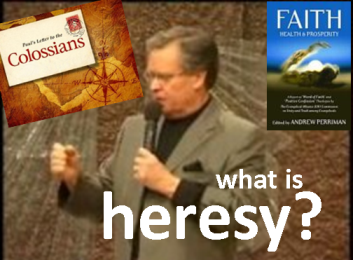
I am uncomfortable with Bible teacher Eddie Hyatt’s use of the term “heresy.” However, I did appreciate the message of his article “The Colossian Heresy Revisited: Has the Prophetic Stream Lost Its Focus?” from the Fall 2005 Pneuma Review.
– AI
Response
Thanks for your comment. There certainly are differing opinions today about what “heresy” is and how Christians should use the term. For example, W. Simpson also discussed the term briefly in the same issue. He talked about how many critics of the faith movement call many of their biblically unsupported tenets “heresy” but that this is often an inaccurate use of the term. “Unfortunately, many of the so-called ‘pop-apologists’ of our time seem to know only one word for classifying errors and excesses in their polemics—the singularly divisive and frequently misapplied appellation of ‘heresy’” (see also Note 1).
If heresy is false teaching that blocks or obliterates saving faith in Jesus as Messiah, then this was not how Dr. Hyatt was using the term. He did say, “what some New Testament scholars call ‘The Colossian Heresy,’” and proceeded to use the term “heresy” through the remainder of the article to describe the unbiblical emphasis on spiritual manifestations.
Thank you again for bringing this to the attention of our other readers.
Raul Mock and the editors







Al, thanks for your comment. I too am uncomfortable when anyone is too free in applying the word “heresy” to everyone with whom they disagree. The word in the NT actually refers to a faction or sect and not necessarily to unorthodox/false teaching. Heresy as false belief/thinking that takes one outside of saving faith is a definition that emerged in the history of the church and its acquisition of earthly affluence and power. It became a punishable, civil crime. I used the word in the mentioned article because the “Colossian heresy” is a commonly used designation in academia for the erroneous teaching that Paul was confronting in Colosse. At that time, in what i believe was a series of providential events I saw that there is erroneous teaching today that is similar to the problem that Paul was confronting in Colosse, and that is why I used that title. It was a way to link a contemporary church issue with the problem Paul addressed in the 1st century. I do not go around labeling people as heretics or their teachings as heresy. In fact, I think you would be hard pressed to find the word in my writings during the nine years since that article was published. God bless you!