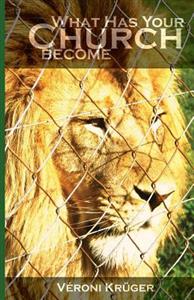
Veroni Kruger: What Has Your Church Become

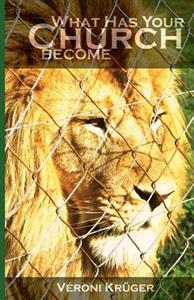 Véroni Krüger, What Has Your Church Become (CreateSpace, 2014), 230 pages, ISBN 9781500556839.
Véroni Krüger’s work What Has Your Church Become is a look with historical insight at what the church was at its beginning, at Pentecost, compared to what it has become. Reverend Krüger uses a literary style with scripture as its own interpreter and his primary source of documentation. Believers young in the faith would benefit greatly reading it. What Has Your Church Become would serve to introduce to them some important spiritual Truths. It is an easy read and inspiring, not argumentative.
Reverend Krüger pastored a pentecostal church and holds a masters degree in Greek. This wide range of experience in ministry makes him amply qualified from a pentecostal perspective to discuss the changing church. In bold honesty Reverend Krüger encourages the church to face its realities from frenzied emotionalism to blind intellectualism. Yet he doesn’t dazzle us with Greek terms and syntax. His easy reading style encourages us to embrace the message.
What Has Your Church Become is an ecclesiological study (a study of the church). Krüger has brought the truth into our language with the clarity, simplicity and emphasis that honors it as a timely message from God’s Word.
What Has Your Church Become is written in 4 sections, the first was background information and brief which I summed above. In his second section Reverend Krüger offers scriptural evidence of the ideal church as God envisioned it at Pentecost after which in section 3 he outlines the Pentecost movement in church history. Lastly he provides a look ahead to the potential for tomorrow’s church.
The Ideal Church
Aside from the scriptures which he writes out for our immediate reference, there are very few quotations from other sources. One I must give you because for me its provides us with his overarching theme. The late Dr. Richard Halverson, US Senate chaplain from 1950 to 1995, provided us with a succinct history of the church:
In the beginning the church was a fellowship of men and women centring on the living Christ. Then the church moved to Greece where it became a philosophy. Then it moved to Rome where it became an institution. Next, it moved to Europe where it became a culture. And, finally, it moved to America, where it became an enterprise.
Pastors who read his work with an honest heart will find themselves equipped with a month of messages and a driving burden to share them. Brother Krüger opens up the Psalms in the process. Sprinkled throughout are the davidic thoughts that undoubtedly were in themselves prophetic precursors of New Testament worship.
Worship requires liturgical expression. Brother Krüger sees this as a matter between the Holy Spirit’s opportunity to minister in contrast to a static and well-defined church culture developed to benefit the leadership’s personal corporate goals. Interpreting I Corinthians 14:26 he contrasts professional standards, impersonal large gatherings, leadership manipulation, spiritual weakness and an emphasis on numerical growth with the Biblically outlined work of the Spirit and our response to it. God’s people are to experience God when they gather together—intellectually (studying the Word), spiritually (worshipping God), and emotionally (participating in the service with a sense of belonging and community). Participating in the liturgy for Brother Krüger means becoming more aware of the Divine Presence with human leadership fading into the background. Liturgical worship is not an oxymoron but God’s opportunity to minister to His people. And Brother Krüger sees this as the ongoing work of the Holy Spirit among us.
Brother Krüger is pentecostal by denominational background but he is quick to recognize the work of the Spirit in salvation and he relegates glossolalia to a lesser position of importance than Classical Pentecostal groups have traditionally done. Not a dispensationalist, he maintains that the gifts of the Spirit operate today within the church—or should—but his emphasis is on the Holy Spirit at work in us (worship) first and then among us and through us (service).
Worship without the Holy Spirit’s work in believers becomes mere powerless form rather than the means to an empowered witness. The fruit of the Spirit, in fact, validates the gifts. The clear evidence of the Spirit is not outward but inward. The indwelling Spirit does not change a believer’s personality but He empowers it. The Spirit inspires us alive to witness to Jesus’ death and resurrection. To Brother Krüger , the evidence is in Acts 1:8. He refers to this as “evidence of the presence of the Holy Spirit.”
The Holy Spirit is indispensable in the ministry of the church as the Body of Christ: His power (effective witness and ministry), His personality (fruit of the Spirit) and His holiness (our sanctification). Brother Krüger also writes about the supporting concepts of body language (how unbelievers read us), the headship of Christ (His Lordship or authority over us) and total church involvement in ministry.
Finally, the first church was missional, which embraces each one’s calling and service to Christ.
Brother Krüger ‘s thoughts on missions recall for me the conclusion of the missionary council of 1928 meeting in Jerusalem when they expounded on the Great commission: “Go and make disciples of all nations.”
Our message is Jesus Christ. He is the revelation of what God is and of what man through Him may become. In Him … we find God incarnate, the final, yet ever-unfolding, revelation of the God in whom we live and move and have our being… Jesus Christ…through His death and resurrection…has disclosed to us the Father, … as almighty Love, reconciling the world to Himself by the Cross….
If such is our message, the motive for its delivery should be plain. The Gospel is the answer to the world’s greatest need. It is not our discovery or achievement; it rests on what we recognize as an act of God… We believe that men are made for Christ and cannot really live apart from Him… Herein lies the Christian motive; it is simple. We cannot live without Christ and we cannot bear to think of men living without Him… Christ is our motive and Christ is our end. We must give nothing less and we can give nothing more.” – DuBose, Francis M. ed. Classics of Christian Missions (Page 336).
Brother Krüger calls this “the cosmic proportions of the calling of the Servant of God” and “the worldwide scope of God’s mission.” These are all embracing and absolute terms that offer the church no plan ‘B’ or alternate possibility for ministry. He speaks of Jesus’ ministry which started in Jerusalem as an ever widening “circle … to become all-inclusive… of the future impact of the Gospel.”
He stings our self-centered sensibilities in saying: “any lesser goal on our part is an insult to the comprehensiveness of his [Christ’s] sacrifice.”
He finishes this section with a look at missiology, what it isn’t and finally what it is.
The Pentecostal Movement
This section can be read separate from the rest of his book since it encapsulates his experience in Pentecost and including in this autobiographical sketch is the record of his leaving the Pentecostal church he attended. Brother Krüger ‘s understanding of historical Pentecost comes through the Dutch Reformed Church in South Africa patterned after this Western tradition (USA and Europe).
The link between sections is hinted at in his leaving the Classical Pentecostal movement. Pentecostalism is not a denomination! It is a spirit-led experience open to all believers regardless of affiliation. Brother Krüger remains pentecostal but not in a denominational sense.
Denominations attempt to—in his words—“contextualize the Gospel in their own cultures.” For Brother Krüger pentecostalism has mutated (his word) into a move of the Spirit that recognizes no particular orthopraxy or denomination distinctive but is distinguished by a child-like faith and acceptance of the Spirit’s ministry among them. In support of this observation, he sprinkles examples from the experiences of a few others whose testimony stood out in his memory.
His personal experience is a delightful read. In his own words:
My intention in writing about the specific manner in which the Pentecostal Movement in my experience handled (and still handles) the theology as well as the phenomena is to indicate how people belonging to the movement and all others may benefit from the experience.
Now What?
“What should we do about everything that has been said?” asked Brother Krüger . He considers these topics. You might think of more.
- Pentecostalism or ministry?
- Evangelical, charismatic liturgies are possible. These are not exclusive experiences or particular to any theology or practice.
- Back to the Bible.
- Preaching for affect or to teach?
- The church and the work of the Spirit is local, not denominational.
- Dependence on God or corporate ingenuity?
- Living the message outside the church; preaching alone is not the complete work of the Spirit.
- The Church is beyond all of us; it is a work of God.
Brother Krüger reminds us finally that God’s church is God’s work, God’s building project. He alone is architect and general contractor.
It is my sincere prayer that this [book] may by the grace of God play some role in that work of building. – Véroni Krüger
Reviewed by John King









Veroni Kruger writes:
Dear Editor,
Thank you so much for the review of my book. I feel John King has done an excellent job. There is, however, one small detail that should be corrected if posible.
The second paragraph begins with “Reverend Krüger pastored a pentecostal church and holds a masters degree in Greek.” I actually completed a doctorate in Greek. In South Africa it is known as DLitt, the equivalent of a PhD.
Thank you again.
Blessings,
Veroni