Keith Warrington, Director of Postgraduate Studies and Senior Lecturer in New Testament at Regents Theological College, Nantwich, has written on healing before, notably in Jesus the Healer: Paradigm or Unique Phenomenon (Carlisle, UK: Paternoster, 2000). Some of the same concerns resurface in Healing & Suffering. For example, do the Gospels and the Acts provide definitive models for healing ministries today, or are they only testimonies to the centrality of Jesus’ messianic identity and ministry for Christianity of all eras? However, its most emphatic focus seems to be on exploring a balanced perspective on the apparently oppositional realities of divine healing and human suffering. As such, this text has a decidedly pastoral emphasis, although assuredly based in and shaped by substantive theological, and especially biblical, inquiry. It is also refreshingly rich in personal testimonies, not only, as has been common in Pentecostalism, of extraordinary healings, although these are included as well, but also in incidents with other outcome occurrences—such as, for instance, how God can and does bring joyous and victorious peace even when dramatic physical healing doesn’t happen as has perhaps been expected. In Healing & Suffering Warrington addresses one of the most pressing issues for contemporary Pentecostals and Charismatics as well as possibly for many other Christians. Pastors and scholars alike will doubtless benefit from reading it. Further, anyone struggling with understanding physical suffering in light of their belief in divine healing may discover coveted direction herein.
Healing & Suffering is well laid out. It has an extensive Table of Contents, effectively functioning as an outline for the entire work, and also an extensive Scripture index. Although, it has no Author or Subject indexes, the unusually full TOC helps make up for it. The Selected Reading section is rather short too, but probably enough to point interested readers in the right direction. Warrington writes in an interesting and accessible style, so this makes for pleasant reading. Footnotes are sparse but probably indicative of the more pastoral orientation overall than one of academic research. The “Reflections” in the subtitle should be taken seriously, for that appears to be primarily the intent and object of this work. Indeed, much of the general direction of this work seems to arise out of Warrington’s reflections during his own pastoral experiences in the context of biblical exposition.
Should believers ever be ill? Is it biblical to “claim” one’s healing? Why do so many remain ill after prayer for healing? What are the gifts of healing? Did Jesus provide physical healing for believers when he died on the cross?
Warrington begins by explaining up front that he wishes mostly to facilitate thinking and point in the direction of answers regarding healing and suffering. As readers will observe, this statement does not mean he is shy about expressing his opinion; but, he does usually do so without dogmatic assertions. He attempts to address most of the major questions people may have about divine healing and human suffering. For examples: Should believers ever be ill? Is there a method for praying for healing? What is the relationship between sin and sickness? Is it biblical to “claim” one’s healing? Why do so many remain ill after prayer for healing? What is the role of faith? What are the gifts of healing? Did Jesus provide physical healing for believers when he died on the cross? And many other similar questions are asked and addressed.
The Church and the Academy need more of a collaborative partnership that seeks to insightfully integrate pastoral concerns and biblical scholarship.
Healing & Suffering is primarily a biblical study. Warrington looks first at healing in the Old Testament (briefly), then in the Gospels, in Acts, and in the writings of Paul and of James. In each case, he mostly simultaneously challenges easy assumptions about healing even while still asserting the biblical and contemporary validity of divine healing for the body. His study of the Gospels is the most systematically thorough, and possibly the most provocative. For him, the healing stories in the Gospels appear to be primarily pedagogical instruments teaching lessons about the messianic identity and ministry of Jesus Christ. They do not provide a model for contemporary practice. He does, however, affirm that “Lessons may be drawn from the healing ministry of Jesus that can be usefully applied in contemporary historical settings,” but adds that “cautious sensitivity needs to applied in presenting the healing ministry of Jesus as a model for healing praxis today.” Similarly in Acts, he denies healing (and exorcism), which he stresses becomes noticeably rarer after Jesus’ resurrection and ascension, almost any paradigmatic modeling of healing practice for the Christians today, insisting rather that their purpose is to instruct about Jesus. He finds Paul, but James even more so, who he sees as actually holistic, to contain elements more instructive for continuing practice. Warrington says, “Recognizing James as having provided a model … is pastorally and theologically foundational.” James, therefore, is “a useful complement to the Pauline expectation of charismatic gifts of healing.”
A number of observations appear in order. First, Warrington’s Healing & Suffering should be received with welcome if for no other reason than its honest attempt to grapple intelligently and articulately with the hard questions concerning healing. Secondly, it is a gigantic leap forward from both the popular literature laying out this or that facilely formulaic model for almost automatically experiencing divine healing and academia’s all-too-common cessationism effectively shutting the door on any realistic expectation of experiencing divine healing. If it aims to be balanced between such extremes, for the most part it achieves that praiseworthy objective. Third, and quite important, it potentially provides solace for those suffering believers who may have been made to feel uncertain or even inferior because they have not (yet) received a miraculous healing. For these and other reasons like them, Healing & Suffering is a commendable book. And I must add that its insightful integration of pastoral concerns and biblical scholarship is most refreshing. I think both the Church and the Academy need more of this kind of collaborative partnership.
Appropriately relating the doctrine of divine healing and the experience of human suffering is perhaps one of the most pressing challenges for contemporary believers attending Pentecostal and Charismatic churches.
However, a number of reservations also appear in order. First, while it apparently intends to be a biblical study with pastoral sensitivity, Healing & Suffering sometimes comes across (at least to me!) as too close to the reverse. Is it possible that we might struggle so stridently with the hard reality of those who are not healed, of those who one who continue to suffer, that we might approach the biblical witness with a bias against a really robust doctrine of divine healing? For instance, Warrington, based on a weak argument that Jesus’ recorded healings occur before his death (What about Rev. 13:8?), and with a much too quick dismissal of Matthew 8:14-17 and 1 Peter 2:24, essentially denies the doctrine of divine healing provided in the atonement. This apparent denial amounts to a major reversal of Classical Pentecostal belief and practice in almost all its historic and contemporary forms. That the doctrine needs careful explication perhaps no informed Pentecostal will argue. Denial is definitely extreme. Admittedly, as he usually does, Warrington leaves ample room for necessary nuances; but still, this seems a risky step biblically and theologically for historic Pentecostal belief and practice. Perhaps Healing & Suffering only wants to “err on the side of caution,” so to speak. And, indeed, that may be a commendable correction to a general trend. Yet shouldn’t genuine balance be striving more so not to err on either side? If we overshoot or if we undershoot, we still miss the target.
Second, while Healing & Suffering refreshingly resists trends to excerpt from Scripture some formulaic model for healing ministry, it might do well to consider the category of precedent. As is well known, a precedent is basically that which is prior in time, order, arrangement, or significance and can serve as an act or instance that may be used as an example in dealing with subsequent similar instances. Jesus used the precedent of Abiathar the high priest and the consecrated bread to defend his own and his disciples’ actions regarding what critical religionists considered the desecration of the Sabbath (Mk 2:25-26). Interestingly, Paul was not afraid to utilize even Christ’s atoning death as a participatory precedent (Pp. 3:10; cf. Gal 6:17). Was there a precise formulaic correspondence model in such cases? No. However, there was an initial or original event or experience that meaningfully informed the inherent nature of subsequent belief and practice. So too, Pentecostals, and others, can look to the healing ministries of Jesus and the Apostles for guidance concerning their approaches to healing ministry. Although Warrington’s repeated insistence on “lessons” learned from Jesus’ and the Apostles’ healing ministries in the Gospels and Acts may intend to offset a complete disconnect, I don’t think that approach alone is robust enough to do justice to the biblical record or for a Pentecostal hermeneutic. Nevertheless, Healing & Suffering is certainly, in my opinion, on the right track in countering popular notions of biblical healing “models” that often lead to abuse at some level—particularly when naively applied in a formulaic or mechanistic manner.
“Jesus Christ is the same yesterday, today, and forever”
— Hebrews 13:8 NKJV
Third, I cannot conscientiously refrain from briefly remarking on the repetitious emphasis in Healing & Suffering that Jesus’ and the Apostles’ healing ministries, along with exorcisms and other manifestations of the miraculous, were mostly all about pointing to Jesus’ messianic identity and ministry. Certainly none will deny the unique nature of Jesus’ miracles as pointing to and provoking faith in him (John 14:11). However—although of course I don’t accuse Keith Warrington of this by any means—such a view could all too easily degenerate into old dispensationalist arguments for cessationism. Thus, miraculous healings, along with other “supernatural” occurrences, can simply be confined to the first century witness to Christ. Warrington correctly avoids this error by appealing to the post-biblical historical evidence of continuing miracles, including healings. Yet the biblical foundation of this continuing charismatic history may have already been undermined by a too casual dismissal of the paradigmatic nature of Jesus’ and the Apostles’ ministries for Christian ministry across the epochs. Likely, many Pentecostals would respond with something like quoting Hebrews 13:8!
I’ve responded perhaps more lengthily to this text because I see it as important. Appropriately relating the doctrine of divine healing and the experience of human suffering is perhaps one of the most pressing challenges for contemporary believers attending Pentecostal and Charismatic churches. In Healing & Suffering, Keith Warrington makes an admirable effort toward that almost overwhelming work. Further, as I understand it, and in specific agreement with him, I am convinced that integrating biblical, pastoral, and theological insights and issues is the way forward. Whether one completely agrees with him, partly agrees, or disagrees altogether, Warrington’s Healing & Suffering is certainly recommended reading for anyone wrestling with correlating God’s healing power and humanity’s all-too-frequent suffering.
Tony Richie, D.Min, Ph.D., is missionary teacher at SEMISUD (Quito, Ecuador) and adjunct professor at the Pentecostal Theological Seminary (Cleveland, TN). Dr. Richie is an Ordained Bishop in the Church of God, and Senior Pastor at New Harvest in Knoxville, TN. He has served the Society for Pentecostal Studies as Ecumenical Studies Interest Group Leader and is currently Liaison to the Interfaith Relations Commission of the National Council of Churches (USA), and represents Pentecostals with Interreligious Dialogue and Cooperation of the World Council of Churches and the Commission of the Churches on International Affairs. He is the author of Speaking by the Spirit: A Pentecostal Model for Interreligious Dialogue (Emeth Press, 2011) and Toward a Pentecostal Theology of Religions: Encountering Cornelius Today (CPT Press, 2013) as well as several journal articles and books chapters on Pentecostal theology and experience.
Vern S. Poythress, Did Adam Exist?, Christian Answers to Hard Questions series (Westminster Seminary Press/P & R Publishing, 2014), 39 pages. Today, Christians are under increasing pressure to “justify” their belief in the Biblical account of creation. Geneticists claim that their research has undermined the viability of the historic Christian account of human origins. So…
Chasing conspiracy theories is not going to solve any problems. True restoration begins when God’s people repent and walk in righteousness. A recent conspiracy theory has garnered much national attention. It involves “Jade Helm 15,” an Armed Services training exercise employing the elite units of the Armed Forces in counter-terrorist warfare. About 1,200 servicemen will…
A Pentecostal in Rome: Fuller Seminary Professor Mel Robeck shares his story about teaching a course at the Gregorian University in early 2018. Over the past thirty-one years, I have flown 127 round trips between Los Angeles and Europe. Eighteen of those trips have been to Rome, nearly all of which included work with the…
Messiah celebrates his final Passover on earth, teaching us much about His own identity as the Paschal Lamb. And it came about that when Jesus had finished all these words, He said to His disciples, “You know that after two days the Passover is coming …” (Matthew 26:1-2a).1 Passover: the overriding event in Israel at…
Presence Is a Verb—a State of Being and an Action The woman abruptly arose from the Sunday dinner table and accusingly spoke to her husband, “You wouldn’t care if I drowned in the waterhole.” She then turned and walked out the door. It had been a typical Sunday for the sixteen-year-old girl. The Pentecostal family…
Pastor-scholar Tony Richie says there is no Jewish-Christian-Muslim God. Nor is there a simple answer to the “Same God” question. When people realize I participate in interreligious dialogue and cooperative efforts they often ask me some version of the question in the main title of this post.[1] If I manage to mention that I have…
To provide the best experiences, we use technologies like cookies to store and/or access device information. Consenting to these technologies will allow us to process data such as browsing behavior or unique IDs on this site. Not consenting or withdrawing consent, may adversely affect certain features and functions.
Functional
Always active
The technical storage or access is strictly necessary for the legitimate purpose of enabling the use of a specific service explicitly requested by the subscriber or user, or for the sole purpose of carrying out the transmission of a communication over an electronic communications network.
Preferences
The technical storage or access is necessary for the legitimate purpose of storing preferences that are not requested by the subscriber or user.
Statistics
The technical storage or access that is used exclusively for statistical purposes.The technical storage or access that is used exclusively for anonymous statistical purposes. Without a subpoena, voluntary compliance on the part of your Internet Service Provider, or additional records from a third party, information stored or retrieved for this purpose alone cannot usually be used to identify you.
Marketing
The technical storage or access is required to create user profiles to send advertising, or to track the user on a website or across several websites for similar marketing purposes.
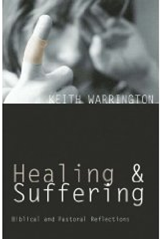

 Keith Warrington, Healing & Suffering: Biblical and Pastoral Reflections (Carlisle, UK/Waynesboro, GA: Paternoster, 2005), 219 pages, ISBN 9781842273418.