Randall Stephens: The Fire Spreads

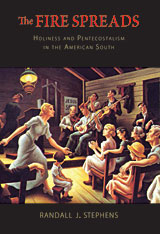
 Randall J. Stephens, The Fire Spreads: Holiness and Pentecostalism in the American South (Cambridge: Harvard University, 2008), 393 pages, ISBN 9780674026728.
Classical Pentecostalism has often been described as a religion of the American South. Much of the story of the origins of Pentecostalism, however, and the precise influences of the South that shaped the Pentecostal faith and praxis in North America, remains untold. Stephens closes much of this gap by retelling the story of Pentecostals in the South following the post-Civil War holiness revival. Stephens follows in the footsteps of recent works that have unearthed the origins and formation of Pentecostalism in the American South, such as Grant Wacker’s Heaven Below: Early Pentecostals and American Culture and Vinson Synan’s classic study, The Holiness-Pentecostal Tradition. In contrast to these broader survey’s, this book deals in particular with regional and chronological nuances that have shaped Pentecostalism in the southern culture, and as such it should make a fine addition to any library, personal or professional.
At the latest with Donald Dayton’s Theological Roots of Pentecostalism, the holiness movement has been established as the precursor of Classical Pentecostal faith and practice. Stephens, however, tells more of the socio-cultural history of Pentecostal origins in the South, using a rich array of sources that range from early Pentecostal publications to diaries, church records, and denominational histories. As a result, the book addresses the changing shape, growth, creativity, and arguments of the movement in the South over the last one hundred years. Stephens is not afraid to portray the frequent scandals and internal debates among Pentecostals, but he does so with the purpose of revealing the genuine enthusiasm as well as innovative and confrontational zeal that has often characterized Pentecostalism. The result is a highly readable book that is as informative as it is enjoyable.
The Fire Spreads is a solid contribution to an understanding of twentieth-century religions history in North America. In that regard, the reader gains at least two significant insights: first, that the South was fundamentally involved in the forming of American religion and, second, that Pentecostalism represents a major catalyst in that formation, ultimately beyond the confines of the American South and the heritage of the holiness revival. In six chapters, Stephens traces the story of Classical Pentecostalism from the roots of holiness revivalism to its entrance into the plain-folk, largely rural character of southern religion, the formation and organization of the Holiness Movement, the birth of Pentecostal fellowships and assemblies, and the institutionalization of Pentecostal churches. Readers find themselves in the company of G. B. Cashwell, L. L. Pickett, W. B. Godbey, William J. Seymour, Billy Graham, Pat Robertson, and John Ashcroft. That this eclectic company is not mismatched lies largely in the fact that Stephens traces a cultural history that has developed from its southern origins to a mass movement of global proportions.
A disadvantage of providing a socio-cultural analysis by telling a historical narrative is the wealth of information that is sometimes hidden in the different story lines. While Stephens groups larger stories together, only the informed reader will be able to trace the underlying currents of, for example, the African American heritage or the ritual and liturgical formation of Pentecostalism in the South. Other themes, such as sectarianism, politics, and ecumenism among early Pentecostals, are rarely made explicit. The advantage of this approach is an unbiased narration and preservation of the Pentecostal “story,†which is still in the process of being told. At the same time, future research will have to make the theological themes of the particular narrative in the American South more explicit, especially in the context of the emergence of a number of global “stories†that are now emerging among Pentecostals worldwide.
In the rapidly evolving fields of holiness, Pentecostal, and southern cultural and religious history, The Fire Spreads offers more than a retelling of a story previously told. As such, it may not be entrance-material to those who have not yet ventured into these fields. The broader surveys by Synan and Wacker may serve as an informative introduction to the specific socio-cultural interests that drive Stephens’ work. In turn, the inquisitive reader will be rewarded with an imaginative account of Pentecostal history in North America. Copious notes and a helpful index make the book approachable from different angles and a good resource for scholarship, ministry, and personal enjoyment.
Reviewed by Wolfgang Vondey
Â
Preview The Fire Spreads: http://books.google.com/books/about/The_Fire_Spreads.html?id=x4iMvift97UC
Publisher’s page: http://www.hup.harvard.edu/catalog.php?isbn=9780674046856