Veli-Matti Karkkainen: An Introduction to Theology of Religions

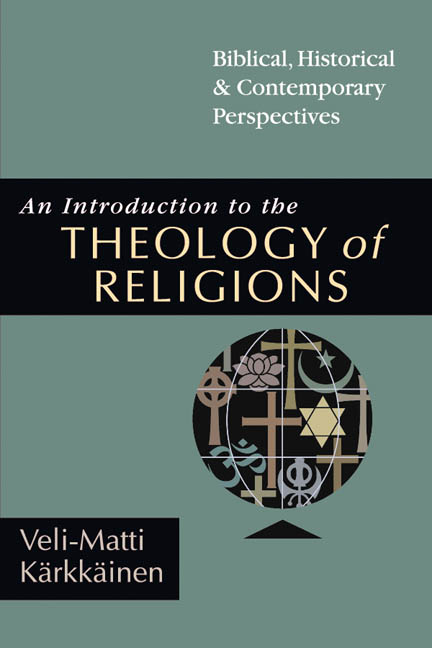
 Veli-Matti Kärkkäinen, An Introduction to Theology of Religions: Biblical, Historical, & Contemporary Perspectives (Downers Grove: InterVarsity Press, 2003), 372 pages.
In a world where wars are waged over disagreements between world religions, widespread ignorance and indifference regarding theology of religions is an astounding and inexcusable reality. In this book Veli-Matti Kärkkäinen takes a bold step towards correcting this sad situation. Kärkkäinen, professor of systematic theology at Fuller Theological Seminary and a prolific author, is noted for insightful surveys and summaries of complex theological subjects (e.g., see his Pneumatology: The Holy Spirit in Ecumenical, International, and Contextual Perspective, Baker, 2002). His own Evangelical and Pentecostal background bring added depth and dimension to his writing which Pneuma Review readers will appreciate as well. In An Introduction to Theology of Religions he makes a tremendous amount of material more readily accessible and intelligible for readers. Key characters and concepts are introduced and investigated objectively. An extensive table of contents, detailed outline, full bibliography, and thorough author/subject indexes are helpful aids for readability and research. Anyone, whether pastor or teacher, student or scholar, interested in gaining a good working knowledge of one of the most challenging but stimulating fields of study among the theological disciplines will assuredly benefit from a reading of this book. It may be particularly well-adaptable as a college or seminary textbook.
Veli-Matti Kärkkäinen begins with an introduction explicating the nature and needs of the newly developing discipline of theology of religions, and adds practical advice on how to use this book. Then he tackles, as the subtitle suggests, biblical, historical, and contemporary perspectives on theology of religions, closing with a brief epilogue. Noting that the rising challenge of religious pluralism now necessitates addressing theology of religions, Kärkkäinen distinguishes comparative religions, the study of world religions themselves, from Christian theology of religions, thinking theologically about “the meaning and value of other religions†and “the relationship of Christianity to other religionsâ€. He also introduces the discipline’s search for paradigms, identifying the one he adopts (ecclesiocentrism, Christocentrism, theocentrism, realitycentrism1), and its parameters, identifying the prevalent typology (exclusivism, pluralism, inclusivism). On opposite poles, exclusivism argues that no salvation exists outside Jesus Christ while pluralism insists that different religions are more or less equally valid paths to God/salvation. Inclusivism, more of a middle position, affirms that salvation is available only by and because of Jesus Christ but neither is Christ necessarily restricted to the Christian religion per se.
In the biblical perspective Veli-Matti Kärkkäinen observes that though a thoroughgoing theology of religions is not found in Scripture some important “leads†do exist. Significantly, an ongoing dialectical tension between universalist (God’s love for the world’s religions) and particularist (God’s judgment on the world’s religions) tendencies is evident. History shows “limited openness to other religions†among some early Church Fathers, but an increasing insistence over time on “no salvation outside the Church.†Occasional positive attitudes toward other religions are discernible after the early Church period. The Enlightenment Age definitely changed the direction more toward relativity of religions. But many missionaries and other thinkers in personal contact with non-Christian religions adopted a “fulfillment theory†of religions, arguing that Christianity completes and crowns what was anticipated in embryonic form in other religious faiths.
The bulk of Kärkkäinen’s book concerns the current scene, addressing “Ecclesiastical Approaches,†or how Christian churches respond to world religions, and “Theologians’ Interpretations.†Here his skillful navigating of the waters of the world of ideas regarding religions is especially helpful. Vatican II (1962-65) has had truly “transformative significance†for Roman Catholicism, leading to a much more inclusivist stance toward other religions. So-called mainline Protestant denominations such as Anglican/Episcopalian, Lutherans, Reformed, and Methodists generally follow suit. The Free Church tradition, including Anabaptists, Mennonites, Baptists, Pentecostals, and Charismatics, exhibits more variety than unanimity on theology of religions, but locates in exclusive-inclusive camps. Some Evangelicals are engaged in a painful process of struggle between exclusivism and inclusivism. Generally speaking, the ecumenical movement, including the World Council of Churches, is in close proximity to the official Roman Catholic position accenting inclusivism and interreligious dialogue.
In “Theologians’ Interpretations,†Kärkkäinen applies the paradigm of ecclesiocentrism, Christocentrism, theocentrism, realitycentrism, or, salvation through the Church, through Christ, or through God/Ultimate Reality. This allows more flexibility and variety than the more standard exclusivist-pluralist-inclusivist model, but still has its limits. Understandably, a short book review does not have nearly enough space to adequately analyze the ideas of leading theologians of the day. Put briefly, Karl Barth, Hendrick Kraemer, and Paul Althaus signify early Catholic/Protestant approaches to ecclesiocentrism, while Karl Rahner, Hans Küng, Jacques Dupuis, and Gavin D´Costa exemplify Christocentrism. Mainline Protestants Paul Tillich, Wolfhart Pannenberg, Lesslie Newbigin, and M. M. Thomas and Evangelicals Sir Norman Anderson, Clark Pinnock, and Amos Yong are also representative of Christocentricism. Theocentric/Ultimate Reality thinkers, include, most infamously John Hick, and also Stanley J. Samartha, Raimundo Panikkar, and Paul Knitter. Evangelicals who are ecclesiocentric include Millard J. Erickson, Harold Netland, and Vinoth Ramachandra. Obviously, a large difference of perspective exists among such original thinkers as these but enough similarity is shared to broadly place them together. Perceptive readers will note that generally speaking exclusivism overlaps with ecclesiocentrism, pluralism with theocentrism/ultimate reality, and inclusivism with Christocentrism.
In his epilogue, “The Way Forward,†Veli-Matti Kärkkäinen again notes the early stages of development for theology of religions and advises against continuing the current polemical mode of discussion. He favors more of a mutual dialogue. He warns that religious pluralism is “the most impending†problem for theology of religions, and looks forward to Christian theology of religions, which is now much more developed than that of other religions, being joined in discussion by them. He thinks theology of religions should be added to the core curriculum of educational institutions of various persuasions too.
I am particularly intrigued with what An Introduction to Theology of Religions says about Pentecostals. Noting that, next to Roman Catholicism, Pentecostals represent “the largest segment of Christian churches currently,†Kärkkäinen believes they have much to contribute on this subject and should be taken seriously. He insists, however, that we remember Pentecostalism, especially after global growth extending outside the West, is characterized by “variety and heterogeneity.†Pentecostals simply cannot be cubby-holed easily. Though Pentecostals are often aligned with fundamentalists and other conservatives, and “most limit the saving work of the Spirit to the church,†some see “the Holy Spirit at work in non-Christian religions, preparing individual hearts for eventual exposure to Jesus Christ.†Yet, while not wishing to limit the Spirit, many Pentecostals are “extremely reserved†about the Spirit’s “salvific ministry outside the church.†Pentecostalism’s close cousin, the Charismatic Movement tends to be a bit more open on this matter. However, Pentecostal theologians such as Amos Yong (and of course, Kärkkäinen, and me too) are challenging these stereotypes. Possibly Pentecostalism is shaking off the shackles of fundamentalism in favor of its own authentic pneumatological (and still Christocentric!) theology of religions. In any case, Veli-Matti Kärkkäinen’s Introduction is certainly a significant assistant for this field of study. Perhaps most importantly, Kärkkäinen shows that before Pentecostals reach a conclusion regarding theology of religions and our response to radical religious pluralism we need to carefully survey the Scriptures, Christian history, and the contemporary setting. That seems so much better than jumping on a belief bandwagon driven by non/anti-Pentecostals.
Reviewed by Tony Richie
Â
1 Realitycentrism is a term used to describe an especially radical vision of religious pluralism that prefers to use “Ultimate Reality†as a description of God in order to make references more palatable to those religions, such as Hinduism or Buddhism which do not believe in a personal deity but in some kind of impersonal force or being. In other words, it is a more philosophical and less theistic version of “theocentric.â€
Â
Publisher’s page: http://www.ivpress.com/cgi-ivpress/book.pl/code=2572
Preview An Introduction to Theology of Religions: http://books.google.com/books/about/An_Introduction_to_the_Theology_of_Relig.html?id=du-TlKBnz9MC
Â