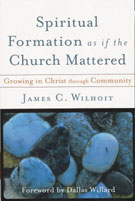
James Wilhoit, Spiritual Formation as if the Church Mattered

 James C. Wilhoit, Spiritual Formation as if the Church Mattered: Growing in Christ through Community (Grand Rapids: Baker Academic, 2008), 233 pages, ISBN 9780801027765.
Dallas Willard, in The Spirit of the Disciplines, challenges the Church to return to the primary purpose of proclaiming the gospel and making disciples (18). James Wilhoit’s spiritual theology, as viewed through the lens of a careful ecclesiology, answers Willard’s challenge for the Church to pursue renewal in authentic discipleship. Beginning as conversations with his students and later as interviews with church leaders, the author’s research attempted to discover patterns and practices of spiritual formation within Christian faith communities. He discovered that “some churches are marked by the presence of a ‘culture of formation’ … while others may have many programs and much activity, [but] lacked the presence of … a transformative culture†(13).
Wilhoit, maintaining that he writes “as an evangelical … deeply concerned about the erosion of intentional practices of spiritual formation in many … churches,†explains his concern that “patterns of nurture†long practiced within the church have either been abandoned or set aside. He lists systematic Bible teaching, Scripture memorization and reading, Sunday evening services “with an emphasis on testimonies, missions, and global Christianity,†observance of Sabbath, shared meals, hospitality, church summer camps, pastoral visitation, and intergenerational socializing as elements of formative spirituality often missing in contemporary faith communities (13). His intent is to present a process of formation based on patterns and practices he defines as four spiritual commitments or dimensions including “receiving, remembering, responding, and relating†that become, in effect, “a curriculum for Christlikeness†in the local church (7).

The author’s theology of formation begins with the gospel. He carefully exposits the problem of sin; its remedy in Christ and the unfolding pattern of sanctification as essential to the individual’s formation in Christlikeness and to the growth and effective ministry of each community of faith. Wilhoit is careful to precisely define grace, which he views as free and unmerited favor, but also inclusive of God’s “regenerating and strengthening power†(79). This recurring theme of grace presents the connecting thread of theological truth that weaves together the author’s exposition of practices and disciplines designed to provide an intentional focus on seeking God’s presence and discerning the Spirit’s movements within the daily life of a faith community.
His conviction that “spiritual formation must continually return to the truths of sin, cross, redemption, grace, and true holiness because the prevailing plausibility structures of our culture push us in the direction of idolatry and false gospels,†emphasizes an approach to formative spirituality that is solidly grounded in biblical theology (76).
The author’s holistic approach to spiritual formation, his focus on a well-developed hamartiology and the importance of community, are important aspects of the text that distinguish it from many other works on formative spirituality that do not develop these ideas as carefully or in as much detail. Wilhoit carefully develops his discussion on the spiritual brokenness of the human person as viewed through the lens of yearnings: those yearnings that persist and are seen “to be the result of compromised discipleship†and those yearnings that have been “fully met in Christ†(61). The author understands that practicing spiritual disciplines may either be used as “a space to meet God and be refreshed and healed by his grace†or as “material [that some use] to become far more accomplished legalists†(76). His refusal to reduce formation to “doingâ€, but rather examine, from the standpoint of biblical theology, the ontological truths of formation, are strengths of Wilhoit’s presentation.
Although written with practical application in mind, the text does not neglect careful analysis, discussion and explanation of the more academic yet essential aspects of spiritual formation. At the conclusion of each chapter, the bibliographic entries “For Further Reading†provide additional pertinent resources for the research scholar as well as those ecclesial leaders seeking further study in spiritual theology and practical applications for the formative process. The theological soundness and practical applicability of the text’s carefully developed thesis and themes; the well-designed graphic illustrations, which provide excellent visual representations of concepts in spiritual theology, underline the book’s significant value for use in pastoral staff training, Christian formation classes in church settings and also for use in seminary contexts.
Reviewed by Mara Lief Crabtree
Preview and Excerpt: http://assets.bakerpublishinggroup.com/processed/book-resources/files/Excerpt_Wilhoit_Spiritual.pdf