
Jeffery Sheler: Is the Bible True?

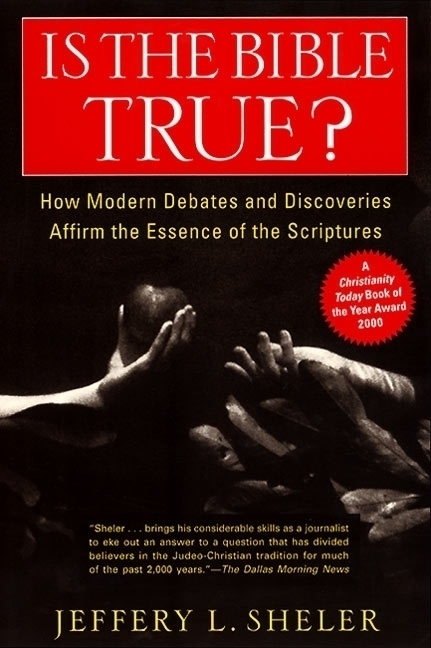 Jeffery L. Sheler, Is the Bible True? How Modern Debates and Discoveries Affirm the Essence of the Scriptures (Harper San Francisco/Zondervan, 1999), 279 pages, ISBN 9780062013460.
As usual, Christianity Today featured its annual list of leading Christian books in its April edition. This year it offered the 10 best, several honorable mentions, and also a list of the last century’s 100 leading books. I had not read any of this year’s list so I started with number one, Jeffery Sheler’s Is the Bible True?
I quickly learned that the author is not a theologian or scholar in a religious sense. Sheler is a journalist who has written much about religion for his employer, U.S. News and World Report, in the last ten years. Sheler brings his journalistic skills to bear in his book, along with the access that his position gives him into academia and other hard to penetrate circles of influence. Sheler also had the advantages of the superior and at times amazing research talents and resources of his magazine staff along with the encouragement of his employers. Quite a combination for such a book.
The book’s subtitle tells the reader that she is about to learn or confirm that the Scriptures are essentially true, so that the conclusion of the debate that is presented is not ever in doubt. Nonetheless I found that Sheler methodically and fairly presented the most compelling facts or suppositions that are today’s fashion in the endless argument about the validity of the Bible.
Sheler divided his text into six parts. He begins with a quick review of the history of these age old arguments: how the Bible or canon came to be, who authored the various books, and why the Bible is a revelation-story about God and His Son.
Part two deals with the good and bad archaeological finds of the last 150 years. It includes a look at the lack of any tangible evidence that any patriarch actually lived. I have always found discussion of this dearth of “proof†worrisome. I remember when I was working my way through Gunther Plaut’s commentary on the Torah asking God why He hadn’t solved all the mystery of the patriarchs and the first 1000 or whatever years of scripture’s content with a few well placed nicely illustrated artifacts. Such would be so helpful and would end so much of the debate that never ceases. God spoke to my heart at that point and said “Mur, I am God, I don’t have to prove myself to men. It is the other way around, men have to prove themselves to me.â€
I found the part on archaeology most helpful. I had been unaware of most of the material presented by Sheler on this subject. I also learned a great deal in part three which presents what we have learned so far from the Dead Sea Scrolls. He also tells the story of this find and how those involved have conducted themselves. We humans have a tendency to look out for number one— not necessarily a nice attribute.
Then Sheler delves into the quests to discover the historical Jesus. We learn that there have been three quests in recent times. I ended up thinking that vanity is a force which drives far too much of our lives. Next we learn about the recent emphasis on Bible Codes and what they are all about. Much ado about nothing in Sheler’s opinion, and I agree. The last part of the book is Sheler’s conclusion which was never really in doubt , since we were told beforehand what we would learn.
It is a conclusion, however, that I have known to be true ever since I dared to believe and act upon an evangelist’s invitation 40 years ago. I knew nothing about the Scriptures. The Bible was a book I found in hotel room nightstands. It was incomprehensible and meaningless. Not worth my attention. The debate over inerrancy, infallibility, historicity and so on meant nothing to me. They still don’t. Somehow I just knew they were of the highest value and reliability as soon as I was birthed into the Kingdom of God.
Sheler’s book is well done, though some scholars probably will not like it. It is not deep enough for that crowd, but to the ordinary person in the pew who wants a better understanding of the debate, here is an opportunity to be on the cutting edge, and what I think is also the popular edge of the debate. I enjoyed the book. It is good journalism.
Reviewed by H. Murray Hohns
Publisher’s page: www.harpercollins.com/9780062013460
Â