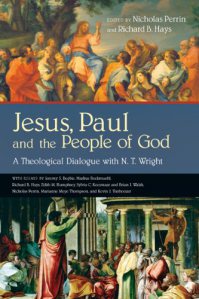
Jesus, Paul and the People of God: A Theological Dialogue with N. T. Wright, reviewed by Amos Yong

 Nicholas Perrin and Richard B. Hays, eds., Jesus, Paul and the People of God: A Theological Dialogue with N. T. Wright (Downers Grove: InterVarsity Press, 2011), 294 pages.
Every time I read N. T. Wright I come away edified, instructed, inspired, and even transformed. This book is no exception. As in much if not all of his other work (I am reluctant to be emphatic about the all since I do not want to give the misleading impression that I have read all of Wright’s books—I do not think that I will live long enough to do that, especially since the former bishop of Durham writes books faster than I can read!), Jesus is lifted up; the benefit of this book is that we also get a glimpse of how Wright sees St. Paul lifting Jesus up as well. Let me explain through a cursory overview of the two parts of this book.
As a product of the nineteenth annual Wheaton Theology Conference (at Wheaton College in Wheaton, Illinois) held in April 2010, the volume features eight chapters responding to the work of the newly appointed chair of New Testament and Early Christianity at the University of St. Andrews. Half engage Wright’s focus on Jesus (in part I) while the other half interact with Wright’s understanding of Paul (part II). Each chapter includes a brief rejoinder by Wright at the end, while each part concludes with a lengthier reflection by Wright on whither historical Jesus and whither Pauline studies in the life of the church, respectively (in part I on Jesus, quite a bit lengthier—about 45 pages worth, the longest chapter of the book). To be sure, the conference organizers had to be selective in inviting respondents to Wright’s work, so the essayists engage Wright’s corpus from their respective vantage points.
As Vanhoozer points out, Wright’s body of scholarship is slowly but surely initiating a paradigm change, not just in historical Jesus or historical Paul scholarship but also in the fields of New Testament Studies and even of historical, dogmatic/doctrinal, and systematic theology. Of course, this is happening in tandem with other developments such as postliberal theology and the New Perspective on Paul initiatives, the latter especially to which Wright has made his own substantive, even if also critical, contributions. The result, methodologically, is a sure-footed via media between conservativism and liberalism, between orthodoxy and historicism, between modernism and postmodernism, between biblical theology and theological interpretation, etc. More importantly, it is precisely in and through a careful rereading of the New Testament in particular and the biblical canon as a whole that Wright is forging a fresh understanding of the Gospel in Jesus Christ as it relates to God’s election of Israel, to the formation of the church as new people of God in relationship to the restoration of Israel, and to the mission of the people of God in the present time. To be sure, there will be detractors a plenty given all of the ground covered across the Wrightian corpus, but even if he is only half right, there are many implications for what that means for faithful Christian discipleship in our present time. (And again, even if Wright is only half right, there will be even more implications to be discerned from out of the process of correcting his proposals.)
Renewalists—those who find themselves within and/or identify with pentecostal and charismatic Christianity—need to take up and read Tom Wright’s many books, if they have not begun to do so already. For the uninitiated, this volume under review will serve as an excellent introduction to what Wright has been up to, in particular his two chapters concluding each part of the book. Four major points of intersection deserve mention (among many others that constraints of space and time prevent from registration here). First, Wright’s dogged quest for the historical Jesus presents us with a fresh perspective on the identity of the Galilean Jew occluded by the theological tradition. This is a fully-human Jesus who yet fulfills through his life, death, resurrection, and ascension into heaven God’s plans to restore Israel and redeem the world. The Gospel is thus about what God accomplishes in Jesus of Nazareth. I wonder what might ensue in a conversation about Jesus, about God, and about God’s saving purposes when, for instance, Oneness pentecostals engage with the work of N. T. Wright? Renewalists in the pentecostal tradition—both Oneness and trinitarian—love Jesus; it is also palpably evident that N. T. Wright does as well. How might a reconsideration of the person and work of Christ unfold in a dialogue between pentecostal renewalists and Wright’s understanding of Jesus? Such a conversation may be best positioned to revisit the scriptural witness afresh, especially in light of the anti-creedal postures that animate Oneness readings of the Bible.
Last, but not least, I read N. T. Wright and am driven back to the scriptures that he carefully attends to. Wright is no bibliolater; but he is committed to the apostolic testimony as preserved in the biblical canon. Renewalists are also people of the book, although their “this-is-that” hermeneutic oftentimes collapses the distance between the scriptural and the present horizons. Wright’s critical and historical realism is a solid reminder to renewalists that “what happened back then” is fundamentally important for Christian life today; but renewalists can also contribute to Wright’s accomplishments the testimony that what happened back then continues to happen today—thereby providing concrete witness to the possibilities inherent in Wright’s own emphasis that the drama of scripture needs to be lived into, replayed, and improvised by each generation. The point is that the Bible is a living book, and Wright’s writings and renewal testimonies both bear complementary witnesses to that fact.
Reviewed by Amos Yong
Publisher’s page: https://www.ivpress.com/jesus-paul-and-the-people-of-god
Preview Jesus, Paul and the People of God: books.google.com/books?id=k3u14Gz_dboC









TW writes: "A Review that Causes me to want to read this book. Read if you have a hunger for God and are not afraid of Theology."
TW writes: "A Review that Causes me to want to read this book. Read if you have a hunger for God and are not afraid of Theology."
FT writes: "love this author."
FT writes: "love this author."
TW says: "Inter-Varsity Press is a marvelous publisher of quality Christian books."
TW says: "Inter-Varsity Press is a marvelous publisher of quality Christian books."
AL writes: "Currently 700 pages into Tom N. T. Wright's latest on Paul… great intro to the Spirit in Paul at the minute…"
AL writes: "Currently 700 pages into Tom N. T. Wright's latest on Paul… great intro to the Spirit in Paul at the minute…"
TW writes: “A Review that Causes me to want to read this book. Read if you have a hunger for God and are not afraid of Theology.”
TW writes: “A Review that Causes me to want to read this book. Read if you have a hunger for God and are not afraid of Theology.”
AL writes: “Currently 700 pages into Tom N. T. Wright’s latest on Paul… great intro to the Spirit in Paul at the minute…”
TW says: “Inter-Varsity Press is a marvelous publisher of quality Christian books.”
FT writes: “love this author.”
AL writes: “Currently 700 pages into Tom N. T. Wright’s latest on Paul… great intro to the Spirit in Paul at the minute…”
TW says: “Inter-Varsity Press is a marvelous publisher of quality Christian books.”
FT writes: “love this author.”