Amos Yong: The Spirit Poured Out on All Flesh

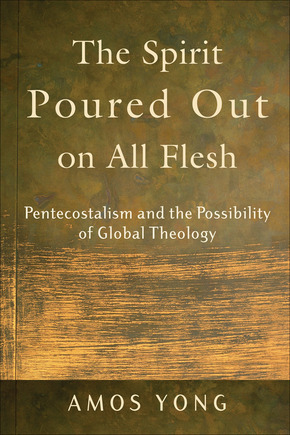
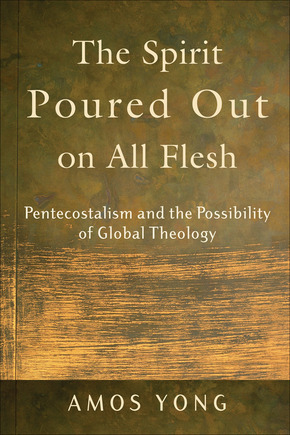 Amos Yong, The Spirit Poured Out on All Flesh: Pentecostalism and the Possibility of Global Theology (Grand Rapids: Baker Academic, 2005), 320 pages.
The oft overused term “instant classic” is, of course, an oxymoron. To become a true classic takes time; by definition, it cannot be an instant occurrence. Still, in a less straightforward sense that a potentially classic contribution to the Pentecostal conversation seems immediately apparent, Amos Yong’s The Spirit Poured Out on All Flesh may indeed be an instant classic. Whether one is interested in diverse Pentecostal origins and activities around the world, Pentecostalism’s inherent ethos as a movement, or an in depth application of its underlying pneumatological theology and spirituality addressing many of the most pressing themes of our day—or all of the above—this book has something solid for you. It can be guaranteed to inform, challenge, provoke, and otherwise stimulate theological thought and praxis.
Dr. Yong ably expands and extends the discussion on every topic he addresses. A prophetic tone is often discernible in the challenges he tosses out (e.g., on religiously substantiated racism and Pentecostalism’s missed opportunities and new possibilities; Pentecostals’ elitism in the West). His discussions also disclose profound pastoral concerns (e.g., for spiritual formation and growth, missions and ministry). His is not a timid description of where Pentecostalism is or may be headed, but a definitive prescription for both broad and deep progress. Yet Yong humbly concedes the provisional nature of his work, calls for others to evaluate the results, and then to converse with him through critiques that can help construct an ever more efficient theology. Though Yong addresses general Christianity, he presses home interests and insights from and for Pentecostalism (e.g., multiple dimensions of holistic salvation; a Spirit Christology avoiding subordination/displacement of either Son or Spirit). But for him Pentecostalism is “deep and wide”—his is definitely not a narrow or shallow portrait of the movement. Laying aside sectarianism, Yong includes classical Pentecostals, neo-Pentecostals/Charismatics, and Pentecostal-like groups from around the globe in an ongoing conversation about life and faith in one of contemporary Christianity’s most vital branches of the family tree.

To begin with, the Preface explains a variety of Pentecostal, ecumenical, eschatological, and personal contexts. Here readers detect the diversity driving a theological vision rooted in a unifying pneumatological orientation. Then the Introduction sets the stage by identifying “emerging global issues” forming the foci for what follows in the bulk of the book: multidimensional salvation; pneumatological soteriology and ecclesiology; ecumenical potential; Oneness and Trinitarian identity and plurality; public theology and world religions; and, a theology of creation and science. Everything from Pentecostal history, theology, and spirituality to the politics and practices of racism, feminism, and colonialism are discussed alongside issues of interfaith relations, liberation of oppressed peoples, and the problems and potentials of Spirit-filled walk and witness in a postmodern world. Always Yong exegetes the Scriptures and engages the theological discipline with an incredible command of resources. Convinced that today’s “late modern world” is characterized by increasing complexity and ambiguity, he is nonetheless persuaded “not only that Christian theology can continue to speak in this new global context but also that pentecostal theology in particular can do so” (pp. 17, 18). Indeed, if anything, the remainder of the work amply illustrates the relevance of “world pentecostal theology” (p. 135). Yong clearly elucidates his presuppositions and methodology, which he consistently applies throughout the work. Truly, typically, and distinctively Pentecostal, he builds on a Lukan hermeneutic, a pneumatological framework, and an experiential base while stressing the centrality of Christ and insisting Pentecostals can no longer put off apologetic and systematic theology.
Here is intelligent, articulate thinking that is more than a bit bold at times (e.g., ecumenical/inter-religious emphases). Still, it attempts to anchor even its more speculative suggestions in the best Pentecostal tradition (striving throughout to be “Christ centered and Spirit driven”—pp. 83, 156; cf. pp. 203, 226). Some readers may occasionally question whether Yong always quite pulls that off (e.g., on the provisional authority of the papacy or episcopacy). Those willing to listen long enough to really consider his ideas and their implications will often end up answering in the affirmative. Doubtless, even when disagreeing they will benefit from the process. At times Yong suggests pneumatological theology reinvigorates old doctrines (e.g., integrating atonement theories; more organic, less privatized ecclesiology). At other times he tackles new terrain (e.g., theologically exploring science). We do well to remember his “pneumatological theology of quest” (p. 30). To employ early American pioneer imagery, Yong is a scout more so than a settler, always pushing beyond theological frontiers into uncharted territory; yet he marks well the trails he blazes precisely because he is mindful of those following who are doing the hard work of homesteading necessary for building a lasting spiritual civilization capable of sustaining and nurturing Christian faith and life.
Close to the heart of Yong’s endeavor is conceptualizing Spirit baptism as a broad metaphor for a dynamic and eschatological pneumatological soteriology characterized by less rigidity and more fluidity. In a carefully qualified sense, therefore, Spirit baptism would include initial conversion (justification/new birth), ongoing and entire sanctification (holiness), and charismatic endowment and vocational empowerment through spiritual gifts. Drawing on John Wesley, Yong argues more for a “via salutis” (way of salvation) than an “ordo salutis” (order of salvation) (p. 104). Through an overarching rubric of Spirit baptism salvation can be conceived as a conversionary process of ever intensifying transformation including multiple bilateral (nonhierarchical) stages of spiritual experience on a journey culminating in glory. Salvation as process means, “I was saved, I am being saved, and I will be saved” (p. 118). With this move Yong hopes to avoid stalemate debates about conversion-initiation, serial “works of grace” (crisis-development), and even divine sovereignty and unconditional eternal security, without sacrificing Pentecostal experiences of the Spirit. Not entirely without precedent (cf. “pentecostal pioneer David Wesley Myland”; p. 99 fn. 46), this nevertheless represents an innovative and irenic attempt to take Pentecostal pneumatological soteriology beyond conventional categories. It implies that in different ways at the same time both Pentecostals and their detractors have been both right and wrong on key points! It also directly affects interrelated areas (e.g., a less symbolic, more pneumatic sacramental theology). Questions arise. Have Pentecostals overly dogmatized about dynamic experiences and thereby at least partially undermined their own testimonial purposes? Is any single metaphor broad enough to encompass all Christian experience? What are the possibilities and pitfalls here? Will Pentecostals and the wider Christian community gain ground together? Or do Pentecostals end up giving up hard won land our forefathers and foremothers fought for so sacrificially? Whichever track is taken, wrestling with these issues seems sure to enliven and enrich Pentecostal theology for some time to come.
Yong is a master synthesizer. He is particularly adept at taking apparently disparate views and demonstrating, without denying real differences, ways they might appreciate, inform, and enhance one another. Results are never merely condescending or compromising, but always truly creative. He employs this process surprisingly successfully with Christians and non-Christians, Pentecostal Christians and non-Pentecostal Christians, various “liberal/post-liberal” and “conservative” ideologies, Roman Catholics and Pentecostals, and political-sociological agendas and spiritual-individual experiences, and others. Along this line his discussion of Trinitarian and Oneness Pentecostal theology is especially intriguing. Potentially cross-fertilizing concepts of unity and plurality are creatively explored. One suggestion I question, however, is Yong’s admittedly “ambivalent” discussion of possibilities in Oneness theology as points of contact with non-Christian radical monotheists (see pp. 227-31, 264). The most effective inter-religious dialogue includes candor about what we really are in our most authentic identity. For most Christians, including most Pentecostals, that identity is Trinitarian. Involving fringe views only adds another hurdle to overcome. Also, Oneness Pentecostals avidly affirm the deity of Jesus Christ, a typical stumbling block with radical monotheists. There is one way Yong may not be far off the mark. Pentecostalism’s internal struggle regarding the Godhead may indeed help prepare it for external dialogue involving the same subject. After nearly a century of struggle over the Godhead, have Pentecostals learned anything positive that can be passed along or pressed into service? If so, how does it inform inter-religious dialogue?
Reading The Spirit Poured Out on All Flesh is an exciting adventure well worth undertaking. Enjoyment is enhanced in that this is a most readable work. Without sacrificing substance, Yong avoids a pedantic tone and keeps the pace of the text moving along briskly. More advanced scholarly subtleties are adequately addressed in fairly copious footnotes. The last chapter, on religion and science, is the most abstract. Yet a crisp, groundbreaking pneumatological theology of nature confronting traditional dualisms and dichotomies is gripping even here. The philosophical framework of the entire book’s “dynamic, holistic, and multidimensional soteriology” and “ecumenical, sacramental, and charismatic ecclesiology” (p. 294) is finally here declared most forthrightly. Readability is further fostered by especially well done organization. Well marked and cross-referenced section and sub-section headings, beginning and ending with clear, concise overviews and summaries, are helpful indeed. One wishes for a fuller subject index. Overall, Amos Yong has accomplished a most difficult task: writing a deep book with a wide appeal. Most importantly, it has worldwide applicability. Anyone interested in anything about today’s developing Pentecostalism will want to read it. It will make an exceptional textbook for scholars and students.
Reviewed by Tony Richie
Publisher’s page: http://bakerpublishinggroup.com/books/the-spirit-poured-out-on-all-flesh/232981
Preview The Spirit Poured Out on All Flesh: http://books.google.com/books/about/The_Spirit_Poured_Out_on_All_Flesh.html?id=65DsASd_ORMC