Daniel Albrecht: Rites in the Spirit, reviewed by Amos Yong

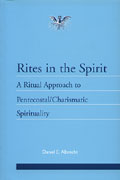
 Daniel E. Albrecht, Rites in the Spirit: A Ritual Approach to Pentecostal/Charismatic Spirituality, Journal of Pentecostal Theology Supplemental Series 17 (Sheffield, England: Sheffield Academic Press, 1999), 280 pages, ISBN 9781841270173.
Pastors and Church leaders in the Pentecostal and charismatic movements should take note of this book written by Albrecht, Professor of Church History and Christian Spirituality at Bethany College of the Assemblies of God (Santa Cruz, California). It is valuable for the three objectives the book achieves. Whereas many Pentecostals and charismatics think themselves to be anti-liturgical or anti-ritual, Albrecht unveils the liturgical and ritual structures underlying our worship practices. He shows that Pentecostal/charismatic worship includes the sight, sound and touch dimensions of human experiences. Therefore, Pentecostal/charismatic worship embodies both the sacramental—whereby the spiritual realm is mediated through the material—and ritual. Albrecht distinguishes rituals from rites. He states that rituals are the, “acts, actions, dramas and performances that a community creates, continues, recognizes and sanctions as ways of behaving” employed in worship services. Rites are the specific portions or phases of these services. Albrecht discusses in detail pre-service gathering or greeting rites, rites of worship and praise, rites of preaching, altar and response rites, and post-service dispersal and farewell rites. He shows how these provide a structure through which Pentecostals and charismatics encounter God.
Rites serve as a window into the Pentecostal/charismatic self-understanding and worldview. The appropriate sensibilities—embodied attitudes, orientations, and affections—with which worshippers come are crucial regarding the performance of these rites. Albrecht shows how Pentecostal/charismatic worshippers participate fully in the service and are transformed by expressing sorrow and contrition, contemplating and celebrating God’s presence through ecstatic and ceremonial experiences. Further, Pentecostal/charismatic commitments to being led by the Spirit—what Albrecht calls spontaneity and improvisation—combats stagnation by ensuring that rites evolve dynamically and vary in terms of format and/or performance. Of course, this dynamism extends to the relationship between the rites and the sensibilities as well, since the rites foster these sensibilities in devoted worshippers even as the sensibilities shape the very experience of the rites in turn.
Finally, in addition to providing structure and shaping sensibilities, Pentecostal/charismatic rites are both expressive and efficacious on the congregational and the individual levels. Rites provide opportunities for expression in three important areas. First, for human concerns there are faith in prayer rites, repentance at altar rites, communal solidarity in greeting or dispersal rites etc. Second for social configurations rites aid in distinguishing pastoral from lay leadership, confirming prophetic roles or calling, and allowing the emergence of charismatic giftings and perhaps vocations. Lastly rites aid in determining theological relationships within the local congregation, in mission to the world, and vertically toward God himself. In a purely pragmatic sense, these expressions also aid in fostering community, nurturing wholeness, motivating action and enabling transformation.
This very abstract overview does not do justice to Albrecht’s rich documentation of how rites and ritual function in Pentecostal/charismatic congregational life, and how Pentecostals and charismatics worship ritually. Drawing from extensive field research at three Northern California congregations—representing the Assemblies of God, the Church of the Foursquare, and the Vineyard—case studies and descriptive accounts illuminate the ritual analyses presented. For myself, reading Rites in the Spirit sensitized me to the subtle ways in which we have been led—by the Spirit, I would go so far as to say—to strategically develop our corporate worship experiences. It overwhelms me with the reality that the mundane rites we perform do actually mediate our encounters with God. It also encourages me to embrace the dynamics of Pentecostal/charismatic ritualizing while expecting to be transformed through the process. I encourage all Pentecostals and charismatics involved in pastoral ministry to engage this important book, not only to appreciate how and what we do, but also to be equipped to shape and mold the future of Pentecostal-charismatic ritual.
Reviewed by Amos Yong