
Holistic Mission, A Review Essay by Tony Richie

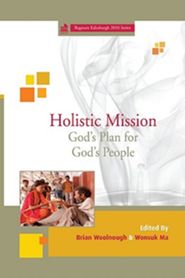 Brian Woolnough and Wonsuk Ma, eds., Holistic Mission: God’s Plan for God’s People, Regnum Edinburgh 2010 Series (Oxford, UK: Regnum, 2010), 279 pages, ISBN 9781870345859.
Holistic mission, or integral mission, implies God is concerned with the whole person, the whole community, body, mind and spirit—and, that’s just what this book is about. Specifically, it discusses the meaning of the holistic gospel, how it has developed, and implications for the Church. Holistic Mission takes a global, eclectic approach, with 19 writers, all experienced in and committed to holistic mission. It addresses its theme in a critical and honest manner, arguing that “To be part of God’s plan for God’s people, the church must take holistic mission to the world.” The perspective of this book, and the tradition of the different contributors, are largely from the conservative, evangelical, Pentecostal, charismatic wing of the Church. It’s therefore likely of particular interest for scholars and students of missiology from this general background, or those interested in it academically, although it emphasizes both evangelical and ecumenical streams. Furthermore, it is certainly not “merely academic,” being filled with information fit for the most practical-minded practitioners. In fact, a deliberate effort to give a wide-ranging and eclectic overview of holistic mission definitely shows. The editors have brought together perspectives from theologians, church leaders, practitioners, and insights from around the world from the United Kingdom, Asia, Africa and southern and northern America. Their joint insights are both illuminating and inspirational.
The editors are well qualified for this particular task. Brian Woolnough is Research Tutor at Oxford Centre for Mission Studies (OCMS) and Emeritus Fellow of St Cross College, Oxford. Having originally trained as a physicist, he spent most of professional life in education as an academic at Oxford University. Woolnough then worked with international team of Tearfund, UK, travelling widely in Asia and Africa, before moving to OCMS. Wonsuk Ma, a Korean academic and missionary, has been the Director of the Oxford Centre for Mission Studies (OCMS) since 2006. Previously he served as Academic Dean of the Asian Theological Seminary in the Philippines. Ma is the founder of the Asian Pentecostal Society and two international journals: The Asian Journal of Pentecostal Studies and the Journal of Asian Mission.
The Regnum Edinburgh 2010 Series itself is inspired by the Centenary of the World Missionary Conference of 1910, held in Edinburgh, which was a suggestive and determinative moment for Christian mission in the 21st century. Since 2005, an international group has worked collaboratively to develop an intercontinental and multi-denominational project, known as Edinburgh 2010, and based at New College, University of Edinburgh. This initiative has brought together representatives of twenty different global Christian bodies, representing all major Christian denominations, confessions, and many different strands of mission and church life, to mark the Centenary. Essential to the work of the Edinburgh 1910 Conference, and of abiding value, were the findings of the eight think-tanks or “commissions”. These inspired the idea of a new round of collaborative reflection on Christian mission—and the present volume is one part of that reflection process. Commendably, there has been a concerted effort to assure that the study process has been polycentric, open-ended, and as inclusive as possible of the different genders, regions of the world, and theological and confessional perspectives in today’s Church.
A basic assumption of Holistic Mission is that contemporary Christian missiology is undergoing a recovery of a theology of mission that integrates faith and life, word and deed, proclamation and presence. It suggests this holistic understanding of Christian mission is deeply rooted in the biblical theology of the Judeo-Christian faith. In particular, it notes that in the explosion of Christianity in the global south in the twentieth century the Church has had to contend with sharp socio-political issues of poverty, greed, corruption, health, education, and human sin in all its manifestations. Accordingly, because the Christian gospel of kingdom of God is “universally transformative, strong, and holistic, it challenges the status quo everywhere it is proclaimed.” Holistic Mission is particularly concerned with countering the ill effects of colonialism in which it judges that the gospel of Christ was diminished, and the workings of God’s kingdom in the world not sufficiently understood. Therefore, it challenges the churches today to “authenticate the gospel in contexts where colonialism has left a legacy of structural poverty, economic underdevelopment, and disempowered and marginalized peoples.”
Holistic Mission is arranged under five headings. Parts A and E are one chapter sections by Woolnough framing the overall conversation. Part A, “Introduction,” begins with arguing the good news of the Christian gospel addresses the all the needs of the world, including the spiritual, emotional, psychological, and physical. Woolnough laments that so much missionary work in the past has focused on either conversion or social work but rarely both together. However, this is changing, as his personal experience among African and Asian Christians amply illustrates. Accordingly, he decries a Western tendency to isolate and separate the spiritual and social, and calls for holistic integration instead. For him, shalom, the Hebrew word meaning peace, completeness and welfare, is at the heart of holistic gospel. Thus not only does it propose a way of restoring our relationship with God, but also to mend individual psyches, to bring justice and peace to the political systems between peoples, and to heal our relationship with God’s created environment. Finally, Woolnough briefly traces holistic mission from Edinburgh 1910 onward to 2010, and outlines the importance of ecumenical cooperation in doing holistic mission.
Part B, “What is Holistic Mission?” has chapters from Ron Sider, Chris Sugden, Esther Mombo, and Damon So dealing with the nature of holistic mission as demonstrated in different contexts. In Part C, “Holistic Mission, from 1910-2010,” Al Tizon, Nicta Lubaale, Samuel Jayakumar, and Tito Paredes describe how holistic mission has developed since Edinburgh 1910, across different parts of the world. In Part D, “Underlying Issues in Implementing Holistic Mission,” Bryant Myers, Vinay Samuel, Tulo Raistrick, Glen Miles and Ian De Villiers, Deborah Ajulu, Melba Maggay, Martin Allaby, Beulah Herbert, and Margot R. Hodson contribute chapters considers the issues relating to holistic mission in current days.
In Part E, “The Way Ahead with Holistic Mission,” Woolnough concludes, after the discussions in the contributing chapters and the workshop in Oxford, by drawing together the key areas relating to holistic mission which are relevant to the church today, and suggests some challenges and opportunities for the future in “Implications for the Church of Tomorrow.” The key areas include critical and practical analysis of holistic mission in relation to individual Christians, the local church, denominations and church groupings, missionary societies, Christian non-governmental organizations (CNGOs), and theological training institutions. The conclusions and recommendations include reaffirmation of the Lausanne commitment on “Christian Social Responsibility” (1974) and the Oxford Conference (2001) insistence that gospel mission integrate both proclamation and demonstration along with sundry exhortations on the pace and promise of holistic mission in the key areas mentions above. Woolnough climactically and passionately asserts that “Above all, Christian mission is not a matter of either one type of gospel or another—holistic, integrated, evangelistic or social. Jesus is our example in all we do, and in him we see holism at its fullest.”
The Selected Bibliography and Index are helpfully thorough, and the annotated series listings of the Regnum Edinburgh 2010 Series, Regnum Studies in Global Christianity, and Regnum Studies in Mission are excellent for those interested in doing more extensive research. The book concludes with a listing of General Regnum Titles that could also be helpful for readers of The Pneuma Review, especially several strong titles on global Pentecostalism.
Of course, there is no way that this brief overview does justice to the individual chapters of this wide ranging work. The only way to absorb their research and wisdom is to read and study them directly. Readers of The Pneuma Review may be particularly interested in the book’s observation that the conservative, evangelical, Pentecostal, charismatic wing of the Church, which is growing rapidly in the global south and is estimated to represent around one billion Christians, or about one half of global Christianity, has probably shifted more in relation to holistic mission than others. This is especially fascinating since the book’s editors admit that historically much of the church’s missionary strategy has been about church growth, and that it has been remarkably successful over the last century, especially in the majority world and through the Pentecostal and charismatic churches. Further complicating matters, Woolnough says that many evangelicals have argued that society could only be saved, and the kingdom of heaven brought in, by first tackling the fundamental problem of individual sin. With the growth of Pentecostalism and the prosperity gospel, and the charismatic movements within the other denominations, this increased emphasis on individualism, and the concentration on individual spirituality increased and led many evangelicals into ignoring the needs of local society. However, Sugden argues that as Pentecostals in Latin America faced the challenges of liberation theology and Marxist social analysis with their own Holy Spirit informed practice and experience of social and community change, they made significant contributions to understanding the social implications of gospel transformation.
Significantly, Lubaale’s discussion of African Pentecostal churches indicates they tend to be engaged in community building in sectors of society that are largely excluded from the benefits of the formal economy, and furthermore that they are in most cases led by people who are as vulnerable to poverty as their followers. For them, Lubaale suggests, “bringing the demands of Jesus Christ, the bible, together with the understanding of the place of the Holy Spirit, is bringing a new dimension of mission at the grassroots.” However, a theology of prosperity poses problems. A materialistic slant can sometimes become overly stressed all too easily. Pentecostals also face an ongoing fear of “losing the Spirit”, or becoming involved in social and educational processes that may cause them to forfeit their spiritual vitality. Extending a Pentecostal understanding of spiritual discernment to these realms could be crucial in overcoming this kind of fear. There is a special need for the empowerment and liberation of the Spirit to be felt and experienced by the women of Africa who are the majority in the church.
Jayakumar explains that Asian Pentecostals are challenging the mission practitioners to understand holism not only in terms of evangelism and social concern, both of which they are also involved in, but more in terms of evangelism, social concern, and signs and wonders. Interestingly, Jayakumar suggests that the prosperity gospel understood in the context of extreme poverty can provide hope for the hurting and may not necessarily be mere materialism disguised as devout piety. Some of the “prosperity preachers” provide new hope for the poor and the sick. They may even offer sound financial management, enable people to live a Christ-like life and help nurturing Christian families. Allaby notes that Pentecostal involvement with national politics has been complicated and sometimes painful. However, all of these examples portray forays into holistic mission.
An evident strength of Holistic Mission is its wide-ranging diversity. This diversity is expressed in terms of geography, gender, and in other ways. Its commitment to integrating spiritual and social forms of mission is most commendable. Surprisingly in a book on holistic mission, it doesn’t address interreligious relations or interfaith dialogue. How can we have holistic mission without attention to the deepest beliefs and values of 2/3 of the planet? There are sparse general references in Holistic Mission to the religions or to “major faith traditions” and to Hindus and Muslims. Jews are spoken of in biblical contexts only, and Judaism per se not at all, but the Judeo-Christian tradition is mentioned a few times. People of “other faiths” are rarely referenced. Jayakumar does helpfully discuss the plight of Christian Dalits in contrasts with a culture of Hinduism, and he also briefly hints at the problems of an inadequate theology on the fate of the unevangelized as an incentive for evangelistic mission; but, he doesn’t speak in terms of interreligious dialogue or cooperation for social improvement. The lack in Holistic Mission of dealing with the reality of the world’s religious plurality is odd considering it’s affirmation of the 1974 Lausanne statement on Christian Social Responsibility which includes all humanity “regardless of race, religion, color, culture, class, sex or age” as created in God’s image and thus worthy of regard. A section or at least a chapter on interreligious encounter and cooperation would seem to have been a given.
Potentially at least, there are a few red flags too, such as proselytism and conversion issues. My work on the recently (June 2011) completed 5-year international ecumenical process of developing the first ever document jointly approved by the Vatican, World Council of Churches, and World Evangelical Alliance, representing more than 90% of all Christians globally, “Christian Witness in a Multi-religious World: Recommendations for Conduct,” taught me that there is great concern among Majority World cultures that wealthy Western Christians may use “aid evangelism” as unfair bait to lure devotees of local religions into Christian conversion. Glen Miles and Ian de Villiers insightfully address the concerns of some secularists that CNGOs are “Trojan horses for proselytism”. They forthrightly take on related issues of helping communities in need without either coercion or compromise. However, this crucial conversation needs to be expanded to include other Christian ministries as well.
One more thing, though this may sound minor or even petty. Terminology like “Christendom” is problematic. I was startled to see this term recurring in a book that expresses intent to move beyond the damages and ravages of colonialism. “Christendom” is not a synonym for “Christianity.” It signifies a period in Christian history when efforts to build an international empire (“Christen-dom” equals “Christian kingdom”) at the expense of all nations and cultures and religions dominated Western (i.e., Europe and North America) nations. A philosophy of Christendom is what drove colonialism! Accordingly, it’s not wise to employ this term when talking about Christian mission. Christian mission endeavors everywhere need to learn to be more sensitive regarding their use of language. For example, the unfortunate use of “crusade” by some contemporary Christian leaders has needlessly exacerbated already taut and tense relations between Christians and Muslims. Christendom is the same. Except that it manages to anger or hurt other groups as well. By the way, for those who often hear with fear that the West is becoming a post-Christian culture, mostly all this means is that it’s becoming post-Christendom—the cultural, economical, ecclesiastical, and political alliances that dominated and decimated the late medieval and modern world, colonizers and colonized alike, has crumbled. That’s nothing to lament. Christianity is still alive and well.
Holistic Mission is a great book with a grand purpose. Its attempt to set forth Christian mission as an expansive effort to minister to the spiritual, psychological, emotional, and physical needs of individual and communal humanity is impressive. I highly recommend it.
Reviewed by Tony Richie