Irenaeus, Bishop of Lyons: Gnostic Fighter and Unifying Theologian

Pastor Derek Vreeland gives a brief introduction to an important early church father.
Early Life

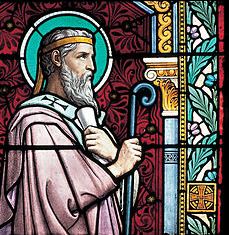
Image: Wikimedia Commons
Little is known about the early life of Irenaeus (c. 130-202). He was born into a Christian home in Asia Minor in modern-day Turkey. Most Catholic histories claim that he was born in Smyrna. (The dates of his birth and death have been debated.)
As a boy he sat under the teaching of Polycarp, who was a disciple of the Apostle John. Polycarp was martyred in 156 AD. The death of Polycarp is legendary. It is recorded that Polycarp was tied to a stake and asked to renounce his faith in Christ. He replied, “For 86 years I have been His servant and he has never done me wrong. How can I blaspheme my King and my Savior?” Polycarp was sentence to be burned at the stake by the Roman government. According to tradition, when the fire was lit, Polycarp was not consumed by the flames. A Roman guard stabbed him in the side and according to one eyewitness a dove flew out. So much blood poured out from his side that it put the fire out.
As a young man, Irenaeus was quite influenced by Polycarp. Irenaeus wrote,
I can tell the very place in which the blessed Polycarp used to sit when he preached his sermons, how he came in and went out, the manner of his life, what he looked like, the sermons he delivered to the people, and how he used to report his association with John and the others who had seen the Lord, how he would relate their words, and the things concerning the Lord he had heard from them, about His miracles, and teachings. Polycarp had received all this from eyewitnesses of the Word of life, and related all these things in accordance with the Scriptures. I listened eagerly to these things at the time, by God’s mercy which was bestowed on me, and I made notes of them not on paper, but in my heart, and constantly by the grace of God I mediate on them faithfully.[i]
His connection to Polycarp puts Irenaeus in a special category. Irenaeus was discipled by Polycarp who was discipled by John who was discipled by Jesus himself.
At sometime during Irenaeus’ early years he moved to Lyons in South France. Lyons was the capital of the Roman occupied France. It was a booming city known for its many merchants. The church in Lyons was planted by missionaries from Asia Minor. So for Irenaeus the church in South France was a kindred spirit with the church in Asia Minor.
Days of ministry

The Bishop of the church in Lyons was Pothinus, a native of Asia Minor. At sometime during the early 170s, Irenaeus became a presbyter at the church in Lyons. In 177, Pothinus sent Irenaeus on a mission trip to Rome. This was during the brutal persecution of the Stoic emperor Marcus Aurelius. The emperor was infuriated by the confidence and faith of Christians who had a greater peace than that of his Stoic mentors. Often Aurelius would crucify Christians along the roadsides through the Roman Empire. On one occasion, he surrounded his palace garden with crucified Christians and lit them on fire to light the garden at night.
Pothinus was martyred during 177 or 178 AD during a time of persecution in Lyons. Irenaeus was spared while he was away. When he returned in 178, he was installed as the second bishop of Lyons. From there he taught and wrote until his death sometime between 200 and 206 A.D.) As bishop, Irenaeus had that heart of a pastor. He was also a unifier. He was often called upon as a moderator when debates broke out in the Church. For example, there was a debate over whether Easter should be celebrated on Nisan 14 according to the Jewish Passover or on a Sunday, the day of the resurrection. Irenaeus continually submitted that the dates of religious holidays where not more important than maintaining the bond of love and unity in the Church.
His Teaching

Image: Cambridge University library manuscript 4113 / Papyrus Oxyrhynchus 405. Wikimedia Commons.
Irenaeus was one of the first Church Fathers to organize the basic doctrines of the Christian faith. The most famous work of Irenaeus is Against Heresies, where he fought the heresy of Gnosticism. The Gnostics were a heretical “Christian” group that claimed to have exclusive knowledge. They taught a reality of “dualism”, that is two equally conflicting realities such as light vs. dark, spirit vs. matter, good vs. evil. Matter is evil; only spirit is intrinsically good. This means that Jesus did not come in true flesh and blood, but was a spirit in the appearance of flesh. Furthermore, they denied the necessity of atonement for sin. Sin was escaped through knowledge that was revealed only to the spiritual elite, which of course was them. They taught that Jesus was the transcendent God, but that Yahweh was a lesser God because he created matter, which is evil. They insisted that what was recorded in the traditional gospels were good enough for the common man, but the true gospel was received only by the spiritual elite.
To fight this heresy Irenaeus taught that:
- The Gospel is for everyone.
- The Church that spread out through the known world is Catholic, meaning universal or united. The Church in Ephesus, Rome, Lyons and elsewhere are all branches of one catholic Church.
- God reveled in the Old Testament is the God and Father of the Lord Jesus.
- There is unity between the Old Testament and New Testament scriptures. The Old Testament laid a foundation for the New Testament.
- Jesus came in the flesh as the second Adam to restore what the first Adam lost (Eph. 1:10). The theological term for this is recapitulation.
- The Church must be aware of the heretic’s system in order to expose their error.
- Love is above knowledge. “Knowledge puffs up, but love edifies.” I Cor 8:1
- The Church performs miracles of healing just as Jesus did in order to restore material flesh.
Quotes from Against Heresies
The Source of the Gospel
We have learned the plan of our salvation from none other than those through whom the gospel came down to us. Indeed, they first preached the gospel, and afterwards, by the will of God, they handed it down to us in the Scriptures . . . Matthew also issued among the Hebrews a written Gospel in their own language, while Peter and Paul were evangelizing in Rome and laying the foundation of the Church. After their departure, Mark, the disciple and interpreter of Peter, also handed down to us in writing what had been preached by Peter. Luke also, the companion of Paul, set down in a book the Gospel preached by him. Afterwards, John, the disciple of the Lord who reclined at His bosom also published a Gospel, while he was residing at Ephesus in Asia. [3.1.1]
The “Hands of God”
And therefore throughout all time, man, having been molded at the beginning by the hands of God, that is, of the Son and the Spirit, is made after the image and likeness of God. [4.28.4]
Prophecy and Speaking in Tongues in the Church
In like manner we do also hear many brethren in the Church, who possess prophetic gifts, and who through the Spirit speak all kinds of languages, and bring to light for the general benefit the hidden things of men, and declare the mysteries of God. [5.6.1]
Gifts of the Spirit and Healing in the Church
Catholic Prayer in Honor of St. Irenaeus
Almighty God, who upheld your servant Irenaeus with strength to maintain the truth against every blast of vain doctrine: Keep us, we pray, steadfast in your true religion, that in constancy and peace we may walk in the way that leads to eternal life; through Jesus Christ our Lord, who lives and reigns with you and the Holy Spirit, one God, for ever and ever.
PR
Originally published on the legacy website of the Pneuma Foundation (the parent organization of PneumaReview.com) in June, 2004.
Notes
[i] As quoted by N. R. Needham, 2000 Years of Christ’s Power: Part One: The Age of the Early Church Fathers, (London: Grace Publications Trust, 1997), 97-98.
[ii] All quotations from Against Heresies, expect the first one, are quoted by Stanley M. Burgess, The Holy Spirit: Ancient Christian Traditions (Peabody, Massachusetts: Hendrickson Publishers, 1984), 59-61. Also note that this is the most conclusive historical evidence that the charismatic gifts of the Spirit continued in the life of the church after the death of the apostles. Any claim that the gifts passed away with the apostles is in direct conflict with Irenaeus’ report.