
John MacArthur’s Strange Fire as Parody of Jonathan Edwards’ Theology, by William De Arteaga
Introduction
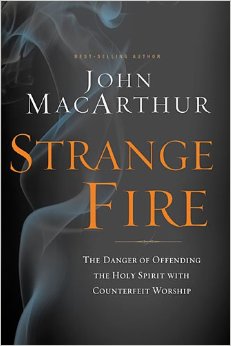
The thesis of John MacArthur’s new book, Strange Fire is that Pentecostalism and the Charismatic Movement, are heretical movements that must be rebuked and eliminated from the church. 1 Everything to do with these movements is fraudulent, inauthentic or a misrepresentation of the true Gospel of Jesus Christ. Strange Fire continues his war on the Pentecostals and charismatics begun with his book published twenty years ago, Charismatic Chaos.2
In the public launch to Strange Fire, MacArthur made clear his utter disdain for the Charismatic Movement in particular:
Nothing coming from the Charismatic movement has provided recovery or strengthening of the biblical Gospel. Nothing has preserved truth and sound doctrine. It has only produced distortion, confusion, and error. Yes, there are people in the movement who know and love the truth, have an orthodox Gospel, but are heterodox on the Holy Spirit. Not all of them are heretics. But I say again the contribution of truth from the people in the movement doesn’t come from the movement, but in spite of it.3
In the introduction to Strange Fire we find this accusation about the Charismatic Movement:
In recent history, no other movement has done more damage to the cause of the gospel, to distort truth, and to smother the articulation of sound doctrine. Charismatic theology has turned the evangelical church into a cesspool of error and a breeding ground for false teachers (pxvii).
The Rev. MacArthur bases these judgments on his close adherence to Reformed and Calvinist theology, and especially the doctrine of cessationism. This doctrine holds that the gifts of the Spirit, as described in Epistles and the Book of Acts, disappeared with the death of the Apostles or shortly after. Thus, in MacArthur’s mind, any manifestations of the gifts of the Spirit in the present must be of a fraudulent nature.
Strange Fire is divided into three parts. Part One critiques both the origins and the workings of the Pentecostal and charismatic movements as counterfeit revivals. Part Two focus on four areas of Pentecostal/charismatic ministry that MacArthur feels are especially fraudulent: the contemporary ministry of prophecy, the healing ministry, the act of speaking in tongues, and the recovered apostolic office. In Part Three MacArthur presents what he deems to be the proper work of the Holy Spirit as salvation, sanctification, and illumination of the Scriptures—the traditional Reformed understanding of the Holy Spirit’s work. This part ends with an open letter to Pentecostal/charismatics, which he calls “continuationists,” urging them to repent of their folly and return to the authentic, i.e., his Reformed and cessationist, form of Christianity.
I wish to make clear in this critique of Strange Fire that I consider that MacArthur’s biblical analysis is often excellent. His methodology of interpreting Scripture with Scripture can often be very insightful. His analysis of the Old Testament seems to be consistently of a high quality, and his radio program Grace to You has blessed millions.
But now I must say that Strange Fire is a deeply flawed book. It is an unintended and woeful parody of Jonathan Edwards’ standards of discernment which MacArthur cites, but fails to apply. Strange Fire, like his previous work of twenty years ago, Charismatic Chaos, is deeply Pharisaic in content, theology and tone. I use the term Pharisaic in its biblical meaning. That is, it is a religious perspective that is orthodox in essential doctrines, but flawed in discerning the present activity of the Holy Spirit.
Biblical Definition of Phariseeism
The Pharisees in the New Testament were a faction that had their theology right. They believed in the truthfulness of the Scriptures, in angels, and in the resurrection of the dead—all things that passed on and were affirmed in Christianity. This was in contrast to another Jewish faction, the Sadducees, who disdained those beliefs. Jesus took sides on this and affirmed the Pharisees’ theology:
Then Jesus spoke to the crowds and to His disciples, saying: “The scribes and the Pharisees have seated themselves in the chair of Moses; therefore all that they tell you, do and observe, but do not do according to their deeds; for they say things and do not do them” (Matt. 23:1-3, NIV).
Their great error was not in scriptural understanding or interpretation, but in discerning the motions of the Holy Spirit in the present. They did not expect or understand that the Holy Spirit could function outside of their group, or in a manner they were not accustomed to. Specifically, they interpreted Jesus’ “signs and wonders” as originating with the power of Beelzebub (Mark 3:22). The Pharisaical perspective is one that is strong on issues that are clear in Scripture and covered by tradition, but almost paralyzed when an issue arises that is not discussed in traditional theology—or threatens their perceived monopoly as “religious experts.”
Phariseeism has a long history in the Church Age, as practically every revival movement has had opposition from orthodox churchmen who have said, “This can’t be of God because it is too rowdy and different from what is normal.”4 For instance, The Wesleyan revival (1740-1800) is considered to have been among the most effective and transformative in Church history. Yet at the time it was bitterly opposed by churchmen of all sorts. One, Bishop George Lavington (1683-1762) was the most influential and constant opponent against Methodism. Lavington was offended by the Methodists hymns (now considered classics), outdoor preaching (now routine), and especially the “exercises” and “enthusiasm” demonstrated at Methodist services. He attributed these to psychological disturbances and demonic intervention—a sign that he was a true Pharisee who could not discern the move of the Holy Spirit in the Wesleyan movement.5
Pride in their theological traditions and opinions was a major characteristic of the New Testament Pharisees (Matt 15:2). This has unfortunately also passed into Christianity with various denominations posturing that their theology is ultimately correct, and deviations from which are damnable. I grew up in the pre-Vatican II Catholic Church which had this fault—we thought all Protestants, or almost all, were destined to hell. MacArthur’s brand of fundamentalist Reformed theology (young earth creationism, etc.) is quite similar in its sectarian prejudices. For instance, he believes a mark of the “heresy” of the Pentecostal and Charismatic Renewal is there willingness to fellowship with and accept Catholic Charismatics, whom Macarthur disdains as pure heretics (p .48, ff).
In full disclosure, this critical essay is written from the perspective of a charismatic Anglican priest with a Wesleyan perspective. As historian of church revivals I believe that the past revivals of the Church, such as the Great Awakening, and the Wesleyan revival, the Second Great Awakening, etc., greatly strengthened and enriched the Church.6
Now let me turn to the work of Jonathan Edwards (1703-1758) probably the greatest theologian American has ever produced. He was a man like MacArthur who loved Reformation theology, but unlike MacArthur, had a grasp of Church history and a true understanding of the process of discernment.
Jonathan Edwards discerns the Great Awakening

To understand Jonathan Edwards’ great achievement in establishing a discernment theology of revival we need to know something about his role in the First Great Awakening. A revival began in his Church in Northampton in 1734, which was triggered by a sermon series about damnation and salvation. The sermons led many to awaken from their nominalism to become truly born again and professing Christians. He wrote a letter to a colleague in Boston describing how it happened. This was then expanded into his first public piece on revival, A Faithful Narrative of the Surprising Work of God in the Conversion of Many Hundred Souls in Northampton (1736)—now often called simply “Faithful Narrative.”
In this pamphlet Edwards described the process of conversion from nominalism into professing Christianity of several persons. This was a process of conviction of sin, despair at self-remedy through works such as prayer or good deeds and finally rest and release in receiving the salvation of Christ. The process at times involved outbursts of emotions.
Their joyful surprise has caused their hearts as it were to leap, so that they have been ready to break forth into laughter, tears often at the same time issuing like a flood, and intermingling a loud weeping. Sometimes they have not been able to forbear crying out with a loud voice, expressing their great admiration. In some, even the view of the glory of God’s sovereignty, in the exercises of his grace, has surprised the soul with such sweetness, as to produce the same effects.7
Edwards describes also how conversion and the presence of God affected the body in strange ways. Abigail Hutchinson, a person profoundly converted and sanctified by the revival, would at times faint away while talking of her experience with God.
When the exercise was ended [a “home group” meeting], some asked her concerning what she had experienced; and she began to give an account, but as she was relating it, it revived such a sense of the same things, that her strength failed; and they were obliged to take her and lay her upon the bed.8
The revival subsided by 1735, although the people touched by it remained fully converted. In 1739, George Whitefield, the great English revivalist, came to the colonies. Under his anointed preaching, revival became widespread—now called the First Great Awakening—with many of the bodily agitations, and emotional outcries becoming common.
This caused some concern and criticism among the clergy, and Edwards wrote Distinguishing Marks of a Work of the Spirit of God (1741) to answer some of these concerns. In that important short work he affirmed that “exercises,” bodily manifestations, often accompany revival, and often bear good fruit, but they can also be counterfeited, or merely self-induced. Thus exercises themselves are not proof of the presence of the Holy Spirit. Rather one has to judge the exercises by the fruit of real change and spiritual progress of the persons and congregations affected by revival.
He developed the criteria based on the Scripture to assess the fruit of revival and see if it was truly from God, regardless of intensity, or lack of intensity in the exercises.
These were five general criteria for discerning if revival and its accompanying exercises were truly from the Holy Spirit:
1. When the operation is such as to raise their esteem of that Jesus who was born of the Virgin, and was crucified without the gates of Jerusalem; and seems more to confirm and establish their minds in the truth of what the gospel declares to us of his being the Son of God, and the Saviour of men; is a sure sign that it is from the Spirit of God.
2. When the spirit that is at work operates against the interests of Satan’s kingdom, which lies in encouraging and establishing sin, and cherishing men’s worldly lusts; this is a sure sign that it is a true, and not a false spirit.
3. The spirit that operates in such a manner, as to cause in men a greater regard to the Holy Scriptures, and establishes them more in their truth and divinity, is certainly the Spirit of God.
4. Another rule to judge of spirits may be drawn from those compellations given to the opposite spirits… “The spirit of truth and the spirit of error.” These words exhibit the two opposite characters of the Spirit of God, and other spirits that counterfeit his operations. And therefore, if by observing the manner of the operation of a spirit that is at work among a people, we see that it operates as a spirit of truth, leading persons to truth, convincing them of those things that are true, we may safely determine that it is a right and true spirit.
5. If the spirit that is at work among a people operates as a spirit of love to God and man, it is a sure sign that it is the Spirit of God. 9
By this time there was considerable excess among other and often intemperate revival preachers. One revivalist believed he could discern the spiritual state of a church pastor, as to whether he was truly converted or a false believer. His negative judgment would prompt the congregation to remove that pastor from the pulpit. This caused much resentment among the clergy towards the revival.
In Edwards’ next work, Some Thoughts Concerning the Present Revival of Religion in New England (1743), he aimed at allaying the fears and resentments of the clergy by informing them of the overall benefits of revival in spite of its faults and indiscreet preachers. In this work he urged that revival must be judged as a whole and not by its extremes.
Another foundation-error of those who reject this work, is, their not duly distinguishing the good from the bad, and very unjustly judging of the whole by a part; and so rejecting the work in general, or in the main substance of it, for the sake of some accidental evil in it.10
Edwards again pointed out how often and how many churches had truly experience good fruit in revival worship and enthusiasm for the Christian life. He affirmed that revival exercises, although strange, such as Abigail Hutchinson’s faintings, often bore much good fruit in the long run. He also pointed out that exercises such as the fallings had occurred before, as in the Scottish Presbyterian Revival of the 1600s, and were continuing in his time.
Yea, such extraordinary external effects of inward impressions have not been found merely in here and there a single person, but there have been times wherein many have been thus affected, in some particular parts of the church of God; and such effects have appeared in congregations, in many at once. So it was in the year 1625, in the west of Scotland, on a time of great outpouring of the Spirit of God. It was then a frequent thing for many to be so extraordinarily seized with terror in hearing the word, by the Spirit of God convincing them of sin, that they fell down, and were carried out of the church, and they afterwards proved most solid and lively Christians.11
Edwards repeated and expanded this message, in his last and now classic work on revival A Treatise Concerning Religious Affections (1742). By the time it came out, revival was on the wane and under severe attack, principally by the writings of the Boston pastor, Charles Chauncy—the great Pharisee of the Great Awakening.12
The Rev. Chauncy did precisely what Edwards warned not to do. Chauncy collected letters only form clergy antagonistic to the revival. He made an arduous horseback circuit of New England where he gathered every story of exaggerated exercises, imprudent sermons, and tactless acts of extremism and cobbled them together as a picture of the revival. That work, called Seasonable Thoughts on the State of Religion in New England (1743), greatly pleased the now frightened clergy. It outsold all of Edward’s works and effectively put an end to the Great Awakening.13
We should note that a significant minority of clergy understood what Edwards had said, and recognized the good fruit that revival had brought to their churches. This faction was called the “New Lights.” They passed on Edwards’ writings to the next generation, so that when the Second Great Awakening occurred (1801-1830), the revival preachers understood the “exercises” in the Edwards’ sense and were not disturbed by them, neither were they stopped by the inevitable Pharisees of the time. The Second Great Awakening succeeded marvelously in transforming America from a Deist country (as its president Thomas Jefferson had become) into a majority evangelical nation.
The opposite happened with the Pentecostal Revival of the 1900s. By that time, Edward’s writings were passé and not read by the clergy or taught in seminary. Thus, when the Pentecostals began manifesting body agitations and fallings, it was incomprehensible to its critics and the new Pentecostals were derided as “holy rollers,” a disparaging moniker that stuck.14
MacArthur’s Misunderstanding and Parody of Edwards
MacArthur’s understanding and critique of the Pentecostalism and the Charismatic Movement is an empty shell of Edwards’ classic insights, and ultimately a parody of it. MacArthur takes Edwards five criteria from Distinguishing Marks to assume the cloak of Edward’s wisdom and discernment (Chapter 4: Testing the Spirits: Part 2). But that is the only element of Edward’s discernment system he incorporates. He violates every other element. Unlike Edwards, MacArthur begins with the assumption that all the “exercises” are inauthentic, fraudulent or perhaps demonic.
Unbiblical practices—like speaking in gibberish, falling backward to the floor, laughing uncontrollably, or withering on the ground—are seen as necessary evidence that the Spirit is moving (6).
This is the very opposite of Edwards starting point. His examination does not begin with discernment by asking what the general fruit of this is, but a prejudice and a priori judgment based on cessationist theology. Consistently, MacArthur cites only the extremes of Pentecostal and Charismatic incidents, sermons and personalities without citing other, more mature elements that should enter into the discussion. Edwards warned against this. It is not accidental that MacArthur endorses Chauncey’s critique of the Great Awakening (32).
Parodying Edwards’ criteria for discerning revival
Let me now give several specific examples of how MacArthur used Chauncy’s “discernment by extremes” (Phariseeism) rather than Edwards’ true methodology of discernment.
In two chapters in Strange Fire, “Testing the Spirits” (Parts 1 & 2), MacArthur takes the five discernment criteria developed in Edwards’ Distinguishing Marks and applies them to the Pentecostal and Charismatic Movements. In every case he highlights examples of extreme preachers, imprudent remarks, and unbalanced ministers, and draws a picture based on these extremes. From such a skewed perspective, the failure of these movements to live up to Edwards’ test for a true revival is a foregone conclusion. An essay of this size does not permit me to examine how he uses each one of Edward’s five criteria to bash Pentecostals and Charismatics, but let me highlight just one.
In chapter 4, MacArthur explains Edwards’ criteria 3, that a true revival is marked by an increased study, and appreciation of the Scriptures as the Word of God and true.
MacArthur claims that both Pentecostals and Charismatics demean the role of the Scriptures and render it less important than their own prophecies and experiences.
Yet the modern Charismatic Movement drives a wedge between the Bible and its divine Author by endorsing unbiblical experiences and espousing extrabiblical revelations—as if the Holy Spirit speaks in his own initiative or operates in the church today in a way contrary to the truth of the Word (67-68).
This is an extreme mischaracterization. I have been in the Charismatic movement from the 1970s, and every teaching I heard on prophecy stressed that all prophetic utterances must align with the Word of God or be considered false.
MacArthur’s attempts to marshal several fringe examples to bolster his claim.
Churches that appeal to new revelations that are often valued over the Bible include the Church of the Living Word, founded by John Robert Stevens, and the United House of Prayer for All People. Steven teaches that the Bible is outdated and needs to be supplemented by prophecies inspired by the Spirit for our time.15
Why doesn’t MacArthur bring into the discussion the doctrine of prophecy from some established Pentecostal denomination such as the Assemblies of God? Using extreme examples one can smear any large group. For instance, MacArthur is a Baptist and fundamentalist Calvinist. If one searched out among the millions who adhere to that mix of Protestantism, one could pick out The Westborough Baptist Church in Kansas, and its pastor Fred Philips. These folks pickets soldiers’ funeral on the bizarre notion that their deaths express the wrath of God on our nation for accepting homosexuality. They are self-described as Baptist and Calvinist, so I could throw in some innuendo to suggest John MacArthur is similar to them in his theology, especially since MacArthur is concerned about and has written about the wrath of God.16
Let me share a bit of the history of the Charismatic Movement to demonstrate that the Charismatic Movement in fact affirms and cherishes the Scriptures in a way that Edwards would admire. The Charismatic Movement first broke out among Episcopalians in 1960, and then spread to other mainline denominations such as the Lutheran, Presbyterians and Methodists. All of those denominations had suffered from decades from liberal creep. That is, the seminaries had been slowly captivated by non-believers who taught a de-mythologizing theology. They asserted things like saying the miracles of the Bible did not really happen and that Paul exaggerated the lordship of Jesus. This had a poisonous result as increasingly liberal pastors replaced their more orthodox predecessors who died or retired. This process dampened and destroyed the faith of their congregations in the veracity of the Bible.
What the Charismatic Movement did was to sharply reverse that trend. That is, the demonstration of real healings, exorcism and other miracles destroyed the foundations of liberal demythologizing. If I just saw a miracle of healing, why should I believe the seminary professor who said the miraculous is “unscientific” and never happened in the Bible?
The end result was that those congregations and pastors that became charismatic also became much more orthodox in traditional doctrine and affirmers in the veracity of Scripture.17 Those pastors and churches that rejected or disregarded the Charismatic movement (a majority of the mainline churches—the seminary poison was too deep) drifted further into liberalism, which led to all sorts of theological distortions such as liberation theology and the drive to normalize homosexuality as something “good” to be affirmed.
In my home denomination, the Episcopal Church, the disregard for the teachings of Scripture on these issues led many of us to leave the Episcopal Church and form orthodox congregations as Anglicans—congregations that are predominantly charismatic.18 We felt a need to separate from the poisonous Episcopalian hierarchy, reaffirm the truth of the Scriptures on every issue, and get away from the liberal seminaries. That has cost many orthodox congregations their beautiful buildings and forced the divisions of many churches. The process is in the news practically every day. MacArthur’s assertion that charismatics lose esteem for the Scriptures and exalt prophecy over Scripture is strange and not true. It comes out of his Pharisaic spirit and from not following Edwards’ warning of viewing a revival as a whole, and not on its extreme parts.
“Fake healings and False Hopes”
MacArthur’s critique of the modern Christian healing movement is perhaps the most exaggerated and offensive piece of the entire work. It is obviously written from the perspective of a person who has no experience with the healing ministry, except perhaps in turning on his remote and viewing some of the more flamboyant TV evangelists.
MacArthur begins his assault by criticizing the ministry of Oral Roberts and claiming that Roberts has no proven track record of authenticated healings. Actually, Oral Roberts University has good records and videos of many of his miraculous healings. A mere assertion to the contrary does not constitute truth.
The thrust of his attack on Roberts is that he invented the “seed-faith” concept of coupling a donation to ministry with a biblical promise of a multiplied return. Now that is a separate issue, and yes, it is annoying and has been abused by many televangelists. MacArthur then turns to Benny Hinn and essentially does the same thing. He also asserts: “At best, Hinn’s supposed healings are the result of a euphoric placebo effect—in which the body temporarily responds to a trick played on the mind and the emotions” (161). How does he know that? Again, an assertion takes the place of proof.
He does not examine or mention any of the less flamboyant and highly effective ministries that dot the country and are found around the world. He could easily find healing minsters that don’t couple their ministry to seed faith doctrine and act with great effectiveness and integrity.19 Dr. Francis MacNutt’s Christian Healing Ministries out of Jacksonville, Florida, or Canon Mark Pearson’s Institute for Christian Renewal in Vermont, for example, represent ministries of great integrity and effectiveness.20 Christianity Today ran a cover story about the amazing and sacrificial healing, evangelistic ministry of Heidi Baker in Africa.21 The Bakers have an astoundingly anointed ministry with many miracles, and a medical journal’s verification of their effectiveness.22 MacArthur makes no mention of these or similarly effective ministries.
At the heart of MacArthur’s cessationist dismissal of the modern Christian healing movement are two huge errors in interpreting the biblical evidence. The first is the incredible assertion that that “New Testament healings did not depend on the Faith of the recipient.”23
In incredibly inept exegesis to prove this, MacArthur points to the incident of the ten lepers who were healed by Jesus (Luke 17: 11-19). MacArthur claims all were healed, but only one had faith—the one who returned (163). This is clearly untrue. The Scripture describes that all had the faith to believe that Jesus would heal them, and all had the faith to obey Jesus command to show themselves to the Temple priests—as commanded by Mosaic Law. What nine lepers did not have was the virtue of gratitude, the point of the incident.
There are numerous examples in the Gospels where the recipient’s faith is affirmed by Jesus as a key to healing. For instance, consider the incident of the woman with internal bleeding in Matthew 9.
For she was saying to herself, “If I only touch His garment, I will get well.” But Jesus turning and seeing her said, “Daughter, take courage; your faith has made you well.” At once the woman was made well (Matt 9: 21-22; See also Mark 10:52, Luke 8:48, Luke 18:4).
MacArthur’s’ woeful misinterpretation of Scripture seems to be based on the Calvinist interpretation of miracles. That is, that they are all entirely due to the sovereign act of God, with no human input. That this is contrary to the biblical evidence is especially clear in the miracle of Peter walking on the water. Jesus called him, and at first he could walk on water, but when saw the wind and the waves his faith faltered, and he began to sink. God did not change, but Peter’s faith level did, which means it was a factor in the miraculous event.
Then Peter got down out of the boat, walked on the water and came toward Jesus. But when he saw the wind, he was afraid and, beginning to sink, cried out, “Lord, save me!” (Matt. 14:29-30).
I believe another reason that motivates MacArthur’s “strange” exegesis is his animus towards the Word-Faith preachers such as Kenneth Copeland who make much of the need for faith in healing and the miraculous. But anger is not the best basis for theological reflection, and as MacArthur has demonstrated, leads to foolishness.
The second major interpretive error that MacArthur makes on the healing ministry is his claim that modern healing ministries cannot be authentically New Testament because modern healing minsters often fail in their results. MacArthur claims that Jesus and the Apostles never failed (167 ff). The biblical evidence is to the contrary, as described when Jesus ministered in his home town.
And they took offense at Him. Jesus said to them, “A prophet is not without honor except in his hometown and among his own relatives and in his own household.” And He could do no miracle there except that He laid His hands on a few sick people and healed them. And He wondered at their unbelief (Mark 6:3a-6 NASB).
Herein lays a hint at why the healing ministers in the United States and Europe are not as effective as most of the New Testament accounts of healing and why healing evangelists are so effective in Africa. Centuries of cessationist theology and liberal de-mythologizing in the West have sapped the faith-expectancy of the general public, reducing it to the levels even below that of Nazareth. Many people who go to a healing ministry have in the back of their minds that “this is not possible,” etc. Like Peter’s fear of the waves, this diminishes their faith. This is not to blame the recipient of healing prayer for not being healed, as there are many and subtle impediments to receiving the grace of healing.24
Another factor could be that the modern healing ministry is still relatively new, and new discoveries are still being made to improve it. For instance in the 1980s the Pentecostal couple Charles and Francis Hunter discovered that there is no example in the New Testament of a petitionary prayer for healing. Rather, healing is always a command based on the authority of Jesus’ name. That change in prayer technique, which remains controversial and is far from universally accepted, seems to increase the effectiveness of the healing ministry.25
MacArthur’s Historical ignorance vs. Edwards’ command of church history
In MacArthur’s zeal to discredit Pentecostalism and the Charismatic Movement, he resorts to arguments and historical citations that are naive and ignorant. For instance, MacArthur attempts to discredit the movement by pointing out its early errors (Chapter 2 “The New Work of the Spirit?”). MacArthur is correct in asserting that there was initial confusion and error over the understanding of tongues. Further, MacArthur points out that Charles Parham (1873-1929), the father of Pentecostalism, had several moral flaws, and thus, in his view, the movement was ungodly from its inception.
Let me deal with the last issue first. MacArthur makes an issue that Charles Parham was a racist (26 ff). That is true, and in fact when he finally visited the Azusa Street revival in 1906, which was headed by the African American Holiness preacher William Seymour, he was shocked by the race mixing he found there, and tried to put things in “right order,” i.e. segregated. He was rightly tossed out by the elders of the Azusa St. Church.
Racism is a serious charge. But it does not take into account the times and the culture of the era. Most American Christians were racists at the time (1900s) and Parham was a man of his times and culture—a Southerner and Texan. It would have taken an extraordinary motion of grace to have changed him on the issue and make him into a prophet of racial equality. His calling was rather to birth Pentecostalism. But MacArthur’s coupling of Parham’s racism to “spoiled” Pentecostal origins is both historically ignorant and biblically erroneous.
For example, Martin Luther (1483-1546) who birthed the Protestant Reformation was a man of his times and culture too. That included some very negative elements. From working class origins, he was often vulgar in speech—his recorded “table talk” would shock many Evangelicals. More importantly, as a medieval German, Luther inherited a deep and illogical anti-Semitism. This did not change in spite of the fact that as his theology developed he began to appreciate the Old Testament to a much greater degree than his contemporaries.
Luther believed that his recovery of the Biblical understanding of salvation by faith alone would make it easy to convert Jews to the new Protestant Christianity. He tried to, but they did not. His frustration turned to bitter anger. In a violently worded pamphlet, On the Jews and their Lies (1543), he calls them every foul name he could think of, and recommended that their property be seized, their libraries burned, and that they be forced to become agricultural indentured servants.26 This was an astounding, and un-Christian proposal, but consistent with the anti-Semitism of the times. Worse, centuries later, the Nazi’s were able to cite Luther to German Christians to justify their anti-Semitism. In fact, many German Christians went along with the Nazi harassment and persecution of the Jews because it seemed “German Christian.” Luther had laid the groundwork for it.27
Using the MacArthur origins analysis and critique of Charles Parham, one could argue that the whole Reformation was wrong and illegitimate because Luther was bitterly anti-Semitic, and how this led to profoundly tragic consequences. Following his own logic, MacArthur should repent of his Protestantism and convert to Catholicism.
Another accusation that MacArthur brings to discredit Pentecostalism at its origins is the possibility that Parham had a homosexual encounter and was a closet homosexual (25). Parham always claimed he was not, and that he was framed by his enemies into a compromising incident. The evidence is unclear. But even if he was guilty, there is a theological error in this coupling too. Personal sin does not invalidate the spiritual calling or achievements of a person. For instance, it is probably true (but unproven) that John Knox, the founder of Scottish Presbyterianism, had an affair with his mother-in-law. In contemporary times, it has been revealed that Martin Luther King Jr. both cheated on his wife and plagiarized his Ph.D. dissertation. None of those things invalidated either person’s calling or spiritual work, although it would certainly be better if all Christian leaders were like the Wesley brothers or Billy Graham.
That God often uses imperfect and sinful persons for great things is clear in the Bible. Most readers would immediately think of David’s murder and adultery. Or Peter’s denial of Christ, and his later attempt to please the Judaizing faction of the Church (Gal. 2:11) There is an infrequently cited and seldom preached passage in Hebrews that makes this doubly plain. In chapter 11, the writer of Hebrews praises the faithful men of the Bible such as Moses and Abraham then ends in a flourish.
And what more shall I say? For time will fail me if I tell of Gideon, Barak, Samson, Jephthah, of David and Samuel and the prophets, who by faith conquered kingdoms, performed acts of righteousness, obtained promises, shut the mouths of lions, quenched the power of fire, escaped the edge of the sword, from weakness were made strong, became mighty in war, put foreign armies to flight (vs.32-34).
All of these men were heroes of the faith, but most had serious moral failings and weakness. Samson had an uncontrolled eye for the girls, and Jephthah was a judge of Israel who executed his own daughter because of an impetuous oath. Yet their faith and achievements were celebrated.28
As a biblical commentator, and one who spent years in doing a line by line commentary of the Bible, this should have been obvious to MacArthur. But his intemperate animus towards Pentecostal/charismatics blinds him to this biblical point. Further on, MacArthur cites the moral lapses of Amie Simpson Macpherson (60) and others, as proof of the corruption and heresy of the Pentecostal and charismatic movements. Certainly, he is correct in noting the recent the plague of scandals among some of the televangelists. There is something seriously wrong, demonstrated by the lack of accountability and oversight, the temptations of big money and influence, and exaggerated prosperity doctrines. But evangelical and Reformed pastors have also fallen into sin and ruined their ministries. It happens in all denominations.
Other unhistorical conclusions
MacArthur makes a major issue of Parham’s error in understanding the tongues gift. Parham believed that when his students began speaking in tongues at the Topeka Bible College on New Year’s 1901, they were doing what Peter had done in Acts 2. That is, their tongues were real human languages unintelligible to themselves, but could be understood by foreign listeners. Christian scholars call this “xenolalia” and it is a very rare gift, but not completely unknown in modern times.29 Parham concluded that with this gift of tongues he could send missionaries to the farthest reaches of the world without language training. There they would be able to communicate the Gospel just as Peter did on the day of Pentecost. In fact, Parham and other early Pentecostal teachers sent young men and women as missionaries with that premise, and they failed miserably. This was indeed a big mistake.
But quickly, such persons as William Seymour, the African-American leader of the Azusa Street Revival, realized that the tongues at the Azusa Street revival were of the nature described by Paul in 1 Cor. 12 and 14. They were for worship, edification, prophecy, and not the same as tongues in Acts 2. The theology of tongues was corrected and Pentecostalism matured and went on.
Further, MacArthur attempts to smear Pentecostalism by pointing out that the early Pentecostal movement birthed a faction called the Oneness Pentecostals when a small minority embraced an aberration and negation of Trinitarian theology. A further error, according to MacArthur, was that Charismatics and Pentecostals later adopted into fellowship the Catholic Charismatics. MacArthur concludes that a movement that birthed or succored such heresies could not be of the Holy Spirit (Chapter 3 “Testing the Spirits, Part 1”). To use this as a proof merely demonstrates his sectarianism and anti-Catholic fundamentalism.
MacArthur seems to be comparing the Pentecostal/charismatic movement with a flawless Reformed movement that exists only in his imagination, or a mythical Early Church without factions or divisions. In fact, the Apostolic Church—within the first generation, while the New Testament was even still being written—split into Hellenistic Christians and Jewish Christians. The Jewish Christian faction, who believed that the Law of Moses had to be followed for salvation, became known as Ebonites and survived as a minority faction into the 5th Century.30 Similarly, the Reformation quickly broke into major and minor denominations, to the glee of its Catholic adversaries. It immediately birthed the Radical Reformation, including a separatist Anabaptist group who formed a commune in Munster, Germany that ended tragically. Reformation historians are clear that radical fringe groups of the Reformation do not either typify the movement as a whole or discredit it as a whole—a Jonathan Edwards perspective. Rather, the Reformation needed time to mature, to “shake down and settle in.” MacArthur’s attempt to make Pentecostalism ridiculous looks an awful lot like a Catholic apologist critiquing Protestantism, “Heresy! Too many divisions, and too much chaos!”
In summary, MacArthur’s attacks on Pentecostalism and the Charismatic Movement is a work of Phariseeism. It will stand with other works of Phariseeism such as Charles Chauncy’s Seasonable Thoughts, Lavington’s, The Enthusiasm of Methodists and Papists Considered, Dave Hunt’s Seduction of Christianity and other opponents of this Holy Spirit.
PR
Notes
1 John MacArthur, Strange Fire (Nashville: Thomas Nelson, 2013).
2 John MacArthur, Charismatic Chaos (Grand Rapids: Zondervan, 1992).
3 From MacArthur’s keynote speech at the “Strange Fire Conference,” Oct 16, 2013. Available at www.standfirmfaith.com
4 William De Arteaga, Quenching the Spirit (Lake Mary: Creation House, 1992). In my forthcoming work, “The Fall and Rise of Pauline and Hebraic Christianity,” I locate Phariseeism among two other “discernment heresies” that deface the work of the Church: Sadduceeism and Gnosticism. All have a distorted understanding of spiritual phenomenon and reality. In Quenching the Spirit I already identified MacArthur’s Charismatic Chaos as pharisaic in nature. He in turn identified me as a deluded charismatic with “reckless faith.” See, John MacArthur, Reckless Faith (Wheaton: Crossway Books, 1994), 160-169.
5 George Lavington, The Enthusiasm of Methodists and Papists Considered (London: G. and B. Whitaker, Sherwood & Co. 1820), 2nd ed., with introduction by the Rev. R. Polwhele.
6 My most important contributions to the history of revivals are: Quenching the Spirit (Lake Mary: Creation House, 1992), and Forgotten Power: The Significance of the Lord’s Supper in Revival (Grand Rapids: Zondervan, 2003). Although an enthusiastic Wesleyan, I have much respect for the Reformed tradition. See Forgotten Power, especially Part Two: “Revival and the Lord’s Supper in the Reformed Tradition.”
7 Jonathan Edwards, A Faithful Narrative of the Surprising Work of God in the Conversion of Many Hundred Souls in Northampton, sect. ii, 354. All citations of Edwards’ work are taken from the very fine website, Christian Classics Ethereal Library. http://www.ccel.org/ccel/edwards/works1
8 Ibid., sec iii, p. 360.
9 Cited from: Jonathan Edwards, The distinguishing marks, In: Goen, C.C. ed., The Great Awakening (New Haven: Yale University Press, 1972), 253.
10 Edwards, Faithful Narrative, sec iii, 371.
11 Edwards, Faithful Narrative, sec. ii, 370.
12 See my discussion of Chauncy in Quenching the Spirit (Lake Mary: Creation House, 1996), Chapter 3, “The Great Awakening Quenched.”
13 Note: my summary and analysis of Edwards’ theology of revival can be easily verified, as Edward’s major writing are now hosted on several excellent websites. I would especially recommend the reading of his Some Thoughts by everyone who is following the Strange Fire controversy. It is concise. Pastors and teachers might want to take the extra time needed to read his classic, Religious Affections.
14 On this point see Gerald R. McDermott, “The Great Divider: Jonathan Edwards and American Culture,” Books and Culture (Jan/Feb 2010).
15 Strange Fire, 69, citing a work by Donald Bloesch, The Holy Spirit (Downers Grove: InterVarsity, 2000).
16 John MacArthur, The Wrath of God (Moody Press, 1986). Actually, an excellent work, on a topic often ignored.
17 See my description of this process in my description of St. Michael’s of Gainesville, Florida in Forgotten Power (chapter 14).
18 From the Anglican Church of North America’s statement of beliefs: “To be an Anglican, then, is not to embrace a distinct version of Christianity, but a distinct way of being a ‘Mere Christian,’ at the same time evangelical, apostolic, catholic, reformed, and Spirit-filled.” Website is: http://www.anglicanchurch.net
19 My wife and I have labored in the healing ministry for decades, seeing many miraculous healing—and some disappointing failures. We understand that no healing minister or ministry is perfectly gifted, but many do have anointed and powerful ministries. As chaplain of the OSL (Order of St. Luke) I have witnessed many healing events at churches which were wonderfully effective and had holy and humble ministers. The Order of St. Luke mission is to spread knowledge of the healing ministry to all Christian churches. It began in the 1930s when cessationism was rife. For a brief history of the OSL see my blog posting at: http://anglicalpentecostal.blogspot.com/2013/09/the-anglican-tradition-in-healing-part.html
20 CMI’s webpage is: http://www.christianhealingmin.org, at which are offered the best and most mature works of the Christian healing movement. The ICR web is http://christianrenewal.wordpress.com
21 http://www.christianitytoday.com/ct/2012/may/miracles-in-mozambique.html
22 Brown, Candy Gunther; Mory, Stephen C.; Williams, Rebecca; McClymond, Michael J. (2010). “Study of the Therapeutic Effects of Proximal Intercessory Prayer (STEPP) on Auditory and Visual Impairments in Rural Mozambique”. Southern Medical Journal 103 (9): 864–869
23 Strange, 162
24 See Francis MacNutt, Healing (Notre Dame: Ave Maria Press, 1974), Chapter 18 “Eleven Reasons Why People are not Healed.”
25 On the amazing history of the ministry of Charles and Francis Hunter and its potential to further expand the reach and power of the healing ministry, see my blog posting: “The Hunter’s Revolution in Healing Ministry.” http://anglicalpentecostal.blogspot.com/2013/05/the-hunters-revolution-in-healing.html
26 The pamphlet was widely distributed and deeply influential. It can be accessed in translation in several internet sites.
27 A good review article on Luther’s anti-Semitism is; Robert Michael’s, “Luther, Luther scholars and the Jews,” Encounter 64 #4 (Autumn,1985),339-356.
28 See the magnificent article on this by Lee Roy Martin “Judging the Judges: Searching for Value in these Problematic Characters,” Pneuma Review (13:4 Fall 2010), 54-75.
29 See H. Hunter, “Spirit Baptism in the 1896 Revival in Cherokee County, North Carolina,” Pneuma, 5:2 (1983), p. 13, note #3.
30 In this case, I am not ashamed to affirm that the Wikipedia article on them is quite good.







By far, one of most informative reviews on MacArthur's new book. Thank you!
One of the most informative reviews on MacArthur's new book by far. Thank you!
Invitation to readers: develop a TL;DR summary of this review.
Invitation to readers: develop a TL;DR summary of this review.
One of the most informative reviews on MacArthur’s new book by far. Thank you!