
Ronald Baxter: Charismatic Gift of Tongues, reviewed by Tony Richie

Pastor-scholar Tony Richie takes on a cessationist critic of glossolalia.
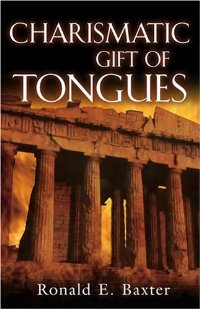 Ronald E. Baxter, Charismatic Gift of Tongues (Grand Rapids: Kregel, 1981), 149 pages.
I can think of only two reasons why anyone would want to read this book: as an unavoidable assignment for a book review or to shore up shallow prejudice against Pentecostals and Charismatics. As a blatant example of pseudo-scholarship Baxter’s Charismatic Gift of Tongues indulges in eisegesis rather than engaging in exegesis. Although a show of studying original biblical languages and surveying historical and theological material is made, no serious grappling with the subject of speaking in tongues or its proponents is honestly attempted. The author admits his “longing” that “we shall be saved from the chaos, confusion and myths spread abroad in the [Pentecostal/Charismatic] movement.” He begins with this bias and repeatedly presses it home hard. My problem with Baxter is not just that I disagree with his worn-out repetitions of all the old cessationist tirades that have been debunked and refuted time and time again not only by P/Cs but even by other honest-hearted scholars (e.g., Chad Owen Brand, Perspectives on Spirit Baptism, Broadman and Holman, 2004), but with his totally one-sided and uneven treatment of the entire topic.
Baxter displays appreciation for alliteration with chapters titled “The Recurrence of Tongues in the Bible,” “The Relation of Tongues to Spirit Baptism,” “The Regulation of Tongues at Corinth,” “The Reason for Tongues was a Sign,” “The Removal of Tongues by Maturity,” “The Return of Tongues: Its Source,” “The Relation of Tongues to Interpretation,” “The Record of Tongues is Perilous History,” and “The Result of Tongues is Counterfeit Unity.” The titles are pretty well indicative of content too. For example, Baxter argues that Pentecost was a non-repeatable event never intended to reoccur. That, of course, raises the problem of biblical repetitions of Pentecostal experience after Acts 2. But for Baxter, in a decidedly circular argument, since Pentecost is by definition non-repeatable, then these are considered exceptions that prove the rule, so to speak, rather than patterns for reproducible behavior. Contemporary tongues are therefore, again by advance definition, counterfeit.
What is going on with Brother Baxter? Why can he not see past his own anti-Pentecostal bias? A hint emerges from a resounding chorus in Charismatic Gift of Tongues adamantly opposing Scripture and spiritual experience. For Baxter, respect for the Bible and reception of spiritual experience are mutually exclusive. He says we must seek “objective truth” not “subjective experience.” Though he insists that he is merely trying to verify experience in the light of Scripture, his repeated tactic is rather to nullify experience based on a reductionist and propositionalist approach to biblical truth. Baxter’s paranoia regarding spiritual experience shows when he argues for two different and divergent methods of determining whether tongues have ceased: by experience and by Scripture. He insists we choose between these two diametrically opposed options as the basis of our decision on tongues. And, of course, experience is unreliable and unacceptable. He never even entertains any idea that Spirit-inspired Scripture and Spirit-inspired experience may be complementary or corroboratory. No, experience and Scripture are irrevocably arrayed against each other—according to Baxter. An advertisement in the back of the book for another Baxter work that promises to be equally unappealing confirms suspicion of his rampant paranoia on experience. Gifts of the Spirit aims to counteract “the many theological myths [that] have sprung up from the fertile ground of experience.” We are told that “in a day of much emphasis on experience or feeling,” it is “a true, Biblical perspective on the gifts of the Spirit.” Note the mutually exclusive juxtaposition of Scripture and experience. C. S. Lewis argued that both subjective experience and objective intellect are essential for knowing truth. Yet Baxter sets up a phony battle between the Bible and experience and then claims anyone who affirms experience invalidates Scripture. Quite to the contrary, the Scriptures themselves suggest reception of the Word is authentically accompanied by such experiences as burning or penetrated hearts (Lu 24:32; Acts 2:37) and the sudden dramatic coming of the Holy Spirit in power (Acts 10:44). John Wesley, “a man of one book” and of a “heart strangely warmed,” exemplifies both elements.
Ronald Baxter, a graduate of Luther Rice Seminary and Baptist pastor, is implacably biased in his position on speaking in tongues. Before boiling over against Baptists, however, Pentecostals should note Baxter wrote Charismatic Gift of Tongues nearly thirty years ago. Fortunately, many former foes have become more Pentecostal-friendly. Leading Baptist and Evangelical theologians such as Millard Erickson and Clark Pinnock espouse less dogmatic, more optimistic views on spiritual gifts, including speaking in tongues. I suppose Baxter’s book may be best judged today as an extreme example of an out of date and ultimately ineffective anti-Pentecostalism polemic. Readers should keep this in mind for accurately assessing its contents and avoiding overreactions to its conclusions. But I do not really recommend reading it.
Reviewed by Tony Richie