
Scott Camp: A Primer on Power

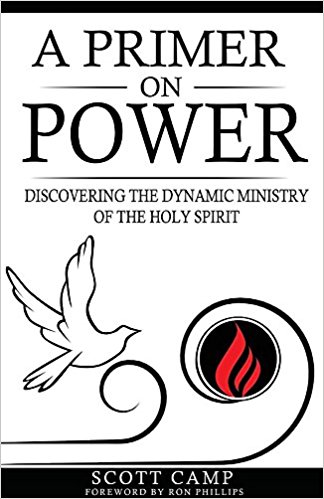 Scott Camp, A Primer on Power: Discovering the Dynamic Ministry of the Holy Spirit (Franklin Publishing, 2016).
It is with thanks to Scott Camp for the chance to review his book, A Primer on Power: Discovering the Dynamic Ministry of the Holy Spirit (Franklin Publishing, 2016). Scott Camp is a full-time traveling evangelist who also teaches Evangelism at the SUM Bible College and Seminary in Oakland, California. Scott is in the midst of finishing up his Doctor of Ministry (DMin) from the Assemblies of God Theological Seminary in Springfield, Missouri. He has extensive pastoral ministry, evangelistic, and leadership experience.
Camp wrote this book, “as a ‘primer’ in the hopes it will create within the hearts of all who read it a hunger for a deeper experience with the Holy Spirit” (25). He also shares from his own personal experience with the Holy Spirit. He writes: “I am unapologetically Charismatic. I believe in an experience of empowerment subsequent to regeneration which has commonly been referred to as the baptism of the Holy Spirit” (25). This leads into his purpose for writing, “The purpose of this book is to introduce this subject in the hopes that my readers may enter into this fullness of the life of the Spirit and His ministry gifts” (25). Camp believes the church in the West is in desperate need of revival. He unashamedly contends that this revival comes only through a direct encounter with the power of the Holy Spirit and Christians experiencing the fullness of the Spirit in their lives (26).
A Primer on Power is a strong mix of anecdotal accounts and biblical-theological exegesis. Camp begins by showing how the church at large is lacking in its ability to function in the power of the Holy Spirit. 78% of Evangelical churches in the U.S. are plateaued and/or declining (31). The remaining 22% growth occurs through transfer membership. Very few new salvations occur on a regular basis. The church in America needs a revival! The key to that revival, argues Camp, lies in experiencing a dynamic power encounter with the person and work of the Holy Spirit. He challenges readers to actively experience the Spirit’s empowerment to dynamically engage others. He quips, “While Jesus has called us to be ‘fishers of men,’ we are content to be “keepers of the aquarium” (31).
Why does Camp want to see renewal in the church? The centerpiece and unwavering purpose for revival exists in effectively carrying out Christ’s mandate, the Great Commission. Prioritizing preaching the gospel to all creation and making disciples of all nations is imperative. Christians lack an ability to accomplish this mandate effectively apart from the presence and power of the Holy Spirit. Camp asserts, “Jesus’ Great Commission mandate could not be carried out without the active ministry of the Holy Spirit. Throughout the Church Age, the Holy Spirit would take the will of King Jesus and communicate it to His Church, filling believers with faith and supernatural power to extend His reign upon the earth, ‘making disciples of all nations’” (47).
The essence of the book then centers on the baptism of the Holy Spirit with the initial physical evidence of “speaking and praying in tongues” for the purpose of mission. However, the book refrains from centering on tongues. The thrust of the Spirit’s baptism produces supernatural power to fulfill the Great Commission. Receiving the Baptism of the Holy Spirit and speaking in tongues serves, for Scott Camp, to “discover the dynamic ministry of the Holy Spirit.” Moreover, this experience allows one to know and experience God on a new level. It enacts strength along with an ability to share the gospel with others in a distinctly new way.
Camp chronicles his personal journey to this experience of the Spirit’s baptism. He highlights how it caused his pastoral and evangelistic ministry to go way beyond his previous ministry experiences. This empowerment dramatically changed and increased his kingdom impact.
To support his thesis, Camp presents a section-by-section analysis of biblical passages ranging from Joel chapter two, to the day of Pentecost recorded in Acts. Additionally, Camp takes readers through key passages in the book of Acts where believers in the first century church received salvation and were then filled with the Holy Spirit (Acts 8, 9, 10, 19). He succinctly demonstrates from scriptural texts examples where believers received the Holy Spirit and spoke in tongues and in turn shared the gospel with boldness. This establishes a pattern of how the Holy Spirit works in the lives of Christians (85-105).
For Camp, “speaking in tongues” is the fundamental evidence one knows one has been baptized in the Spirit. This supernatural power, by the Spirit, enables believers to effectively proclaim the gospel and see people come to Jesus. Camp effectively argues instead of Spirit Baptism being “all about tongues,” the Spirit’s baptism embodies the fulfillment of God’s promises to his people. God confirms a New Covenant with them as seen in the death of Christ on the cross, his resurrection from the dead, and the pouring out of his Holy Spirit. The Baptism of the Spirit, then, serves as an initiation into this New Covenant (70-72). Finally, Camp contends for his readers to experience the Baptism of the Holy Spirit themselves. He urges his readers to press in and be open to all that God wants to do in their lives. He earnestly believes all Christians can truly experience the dynamic ministry of the Holy Spirit in their lives.
Both scholar and non-scholar alike will benefit from reading this book. Pastors, with the support of their church boards, should seriously consider buying this book in bulk and handing it out to their congregations. Written for readers at any stage in their Christian life or understanding of the Bible, this book remains an excellent resource all can easily read, understand, and experience.
Reviewed by Brian Fulthorp