Trajectories in the Book of Acts

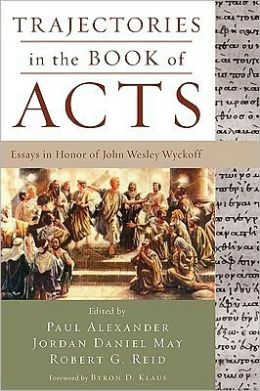
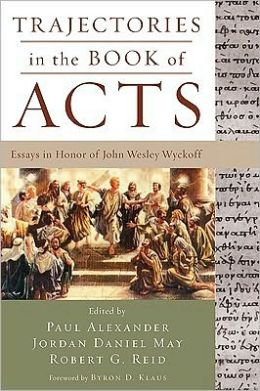 Paul Alexander, Jordan Daniel May, and Robert G. Reid, eds., Trajectories in the Book of Acts: Essays in Honor of John Wesley Wyckoff (Eugene, OR: Wipf & Stock, 2010), 373 pages, ISBN 9781606085400.
Trajectories in the Book of Acts is an anthology of fifteen essays by fifteen different writers in honor of John Wesley Wyckoff, who in 2010, completed thirty-four years as Professor of Bible and Theology at Southwestern Assemblies of God University in Waxahachie, where he is still actively teaching. Wyckoff re-introduced biblical hermeneutics into the curriculum in 1978 and laid great emphasis upon the teaching of Biblical Theology. During his tenure, Wyckoff has taught extensively on the New Testament book of Acts and it has became the subject of much of his work in biblical interpretation. It is by virtue of his great attention to Acts that the essayists chose their title. By the use of the term “trajectories” the different writers refer to the paths or “lines of development” that Wyckoff followed to make clear Luke’s intent when he wrote Acts of [the] Apostles.
The different contributors are both former students of Wyckoff and fellow academic colleagues both within and without the Assemblies of God affiliation of which Wyckoff is an ordained minister. Byron D. Klaus, the President of Assemblies of God Theological Seminary in Springfield, Missouri, supplies a forward to the work edited by Alexander, May, and Reid, all former students of Wyckoff.
This reviewer does not know John W. Wyckoff personally, he is well familiar with his reputation as a skilled biblical interpreter and with his seminal work, Pneuma and Logos: The Holy Spirit in Biblical Hermeneutics (Wyckoff’s Ph.D. dissertation, originally). It is also difficult to ascertain which of the essays written by former students reflect Wyckoff’s own investigations and lectures in the area of biblical interpretation. There are statements honoring Wyckoff’s work but nothing said about his influence upon their own personal reflections. There is no question about the inspiration he left upon those writers.
Chapter one, written by Brue E. Rosdahl, furnishes a brief biography of Wyckoff and supplies a summary of Wyckoff’s subsequent ministry and theological “positions” leading to his eventual concentration in biblical theology and biblical hermeneutics. Wyckoff holds to basic “reformed” convictions: the unity of the Biblical witness, its covenantal theme, and the sovereignty of Christ Jesus along with the leading power of the Holy Spirit in faith and life.
In one way or another, all the essays explore avenues of biblical interpretation that Wyckoff opened up in understanding Luke’s intentions when he related the spread of the gospel in Acts of [the] Apostles. The one exception is the contribution by Roger Stronstad, a good friend of Wyckoff’s who has taught for many years at Regent College and Summit Pacific College, both in British Columbia. Stronstad reiterated his perception of the Baptism in the Holy Spirit, as recorded by Luke in Acts, as having more of a vocational significance than a soteriological one. He first expressed this understanding in his 1984 book The Charismatic Theology of St. Luke (Hendrickson, 1984, pp. 1,12,83). Other essays opened some doors of understanding not before apparent to this reviewer and forcing this reviewer to re-read both Luke and Acts. A former student of Wyckoff’s, Mario Escabedo II, who, himself teaches at Southwestern Assembly of God University, explored Luke’s ecphrastic vocabulary and phraseology which has a visual effect as much as it has an acoustical or auditory one. Rob Starner, also a colleague of Wyckoff and Escabedo at SAGU, investigated passages in Luke, Acts, and Hebrews that were not just similar to each other but were triplicates of each other. Starner proposes that Luke and Paul were both co-laborers and collaborators.
Three of the contributors represented the Reformed Church in America, the Roman Catholic Church, the National Baptist. Two were identified as Non-Denominational. One of the latter, Janet Meyer Everts, teamed with Rachel Schutte Baird (Reformed Church in America), in examining Acts 2:17-18, and its influence on women in ministry. They began with the impact of Phoebe Palmer upon Pentecostal woman ministers and inductively connected them with the women mentioned not only in Luke’s gospel but also in Acts 2:17-18 and Paul’s letters, thus legitimizing the role of women in evangelism and teaching. Craig Keener, a National Baptist, concentrated on Acts 19:9 and Paul’s “academic” (P.56), ministry which attracted Greek listeners along with Jewish ones, after being rejected in the synagogue in Corinth. “Paul’s ‘Christ-centered academic ministry in Acts 19:9 impacted the local culture, showing that the gospel message can succeed wherever open and intelligent dialogue is available” (p.56).
Robert G. Reid, one of the editors of the book, an associate pastor of the non-denominational Rock-Point Church in Flower Mound, Texas, did “An Imperial-Critical Reading of Acts 2” in which he focused upon the statements of Christ being Lord, Savior, and Son of God, in Peter’s sermon at Pentecost as presenting an “alternative empire”―the “empire of God” (p.23), thus subverting “Rome and its most powerful instrument of subjugation—crucifixion” (p.23). He follows this trajectory of study on through by examining Paul’s preaching and teaching as recorded throughout Acts.
Probably the most interesting to this reviewer was the contribution made by James B. Shelton, a Roman Catholic and Professor of New Testament and Early Christian Literature at Oral Roberts University. He focused upon a rhetorical “oddity” which lent itself to an intertextual study of Paul’s and Luke’s writings. The oddity was that of the frequent use of the parresia word-group in Acts and in Paul’s writings. Often accompanied by “meta”, it refers to boldness of speech or address. “Boldness in the Holy Spirit is the source of the essential attributes of Luke’s church” (p.311).
Each of the foregoing five were as familiar with the pioneering work of John Wyckoff as any of Wyckoff’s fellow Assemblies of God scholars. They praised his pioneering work in biblical hermeneutics and biblical theology.
This reviewer did leave some out in this review, such as Paul Alexander, Jeff C. Magruder, Roger D. Cotton, James D. Hernando, Byron Klaus, Robert Menzies, and Jordan May. The purpose was not to neglect them but to highlight a select few so as to “tease” the prospective reader to get into this very well-done work of 373 pages. Scholarly, but generally easy to follow, the book includes brief statements of who the contributors are, lists of the abbreviations used, an index of literary references, and an author index. There was one contribution in Trajectories in the Book of Acts that interfaced Acts 13:47 with Isaiah 49:6. Dr. May’s discussion on the use of the Old Testament within the New, particularly Luke-Acts, was not the easiest to follow until close to the end of the essay. It was, nevertheless, invaluable for its insights on how prophecy has impact upon the Gospel of Christ Jesus. The book is well-worth reading for both student and for the man on the field, particularly the preacher and evangelist.
Reviewed by Woodrow E. Walton