
Transmission Trouble: Clashes in English Language Theological Education in Africa


Missionary-scholar Jim Harries looks at the inherent difficulty in packaging and teaching theology in language translated from another culture.
This short article suggests that there are three possible translation-options when theological education from the West is transferred to Africa. None of those options are very satisfactory. The article concludes that a people need to engage theological education using their own languages.
Conflicting Understandings: Africa and the West
I offer some examples below of ways in which foundational understandings differ in parts of Africa with many people in the West:
- Western theology tells us that God can forgive sin.[1] Sin can be considered “an immoral act considered to be a transgression against divine law.”[2] Sin, therefore, is an offence against God. In much of Africa people are more in fear of offending fellow community members than they are of offending God. People fear the shame that arises from condemnation by their community. To be discovered as having done something that one’s community disapproves of, is considered much more of a serious offence than to have done something that God does not approve of. Because acts can be performed secretly, an important means of discerning whether someone has offended their community is to look at the level of their prosperity. If someone ceases to prosper, perhaps showing visible signs of illness or poverty, then the cause for that can easily be assumed to be some secret shameful offence. The way to overcome shame, then, is to prosper. When African people discover that God forgives sin, that sets up the expectation that he will undo shame. Then that they will be healed and will emerge from their state of misfortune. A forgiven person should prosper. Someone will demonstrate their forgiveness through prospering. This common-sense understanding, according to African people, is often interpreted by Western theologians as being the prosperity Gospel, which they consider to be a very misleading teaching.
- James 5:14-16 reads as follows: “Is anyone among you sick? Let them call the elders of the church to pray over them and anoint them with oil in the name of the Lord. And the prayer offered in faith will make the sick person well; the Lord will raise them up. If they have sinned, they will be forgiven. Therefore confess your sins to each other and pray for each other so that you may be healed. The prayer of a righteous person is powerful and effective.” This passage, as others, makes it clear that sickness can be caused by sin. Matthew 9:1-8 also illustrates this clearly. In the Bible, especially the New Testament, the treatment for sickness is often forgiveness. Disease being caused by sin, one would expect the forgiveness of sins to be linked to healing. The plain reading of many New Testament examples affirms this. Yet the emphasis for healing from the perspective of Western Christians focuses on the use of bio-medicines.
- The Bible gives numerous examples of people prospering because they have developed a close relationship with God. The Mosaic Law was given to enable good living. Hence, one would expect believers to prosper more than non-believers. By extension, people who prosper will disproportionately be believers, and people who do not prosper will be those who have sinned. Contrary to this, many Western Christians minimise the association between Christian belief and good fortune. Notions that diseases like AIDS are a result of sin, foundational to African belief, are frowned upon in the West. Why, when the Bible seems so clear?
- African people are in their lives much troubled by untoward ancestors. They see many instances when Jesus cast out evil spirits, which are presumed to be spirits of ancestors, from people in New Testament times. See for example Mark 1:25-27. In Africa, this is seen as being very valuable ministry. Western theologians cannot see the point in doing this, and may tell African people that the spirits that cause us so many troubles do not exist.
- The Bible tells us “God is love” (1 John 4:8), and that people should love one another (John 13:34). The clearest demonstration of love as understood in parts of Africa, is attendance at funerals. Much demonstration of love requires elaborate, long lasting funeral ceremonies attended by large numbers of people. Should they realise the time, expense, and effort, spent on funeral expenses, Westerners can easily be aghast at such ‘waste’ on behalf of the dead. They would rather see people working productively to bring development.
- Abraham took great trouble to obtain a burial site for his wife, himself, and then also Isaac (presumably, Genesis 23, 25:9). Jacob insisted that he also be buried in the same vicinity (Genesis 50:5). Joseph’s bones were carried many miles for many years until they could be buried in Canaan (Joshua 24:32). The spot at which Rachel was buried was marked by a prominent memorial (Genesis 35:20). Jesus body was laid to rest in a specifically assigned tomb (John 19:41-42). Burning the bones of a dead king was considered a serious offence in the Old Testament (Amos 2: 1; 2 Kgs 23: 16):
We will show that burning the bones of the dead was a bad omen and it meant total obliteration of the dead. It came to profane the memory of the dead since no honor was paid to him and his spirit wondered [sic] aimlessly. It was an end to continuity and the final extinction of the deceased, who had not been “gathered to his ancestors.” In other words, he did not have a share in the resurrection of the dead.[3]
All these events show that dead bodies were in Biblical times held to be important. This seems to be far from the popular Western, especially Western Protestant view, that a dead body is merely a useless collection of chemicals to be disposed of, if necessary by burning it (cremation). Many African Christians struggle to accept that cremation is appropriate for their dead.
- Christian theologians agree that God is omnipresent. God is present everywhere and in everything. In the West, things like dramatic sunsets especially remind us of God. Extraordinarily large trees and boulders remind African people about God. For them it is natural to consider such places to be holy. From the West, giving such objects exceptional awe can be taken as inappropriate superstition.
- Illustrations depicting Jesus always seem to show him wearing robes or a gown and often a sash. The Bible explains how elaborately priests ought to dress (Exodus 28). Westerners in general, and many missionaries in particular, while they may consider themselves to be liberally minded in terms of what constitutes acceptable dress, baulk at the idea of dressing like Jesus and his followers in the pictures. Many African people would like to dress that way. They cannot understand why Western missionaries tell them not to.
- African Christian practice what is often known as ‘problem-solving’. People who attend churches are often adults who have problems. Although the Bible talks favourably of children (e.g. Matthew 18:2-6) there is no mention that there should be gatherings or teaching oriented to children. It seems, then, that Biblical Christianity does not recognise children’s programmes as something distinct from church for adults. Western churches however tend to be strongly in favour of ‘Sunday schools’ for children …
When conflicting understandings are ignored
English is in extensive use throughout Africa. In formal circles, in large swathes of the continent, English is often the only officially accepted tongue. Pragmatically this situation has been caused by a variety of factors. Not least, English is popular because it is the language of money, influence, and power. Who would prefer another tongue, if English so effectively connects one to sources of basic needs and prosperity? Another widespread reason for the preference for English-use in Africa is contemporary mobility. As soon as one brings non-local people into a discourse, certain members are unlikely to know alternative languages, but there is a good chance that all will have at least a rudimentary grasp of English. Widespread use of English is of course self-popularising – as more and more people who see its resulting value come to invest more and more into learning it.
The above situation creates an interesting dynamic. I will here consider theological education and the associated growth and development of the church. I will consider especially Protestant churches that have as an important tenet of belief that people should be able to read and understand God’s Word, the Bible, in their own languages. I want to ask how this works, or whether this works, in contemporary African contexts.
We could add, that it is not English per se that is the problem. Problems in use of English arise because English originates from a people whose worldview and life-understanding is very different to that of many people in Africa. Official meanings and ways to use of English are aligned to Western culture, making it difficult to use the same language in relation to African contexts.
It should be clear that we are starting with a situation in which African people are understanding themselves in the light of their own languages and contexts. They have their own worldviews – although the term worldview is probably too narrow, as it implies a dominance of the visual sense, whereas African people may be more concerned with what they feel then what they see (Oyéwùmi prefers to talk of world-sense rather than worldview for African people [Oyéwùmi 2002: 458]). I would add that perhaps world-feel would be even better! Because someone will always understand anything new or unknown with respect to what they already know and who they already are, the African world-feel is the framework through which Christian teachings will be received from the outside. Anything new will need to be translated to fit into African languages, culture and contexts. This applies to English itself. The English language will be forced to jettison its moorings in Western ways of life if it is to be appropriated as a translation of African language(s). This is obviously a point of great tension: to be fully realised, something needs to happen that is impossible.
A situation we are looking at increasingly, is one in which a body of knowledge created through a language (English) in one context, is to be utilised through the same language but in a different context. Of course, my reference to context here is broad. I am not talking about a person moving from one context to another, like from town to country or forest to coastline. Far more profoundly, when English goes to Africa, almost everything can change: person, history, tradition, climate, culture, altitude, you name it! However, the language itself is not expected to change.
Increasingly, people with their own history, culture, characteristics, and way of life, are being enabled to communicate as if they do not have that history, culture, and different way of life. This is the particular feature of contemporary developments that I want to consider closely in this article. If language learning is learning to use someone else’s language in the way that someone else uses it, then what we are nowadays observing between Europe and Africa could be called language transfer. Learning another language so as to use it in the way it is used in its original context is language transfer.
A Piece of Language Theory
A group of students was split into two groups, A and B. Each group was given three sticks of different lengths. The sticks for the different groups are illustrated below. 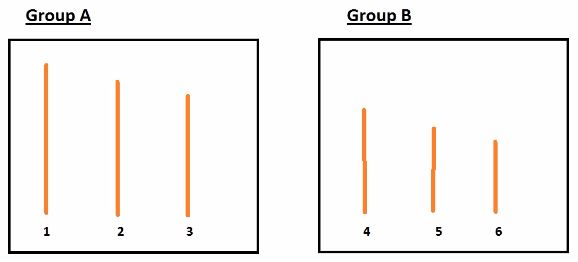
Figure 1.
Group A were asked to identify which of their sticks is short. They identified stick number 3. Group B were asked to identify which of their sticks is long. They identified stick number 4. However, when group B showed members of group A their ‘long’ stick, members of group A could not agree with them. The stick that group B considered to be ‘long’, group A considered to be ‘short’.
The above simple exercise demonstrates something about language; that word meanings are contextual. What a word means (in our case ‘long’ and ‘short’) depends upon the context in which a word is used. In the above case, use of the terms ‘long’ or ‘short’ are not problematic within the groups concerned. But, in inter-group context, the groups end up not able to agree. Parallel things to the above occur when one language is used by very different people, for example traditional-African people and people of European origin. When the two groups come together, if for pragmatic reasons the interpretation of one of the groups is taken as the overall ‘norm’, then the other group will suffer from having to accept things as true that are evidently not true. For example, members of group B will have to accept that stick 4 is short, even though for them it is clearly ‘long’.
Three Alternatives of Language Transfer
I suggest there are three alternative ways an outside language can have influence. I want to look at these three options and ascertain, through discussion, which is dominant. While our focus is on theological education, this issue is much wider.[4]
The first option I want to look at is that learning theology through another language will change the recipients of the education to where they model the intentions of the theological authors they are drawing on. This is typically the objective, aim, and hope of those advocating that Western curricula of theological education be exported to Africa. African people are expected to learn in the same way as do trainee-theologians in the West. Levels of adoption of the teaching concerned are expected to be as high in Africa as they are amongst the originally targeted Western audience. (For it not to be so could bring issues of racism.) There may be an acknowledgment that there will need to be some kind of adjustment to compensate for ‘culture’. The nature of that adjustment is not closely known, nor is it articulated. In the vast majority of cases, it is African people who are expected to make such adjustment, while being expected to pass the same examinations as their non-African colleagues.
The second alternative that I want to consider is that there be imitation of language use, but not change in behaviour. According to this model, African students will describe the African context as if it is Western. This kind of learning is often known as rote-learning. It is often acknowledged that a lot of this goes on in African educational settings. In this scenario, the student realises that a correct answer is required. They also know that their own context and way of thinking will, if applied to the subject in question, quite likely result in an answer different to the one expected. Students will therefore, regardless of the context on the ground, endeavour to give the answer expected by the West. African students will have learned how to express themselves as if they are Western students, regardless of their contextual reality.
The third option could be called contextualisation. For this option, the African person will use English, but use it in an African way. For example, many African ethnic groups circumcise their young people. Baptism is a rite brought by the Gospel. African people may contextualise and take circumcision in lieu of or as a dynamic equivalent to baptism. In case two above, they would do so, i.e. they would circumcise, but they would refer to ‘circumcision’ as ‘baptism’. According to this option three, they will be honest and say ‘we circumcise our young people into faith’. When asked about the Trinity, they may say, ‘no, we do not believe the Holy Spirit to be a person. We believe the Holy Spirit to be God’. When asked if someone can have assurance of salvation, they will respond according to the above-mentioned widespread African understanding of salvation as being prosperous living, and say no, because clearly someone can cease to prosper. If asked whether they believe God to be love, they will accept. If asked how they express that love, they will be honest and say ‘we spend a lot of time at funerals’.
The three options above can be illustrated using timliness as an example. African people are renowned for having a different concept of time to Westerners. Let us say that African churches tend to gather on Sunday’s at noon, but their Western compatriots at 10.00 a.m. In number one above, the Western-trained theologian will meet at 10.00 a.m. no matter what. In case two, he will say that they meet at 10.00 a.m., but they will meet at noon as usual. In case three, the Western-trained theologian will simply be honest and say ‘we meet at noon’, and that is when they meet, even though according to what they are told in bible college, that might be ‘wrong’.
The actual outcome of Western-based English language theological education is likely to be if not bound to result in a combination of the above three. I now want to ask; what does that look like?
Conclusion: Theological Education in Africa: what happens?
For all that Western theologians might talk about contextualisation being appropriate for Africa, if they at the same time carry a foreign curriculum in a foreign language to Africa, then they clearly cannot be in favour of contextualisation as I described in option three above. The person functioning according to option three will not pass the examinations. Hence, he will be side-lined and excluded from the ongoing theological-education system. If this person comes to the West to study, he or she will fail.
The options we remain with are one and two. That is, either the theological education system will transform Africa in terms of their Christian practice into a pseudo-Europe. Alternatively, in order to succeed in the system, the African student will be forced to be less than honest.

Many question whether it is advantageous to make our aim to transform African people into pseudo-Europeans. Even if it is the goal, it is not entirely possible. Even if it were possible, it might take many generations, and it might take more effort than is currently being made to separate people from their original contexts. On the other hand, this is likely to be happening to a degree. To a certain extent, African people will be becoming Europeanised, whatever that means.
In simple terms, given the situations we mentioned at the start of this article, and the three possible scenarios we have looked at, to the extent that African people have not become Europeanised, they remain under immense pressure to talk as if they have. When theological education comes from the West, then answers are expected to be with respect to Western culture. I consider it problematic when, in order to become theologically accredited, African people are forced to lie.
This problem has no easy solution. The way towards a solution is to allow people to express themselves with respect to their own culture. In Figure 1 above, the exercise between groups A and B, illustrate that this would require the discourse of the two groups to remain separate, or distinct. Fortunately or unfortunately, the use of English in Africa, with Africa’s borrowing theological education from the West, makes it effectively impossible to maintain such a distinction. The best means, effected really throughout the history of humankind, to maintain such distinction, is use of different languages. That is, for people to use a language that follows the contours of their culture or way of life. That is, for African people to do their theological education using an African language, and for Western people to do their theological education using a Western language. The process of translation between the two must then take into account the kinds of difficulties we have described above, which are illustrated by the exercise between groups A and B in Figure 1.
PR
Bibliography
Oyéwùmi, Oyèrónké, 2002, ‘Visualising the Body.’ 456-486 in: (Eds.) Coetzee, P.H. and Roux, A.P.J. The African Philosophy Reader. Second Edition. Cape Town: Oxford University Press.
Notes
[1] I John 1:9 tells us that: “If we confess our sins, he is faithful and just and will forgive us our sins and purify us from all unrighteousness” (NIV).
[2] https://en.oxforddictionaries.com/definition/sin
[3] Shaul Bar, “Burning the Bones of the Dead” IBS 30/1 (2012). https://biblicalstudies.org.uk/pdf/irish-biblical-studies/30-1_002.pdf
[4] There are clear parallels between my three options, and those mentioned by Sharifian; Farzad Sharifian. 2016. “Glocalisation” of the English language: A cultural linguistics perspective. KEMANUSIAAN the Asian Journal of Humanities 23(Supp. 2): 1–17, 3.