

Rick Nanez: Full Gospel, Fractured Minds?

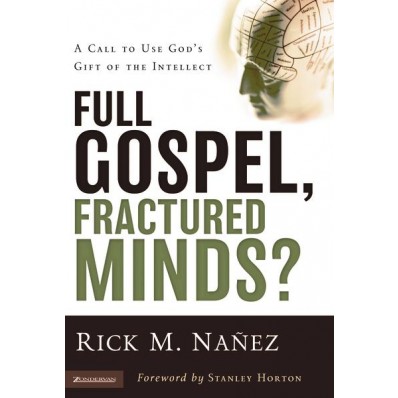 Rick M. Nañez, Full Gospel, Fractured Minds?: A Call to Use God’s Gift of the Intellect (Grand Rapids, MI: Zondervan Publishing House, 2005), 235 pages.
This book is a first of its kind. While others have tackled the issue of intellectual laxity among evangelicals as a whole, Nañez, an Assemblies of God missionary, is the first to devote an entire volume to the issue as it relates to Pentecostals and charismatics.
The first four chapters are devoted to giving a biblical theology of the mind. He makes an admirable case that God gave us a brain with the intent that we would use it for his glory. He gives particular detail to the original Hebrew and Greek meanings for the words heart, mind, etc. In the second four chapters he very ably articulates the anti-intellectual bias of early Pentecostals and is careful to set this in the historical backdrop of the late nineteenth and early twentieth centuries. He demonstrates very clearly that this phenomenon not only included evangelicals but points to the de-emphasis on the mind in American pop culture as well, implying at least that Pentecostals are, at least to some extent, people of their times.
But in my opinion, he overstates the case, occasionally comes across like he has an axe to grind, and seems to be totally unaware of the great strides that have been made in Pentecostal scholarship in recent decades. To be specific, he justly commends Don Gee for his excellent scholarship, but unfortunately does not seem to be aware of Stanley Horton, William Menzies, Gordon Fee, Vinson Synan, Gary McGee and Edith Blumhofer, to a name a few, who have made substantial contributions to Pentecostalism over the last few decades, particularly in the area of theology and history. The list continues to grow as more and more Pentecostals have found their pens! Nañez’s failure to at least mention these is egregious.
Nañez invests the second half of the book pointing the way out of our mental malaise. He calls for a retuning of our educational values so that people are taught how to think, not simply what to think. He calls for the sanctified use of reason and logic, using these mental tools in doing theology and especially in the art of apologetics. He calls for a return to studying philosophy and the sciences, pointing out that many fathers of modern science were devoted Christians. In all of these subjects he articulates very well how one can love God with their mind.
But there are two problems with this part of the book. First, although the content is quite good, a senior colleague pointed out to me that Nañez is rather late. There are any number of colleges and universities sponsored by Pentecostals that provide a Bible based, Christ centered liberal arts education. Evangel University, an Assemblies of God school in Springfield, MO, has been doing this for over 60 years.
Second, the book is culture bound and reflects only the anti-intellectual attitudes as they appear among Western, particularly American Pentecostal/charismatics. He gives scant notice to the fact that Pentecostalism is a worldwide phenomenon. This would not be a problem if he were to admit that he was limiting the scope of his work to Western Pentecostalism, but he does not do so. Whether anti-intellectualism is prevalent or even found in the Pentecostal/charismatic movement outside of the West is not even mentioned. His solutions reflect the same thinking. For example, he advocates the reading of Western philosophers. One wonders what he would say about reading the Confucian classics, which have impacted Chinese society for at least 2,500 years, or the writings of other Eastern philosophers whose writings have molded today’s modern, non-Western world? Would he endorse these as well? We do not know.
There are a few positive things that must be noted. One, he called for the use of the mind without detracting from Pentecostal fervor, calling on us to be passionate both with our emotions and our minds. He calls for balance in these areas. Second, while he rightly takes issue with a number of popular figures in the Pentecostal/Charismatic movement, both past and present, on their anti-intellectual attitudes, he gives thanks for their ministries and recognizes that God has used them mightily. At no point does he resort to critiquing their characters or speak negatively of them. Third, Nañez is a master wordsmith, making the entire book easy to read.
All things considered, I have been challenged again to read more widely, think more deeply, and again consecrate my mind to Him who created me, that I might love him with all of my mind as well as my heart and soul. In considering that the book has some major weaknesses, however, I can only give it a moderate recommendation for reading.
Reviewed by Dave Johnson
Further Reading:
Rob Moll interviews Rick M. Nanez: “Full Gospel’s Fractured Thinking: The problems with shunning the life of the mind” Christianity Today (March, 2006) www.christianitytoday.com/ct/2006/marchweb-only/113-42.0.html
Preview: http://books.google.com/books/about/Full_Gospel_Fractured_Minds.html?id=w_j4N70e_FwC
Publisher’s page: http://www.zondervan.com/full-gospel-fractured-minds









In the Spring 2008 issue, this response from subscriber E.E. appeared: “I would like to respond to the review by Dave Johnson of Rick Nañez’s book, Full Gospel, Fractured Minds? which in appeared in the Winter 2008 issue. I want to challenge some of the thinking of the review. I agree there has been growth in academic training among Pentecostal/charismatics. However, if Pentecostal/charismatic institutions are ‘turning the tide’ on anti-intellectualism this does not seem to be filtering down and helping most congregations. Most congregations continue to embrace an anti-intellectual attitude. Some obvious errors are still being preached from the pulpit, and where does this leave the congregations? Also, the reviewer seems to be expecting too much from the book. Pointing out that Nañez’s thesis about intellectual study wouldn’t apply in every culture is nothing short of setting up a straw man argument since no such thesis would work in every culture.”